
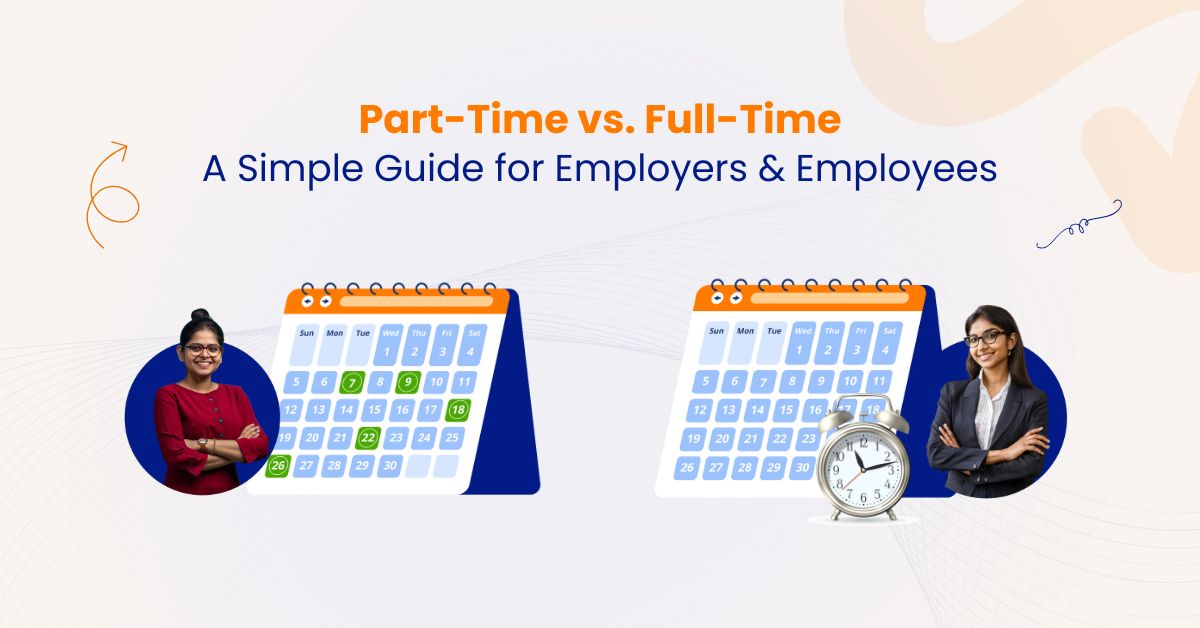
Work patterns in India are changing. Many companies now balance full-time employees and part-time employees to handle business needs, project schedules, and labor costs. Employees also choose flexible hours for better work–life balance, higher income, or personal commitments.
But confusion exists.
Many people still ask:
- How many hours is full-time in India?
- What counts as part-time?
- Do Indian laws define part-time vs. full-time?
- Do benefits change when employees work fewer hours?
- How should employers classify hours per week?
This guide explains part-time vs. full-time in India in simple language.
It uses short paragraphs, clear examples, tables, and India-specific laws.
Bharat Payroll helps companies manage both work types with accurate time tracking, automated attendance, salary calculation, leave rules, and legally compliant payroll.
What Is Full-Time Employment in India?
India does not have one national legal definition of full-time employment.
However, most Indian companies follow these standards:
✔ 8–9 hours per day
✔ 48 hours per week
✔ Based on the Factories Act, 1948, and Shops & Establishment Acts (state-specific)
Full-time employees usually receive:
- EPF (Provident Fund)
Full-time employees receive monthly PF contributions for long-term financial security. - ESI (if applicable)
Eligible full-time workers get ESI coverage for medical treatment support. - Paid time off
Employees receive paid annual leave for rest, travel, or personal needs. - Paid sick leave
Workers get paid days off when sick or unable to work. - Gratuity (after 5 years of service)
Employees earn gratuity payments as a reward for long and loyal service. - Bonus (as per Bonus Act)
Qualified workers receive a statutory bonus based on company performance rules. - Maternity and Paternity leave (as per rules)
Parents receive paid leave for childbirth and early childcare responsibilities. - Medical benefits depend on company policy
Employers may offer health insurance or medical allowances for employees. - Steady monthly salary
Full-time employees receive a fixed monthly salary for stable income.
Full-time workers support long-term roles and core operations for most employers.
What Is Part-Time Employment in India?
Part-time workers perform duties for fewer hours per day or week than full-time employees.
Important fact:
✔ India does NOT legally define part-time hours
✔ Employers define part-time status in the employee handbook
Common practice in India:
- 4–5 hours per day, OR
- 20–30 hours per week, OR
- Work fewer shifts based on business needs
Part-time employees may receive:
- Monthly or hourly wages
- Limited paid leave
- Flexible schedules
- Fewer mandatory benefits (depending on hours worked and state laws)
Part-time work suits students, gig workers, parents, freelancers, and anyone needing fewer hours.
Part-Time vs Full-Time: Key Differences in India
| Category | Full-Time Employees | Part-Time Employees |
|---|---|---|
| Hours Worked | 8–9 hours/day, 48 hours/week | Fewer hours (employer-defined) |
| EPF | Mandatory if eligible | May or may not apply |
| ESI | Applies if salary < ₹21,000 | Applies if eligibility is met |
| Paid Leave | Provided | Limited or none |
| Job Security | Higher | Lower |
| Benefits | More benefits | Fewer benefits |
| Salary | Fixed monthly | Hourly or monthly |
| Overtime Pay | Required by law | Required if overtime is done |
| Professional Development | Common | Limited |
| Business Usage | Core staffing | Flexible staffing |
How Many Hours Define Full-Time in India?
According to Indian labor rules:
- The Factories Act, 1948, defines 48 hours per week as full-time.
- Many State Shops & Establishment Acts define 9 hours per day.
- Employers must follow their state law and internal HR policies.
How Many Hours Define Part-Time in India?
There is no fixed national rule, but most employers use
- 4 to 6 hours per day, or
- 20 to 30 hours per week
Part-time rules must be defined clearly in:
- Offer letter
- Employment contract
- Employee handbook
Benefits: Part-Time vs Full-Time in India
Full-Time Employees Usually Get
- EPF (Provident Fund)
Full-time employees get monthly PF savings for future security. - ESI (if applicable)
ESI supports medical needs when the salary falls under eligibility. - Paid annual leave
Employees receive paid days off for rest and personal time. - Paid sick leave
Workers get paid leave during illness or health-related absence. - Overtime pay
Extra hours are paid at double the wage as per the law. - Bonus (as per law)
Employees receive a statutory bonus based on the company’s performance rules. - Gratuity after five years
Long-term employees earn gratuity for continuous dedicated service. - Maternity benefits
Eligible women receive paid leave and maternity support benefits. - Company health insurance
Employers may provide medical insurance for employees and their families. - Professional development programs
Companies offer training programs to help employees grow professionally.
Part-Time Employees Usually Get
- Flexible schedules
Part-time workers choose convenient work timings for their daily needs. - Fewer hours
They work fewer hours based on the company’s schedule needs. - Fewer benefits
Part-time employees receive limited benefits compared to full-time. - Hourly wages
They often earn hourly wages based on actual hours. - Limited paid leave
Some employers provide limited paid leave depending on policy. - Workers’ compensation (mandatory)
All employees receive protection for injuries during working hours. - Basic compliance as per state rules
Employers follow state regulations for part-time worker rights.
Is EPF Required for Part-Time Workers in India?
EPF applies when:
- Employee salary is ₹15,000 or above (unless opting out), AND
- Employer has 20 or more employees
Part-time status does not matter.
Eligibility depends on:
- Salary
- Employee count
- Employment contract
Is ESI Required for Part-Time Workers in India?
ESI applies if:
- Gross salary is ₹21,000 or below
- The employer is covered under ESI rules
Part-time employees are included if their wages qualify.
Are Part-Time Workers Eligible for Paid Leave?
India does not mandate paid leave for part-time workers.
But many employers offer:
- Casual leave
- Sick leave
- Limited paid time off
The exact number depends on state laws and company policy.
Overtime Rules for Part-Time and Full-Time Employees (India)
Under Indian labor laws:
- Overtime applies after 9 hours/day or 48 hours/week
- Must be paid at 2x the normal wage
- Applies to part-time and full-time non-exempt employees
Accurate time tracking is essential.
Work-Life Balance in Part-Time vs Full-Time
1. Part-Time Advantage:
Better work-life balance, flexible hours, and easier for students or parents.
2. Full-Time Advantage:
Stable income, long-term growth, full benefits, better career progression.
Why Many Employers in India Use Part-Time Schedules
Indian companies choose part-time work due to:
- Lower benefit costs
Part-time roles reduce overall benefit expenses for growing Indian companies. - Seasonal demand shifts
Businesses hire part-time staff to manage heavy seasonal customer demand. - Weekend or evening workload
Extra support is needed during weekend or evening operational hours. - Flexible staffing
Part-time scheduling provides flexible staffing options for changing workloads. - Training needs for short-term projects
Companies hire part-time workers for temporary projects needing quick training. - Budget limitations
Small businesses prefer part-time roles to reduce monthly payroll expenses.
Startups and retail businesses use part-time roles frequently.
Why Many Employees in India Prefer Full-Time Jobs
Employees choose full-time for:
- Stable monthly salary
Full-time jobs provide a steady monthly income for financial stability. - All benefits
Employees receive full benefits like PF, ESI, and paid leave. - Growth opportunities
Full-time roles offer long-term career growth and promotion opportunities. - Job security
Employees prefer full-time roles because they ensure better job stability. - Long-term professional development
Companies invest in full-time workers through training and development programs.
How Bharat Payroll Helps Indian Employers Manage Both
Bharat Payroll supports Indian HR teams with:
- Time tracking
Bharat Payroll tracks employee working hours accurately across all departments. - Attendance management
The system records daily attendance using automated and error-free digital tools. - Leave automation
Leave requests and approvals are handled through simple automated workflows. - PF & ESI calculation
PF and ESI amounts are calculated correctly based on Indian rules. - Part-time & full-time classification
The software classifies employees based on working hours and company policy. - Overtime calculation
Overtime hours are calculated automatically as per Indian labour laws. - Salary processing
Monthly salaries are processed smoothly with accurate earnings and deductions. - State-wise compliance
Bharat Payroll follows all state labour laws for complete payroll compliance.
It reduces errors and keeps Indian payroll 100% compliant.
What Is the Main Difference?
The main difference between part-time and full-time is the hours worked.
Full-time means 8–9 hours per day or 48 hours per week.
Part-time means fewer hours set by the employer.
Benefits and pay differ for each type.
Manage Every Work Type with Confidence
Track hours, automate attendance, calculate PF/ESI, and manage part-time and full-time employees easily with Bharat Payroll’s simple and accurate payroll tools.
Frequently Asked Question
1. How many hours is full-time in India?
Full-time hours in India usually mean working 8–9 hours daily or 48 hours weekly. These standards are based on the Factories Act and the State Shops and Establishment Acts. Employers may define exact hours in the company policy and employee handbook.
2. What counts as part-time work in India?
Part-time work means working fewer hours than full-time employees. Most companies use 4–6 hours daily or 20–30 hours weekly. India has no fixed national rule, so each employer sets part-time hours in contracts and human resource policies.
3. Do part-time employees get PF or ESI benefits?
PF and ESI eligibility depend on salary limits, not hours worked. Employees earning within PF or ESI thresholds may qualify even if they work part-time. Employers must check salary levels, establishment coverage, and state compliance before applying these benefits.
4. Are part-time employees entitled to paid leave?
India does not legally require paid leave for part-time employees. Some employers offer casual leave, sick leave, or limited paid time off. Leave rules depend on the State Shops and Establishment Act and individual company policies mentioned in employment contracts.
5. How does Bharat Payroll manage part-time and full-time hours?
Bharat Payroll tracks daily hours, calculates wages, manages leave rules, and ensures PF and ESI compliance for both part-time and full-time employees. It automates attendance, overtime, and salary processing to help Indian HR teams reduce errors and save time.