
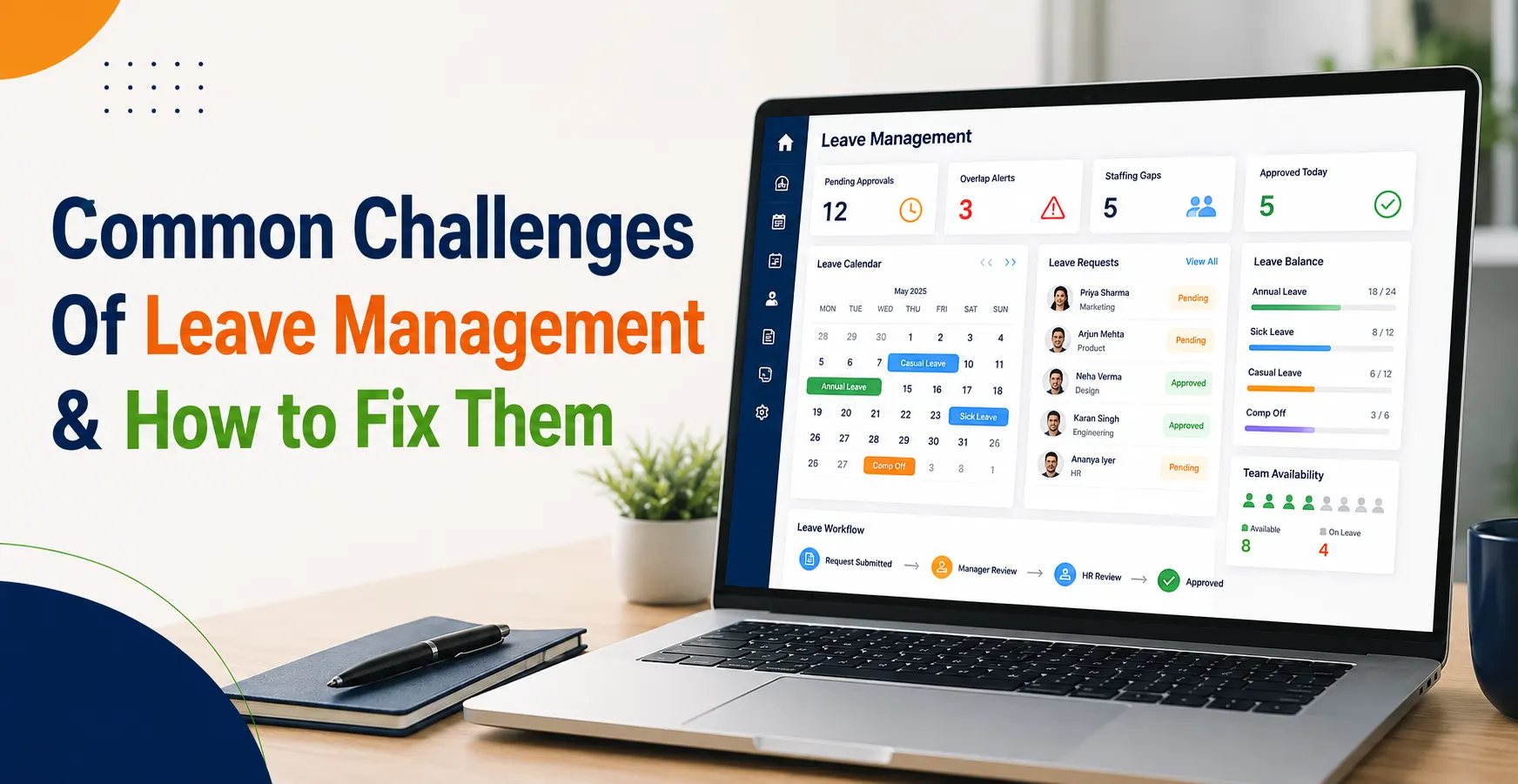
Common challenges of leave management rarely begin as big problems. They usually start with one missed approval, one unclear balance, one same-day request, or one spreadsheet that nobody updated on time. Then the pressure builds. Managers lose visibility. HR spends more time answering follow-ups than planning ahead. Payroll gets pulled into corrections. Employees feel unsure about what they can apply for, when they can apply, and whether their leave was handled fairly.
That is why leave management sits much closer to business continuity than many teams first assume. It is not only about approving time off. It affects employee trust, workload planning, attendance records, salary processing, and policy control across the organisation.
In India, this gets even more layered. Companies work with different leave types, different approval structures, location-based holidays, carry-forward rules, comp-off handling, and role-based eligibility. Once headcount grows, manual leave handling starts showing cracks very quickly. A process that felt manageable with 20 employees becomes risky with 100, and frustrating with 300.
This is where the conversation needs to change. Instead of asking why leave requests feel messy, businesses need to ask what part of the process is causing the mess in the first place.
What Leave Management Really Covers
Leave management is the process of applying, reviewing, approving, tracking, and recording employee time off. It includes planned leave, emergency leave, sick leave, casual leave, earned leave, maternity leave, paternity leave, comp-off, unpaid leave, and every policy rule attached to them.
A strong leave management process should help a business answer basic but important questions:
- Who is on leave and when?
- How much leave balance does each employee have?
- Which leave types are available to whom?
- Who approves which request?
- How does leave affect attendance and payroll?
- What happens when two or more people from the same team apply for the same dates?
If these answers are not clear, the problem is rarely the employee’s request. The problem is the structure behind it.
Fix Leave Delays, Balance Errors, and Approval Confusion
Bring leave requests, balances, approvals, calendars, and attendance-linked records into one structured workflow with Bharat Payroll.
Why HRMS Leave Management Issues are Critical
Leave looks simple from the outside. An employee applies, and their manager approves. HR further records it. Yet that neat sequence rarely stays neat in real working life.
Some employees apply well in advance. Others apply on the same day. Some roles need only one approval. Some need multiple checks. One employee may work from Chennai under one holiday calendar, while another works from Pune with a different local holiday pattern. Add shift-based teams, attendance rules, comp-off requests, probation policies, and negative balance controls, and the process becomes much heavier than it first appears.
This is why businesses that rely on emails, calls, chats, or scattered sheets eventually run into the same kind of trouble.
Challenge 1: Manual Leave Tracking Creates Errors and Delays
The first and most common issue is still manual tracking.
A lot of businesses begin with spreadsheets, email chains, and manager-level tracking. At first, that feels practical. It is familiar, cheap, and quick to set up. The trouble begins when the volume rises. A single missed update can change leave balances. One old sheet can lead to wrong approvals. A delayed entry can create confusion between what the employee sees and what HR believes is correct.
This is where leave management challenges become very visible.
An employee may think they still have sick leave available. HR may see a different balance. The manager may approve leave based on outdated information. Payroll may later record something else altogether. Once those versions stop matching, the issue is no longer only administrative. It becomes a trust problem.
Manual tracking also slows down routine decisions. Employees follow up repeatedly. Managers waste time checking balances manually. HR gets dragged into basic questions that should have been visible to everyone in the first place.
What this leads to:
- Incorrect leave balances
- Slower approvals
- Repeated follow-ups
- Poor record keeping
- Confusion during payroll processing
- Avoidable employee frustration
For a growing company, this is one of the earliest signs that a spreadsheet-based process has reached its limit.
Challenge 2: Unclear Leave Policies Create Inconsistency
The second issue is policy confusion.
Many businesses do have leave rules, though those rules may sit in an old policy file, be explained differently by each manager, or remain unclear when unusual cases come up. Employees then start asking practical questions that do not have one clear answer.
- Can sick leave be taken for half a day?
- Can planned leave be applied on the same day?
- Does comp-off expire?
- Does earned leave carry forward?
- Can probationary employees access all leave types?
- Who approves long leave requests?
When policy wording is loose or applied unevenly, managers begin making their own judgment calls. One team gets flexibility. Another team gets a restriction. One employee gets same-day approval. Another gets rejected for the same kind of request. Once that happens, the business starts looking inconsistent, even if the intention was fair.
This is one of the most serious common challenges of leave management because it quietly affects employee confidence. People do not usually object only to rejection. They object when they feel the rule has changed depending on who asked.
Where this gets harder in India
Indian businesses often need to manage different leave categories, state holidays, role-based structures, and company-specific rules together. A single standard rule rarely covers every situation. That is why leave policies must be clearly defined, easy to access, and applied the same way across departments.
Without that, HR spends too much time explaining exceptions and too little time improving the process itself.
Challenge 3: Slow Approvals Disrupt Workflows
Approval delays look small on paper, though the effect is usually much wider.
An employee applies for leave and waits. The manager misses the email. HR sees the request later. The team is unsure whether to plan around the absence. By the time the request is reviewed, the employee has already made travel plans or taken leave on their own assumption. What could have been a normal approval now becomes a conflict.
Delayed approvals affect both sides.
Employees feel stuck because they cannot plan with confidence. Managers feel pressured because they are reviewing requests late. HR gets caught in between, especially when there are overlapping requests or urgent escalations.
In some teams, approval delays also lead to shadow communication. Employees message the manager separately, call HR, or ask colleagues what usually gets approved. That creates a second process outside the official one, and once that starts, consistency drops further.
Why slow approval is dangerous
It affects:
- team scheduling
- workload distribution
- shift planning
- project continuity
- employee satisfaction
- leave policy discipline
A leave request should not sit idle long enough to create uncertainty. If it does, the process itself needs attention.
Challenge 4: Overlapping Leave Requests Reduce Team Visibility
One of the most difficult parts of leave handling is not approving one request. It is approving multiple requests without damaging team continuity.
This happens often. Two employees from the same function ask for the same dates. A manager wants to support both, though the team cannot afford both absences. One request came first, but the other employee has a stronger personal reason. Another team member is already off, though nobody noticed because the calendar was not updated clearly.
This is where poor leave visibility becomes expensive.
A business can end up short-staffed without realising it early enough. Support teams miss response targets. Payroll or finance teams struggle around month-end. Operations managers get pulled into last-minute changes because nobody had a clear picture of planned absences.
This is not only a scheduling issue. It is a workflow issue.
A proper leave process should help managers see team availability before approving the request, not after.
Challenge 5: Leave Balance Disputes Damage Employee Trust
Employees usually remember one thing very clearly: whether their balance looked right.
When a leave balance appears lower than expected, the reaction is immediate. Employees want to know what was deducted, when it was deducted, and why they were not informed earlier. If HR has to investigate through emails, chats, and old sheets just to explain one balance, the system is already too weak.
These disputes often happen because:
- A prior leave entry was missed
- A cancellation was not updated properly
- Comp-off was not credited on time
- Half-day rules were applied incorrectly
- Carry-forward rules were handled manually
- Payroll and leave records were not aligned
Balance disputes take a simple operational issue and turn it into something personal. Employees start doubting the fairness of the whole process, not just the number on screen.
Challenge 6: Unplanned Leave and Absenteeism Create Last-Minute Pressure
Not every absence can be planned. People fall ill, family emergencies come up, travel gets disrupted, and life refuses to follow a leave calendar. That part is normal. The real problem starts when the business has no clear way to record, review, and respond to those absences quickly.
When unplanned leave is handled through calls, personal messages, or verbal approval, the official record often lags behind. The manager knows one version. HR knows another. Attendance shows something else. Later, when the same case is reviewed, nobody is fully sure what was approved and what was only informally discussed.
This creates pressure in three places at once.
- The team has to absorb the sudden absence.
- HR has to regularise the record later.
- Payroll has to decide whether the day should count as leave, absence, or correction.
That kind of rework piles up quietly. It also creates unnecessary friction with employees, especially when they believe they informed someone on time but the system does not show it clearly.
Challenge 7: Leave Data and Attendance Records Stop Matching
Leave management does not operate alone. It touches attendance, shift records, holiday calendars, anomaly handling, and monthly summaries. Bharat Payroll’s employee-side guide itself shows that leave requests, leave history, attendance anomalies, and approval comments all sit within related employee workflows, while the admin manual links leave management, leave approvals, attendance, calendar, and reports inside the same broader HR environment.
That connection is exactly why mismatches become dangerous.
An employee may be absent because leave was requested but not approved in time. Another may be marked absent even though the request was approved verbally first and entered later. A third may have attendance anomalies and leave entries crossing over on the same date. Once these records drift apart, payroll processing gets riskier and employee trust falls again.
This is one of the costliest common challenges of leave management because the issue no longer stays within HR. It affects salary outcomes, working day counts, reporting confidence, and month-end cleanup.
What these mismatches usually cause
- Leave marked as absence
- Wrong deduction outcomes
- Repeated manager clarifications
- Month-end corrections
- Disputes during pay slip review
- Weak audit confidence
A business may think it has a leave problem, while it actually has a data consistency problem.
Challenge 8: Employees Do Not Get Clear Visibility Into Leave Status
Many leave disputes would not happen if employees could simply see the current status clearly.
They need to know:
- Whether the leave was submitted
- Whether it is pending or approved
- Whether it was rejected
- Why was it rejected
- How many days are left in the balance
- Whether a supporting comment was added
- How the request appears in leave history
Bharat Payroll’s employee guide shows this type of visibility through leave request status, approval or rejection updates, leave balance viewing, and leave history fields such as leave type, dates, reasons, applied-on date, status, and rejection reason.
That matters because employees should not have to chase managers or HR for basic status updates. Once they do, leave handling starts feeling unclear even if the policy itself is sound.
A leave process works better when employees can see what happened without guessing.
Challenge 9: Audit Trails Are Too Weak for Review and Compliance
A leave record is not only useful on the day it is approved. It matters later as well.
A business may need to review:
- Who approved a leave request
- when it was submitted
- whether it was cancelled
- whether comments were added
- whether the balance changed correctly
- whether the same employee has repeated patterns
- whether one team is carrying too many overlapping absences
If the process is manual, this level of review becomes painfully slow. People search old mails, chat screenshots, shared drives, and personal notes. That is not a stable operating method for a growing company.
A stronger system gives both current visibility and historical clarity. Without that, routine audits become stressful, and policy disputes take longer to settle.
Challenge 10: Leave Planning Fails at the Team Level
A leave request is personal for the employee, though the impact is often collective.
- One approval may affect a project deadline.
- Two overlapping approvals may affect a support queue.
- A cluster of absences may slow payroll, finance, or operations at the worst possible time.
This is why leave should always be visible at the team level, not only at the individual level. Managers need to see upcoming absences before approving more leave for the same dates. HR needs to watch trends across functions, locations, and high-pressure periods. Employees also need some visibility into working days, holidays, and calendars so that they do not apply blindly.
Bharat Payroll’s employee guide points to calendar access, holiday list visibility, leave history review, and consolidated reporting views for employee-level details, while the admin manual includes leave approvals, employee leave balance, calendar, announcements, and consolidated reports in the wider structure.
That kind of connected visibility helps a business move from reactive leave handling to planned leave handling.
What Better Leave Management Looks Like in Practice
A better leave process does not mean saying yes to every request. It means giving every request a clear path.
- Employees should be able to apply without confusion.
- Managers should review without chasing records.
- HR should monitor without rebuilding data manually.
- Payroll should process without fixing avoidable mismatches later.
That kind of process usually has a few signs:
- Leave balances are visible.
- Approval status is easy to check.
- Rejection reasons are recorded properly.
- Holiday and leave calendars are easy to access.
- Approvals are routed to the right person.
- Reports are available when HR needs them.
- Attendance and leave records do not drift apart.
When those basics are in place, leave stops feeling chaotic.
How Bharat Payroll Helps Reduce Common Challenges Of Leave Management
Bharat Payroll brings leave handling into a more connected workflow instead of leaving it scattered across separate emails, trackers, and follow-ups.
From the employee side, the platform supports leave request submission, leave balance visibility, leave history tracking, approval status updates, rejection visibility, calendar access, holiday list review, and related attendance workflows.
From the admin side, the manuals show dedicated areas for leave rule settings, leave approvals, employee leave balance, calendar, attendance, and consolidated reports. Bulk approval is also supported in the leave approval workflow, which matters when teams need faster handling without losing control.
That structure helps businesses handle leave more cleanly because the process is no longer spread across too many disconnected points.
What this means for HR and payroll teams
It helps teams:
- Review requests faster
- Keep leave balances clearer
- Reduce balance disputes
- Improve visibility into leave history
- Connect leave handling more closely with attendance and reporting
- Reduce manual month-end correction work
For a business that has outgrown email approvals and spreadsheet tracking, that difference is not small. It changes how much time HR spends managing the process and how much confidence employees have in it.
Why This Matters for Employee Experience Too
Leave is one of the most visible HR processes in any company. Employees feel it directly.
- They know when approval takes too long.
- They know when their balance looks wrong.
- They know when another person gets flexibility, and they do not.
- They know when they need to follow up three times for one request.
That is why leave management affects more than scheduling. It shapes how employees read fairness inside the company.
A better leave process sends a simple message: your time, your plans, and your records are being handled with care.
Final Word
The common challenges of leave management are rarely caused by leave itself. They are caused by slow visibility, unclear policies, manual tracking, weak approvals, disconnected records, and poor team planning.
Once those issues build up, the business starts paying for them in lost time, confused employees, repeated corrections, and avoidable operational pressure.
A stronger leave process gives the company something much more valuable than faster approvals. It gives clarity. Employees know where they stand. Managers know what they are approving. HR knows what the data says. Payroll gets cleaner records to work with.
That is how leave management starts supporting the business instead of draining it.
Keep Leave Requests, Balances, and Approvals Under Better Control
Bring leave tracking, approval visibility, calendars, and employee records into one structured workflow with Bharat Payroll.
Frequently Asked Questions
1. What are the common challenges of leave management?
The common challenges of leave management include manual tracking errors, slow approvals, unclear policy rules, overlapping leave requests, leave balance disputes, attendance mismatches, and poor team visibility.
2. Why does manual leave tracking cause so many problems?
Manual leave tracking often leads to delayed updates, incorrect balances, approval confusion, and payroll corrections. Once records are maintained in different places, accuracy becomes harder to protect.
3. How do leave management issues affect payroll?
Leave management issues can affect working day counts, absence records, deductions, and monthly salary processing. When leave and attendance records do not match, payroll teams usually need extra correction work.
4. How can HR reduce leave approval delays?
HR can reduce delays by using a structured leave workflow with clear approval routing, visible leave balances, employee status updates, and team-level visibility before approvals are made.
5. How does Bharat Payroll help with leave management?
Bharat Payroll supports leave requests, leave history, leave balances, leave approvals, calendars, holiday lists, attendance-linked workflows, and reporting in one connected system.