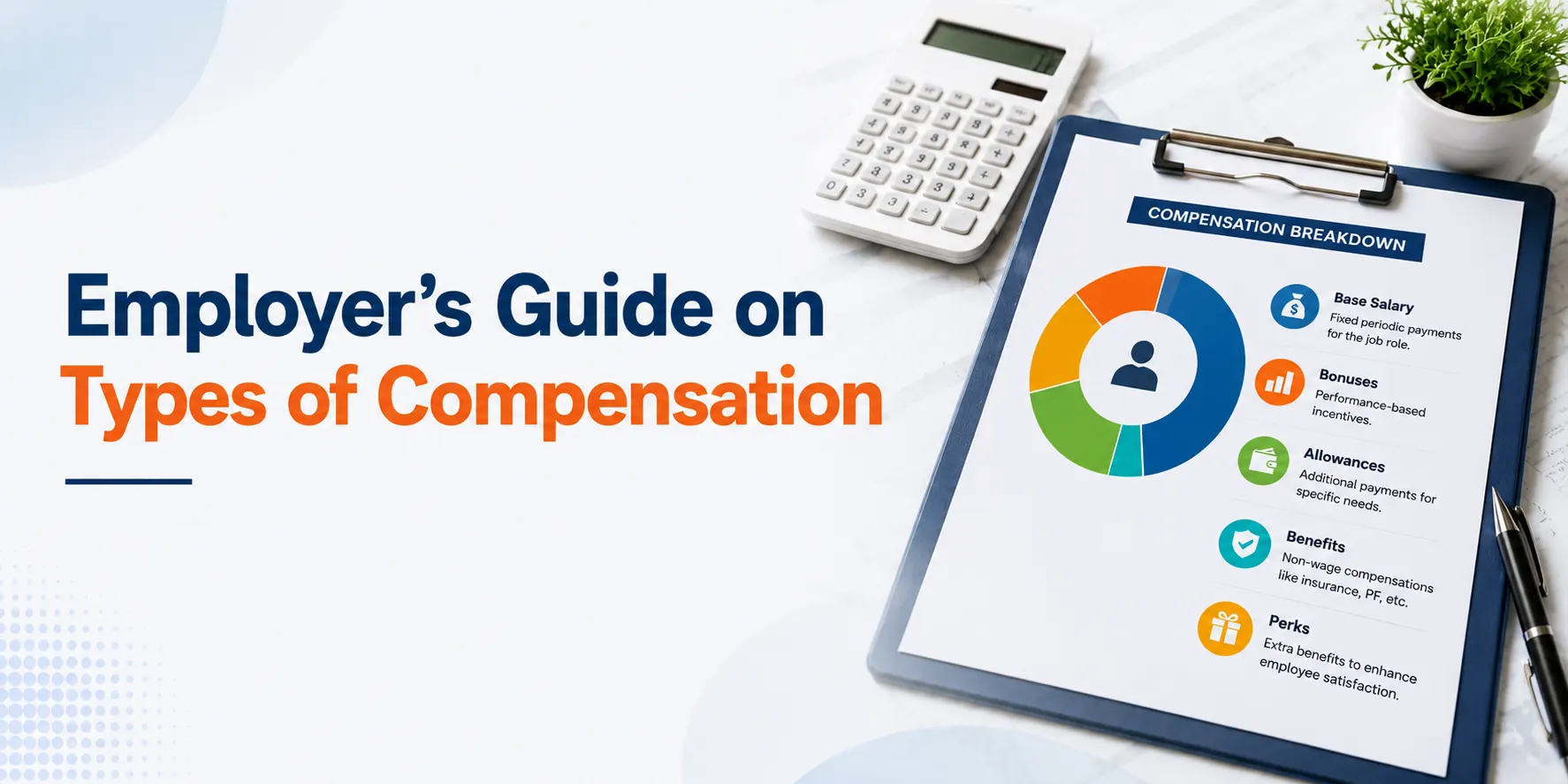
Types of compensation influence hiring, retention, employee trust, and payroll clarity more than many employers realise. A salary may bring someone in, but the wider compensation mix often decides whether that person stays, grows, and performs with confidence. In India, employers now need to think across fixed pay, variable pay, benefits, paid leave, long-term value, and payroll-linked transparency, not just monthly salary credit.
For employers, this is where compensation becomes a management issue, not only an HR topic. If pay structures are unclear, inconsistent, or too narrow, the result is usually visible in offer declines, pay disputes, weak retention, and rising payroll complexity. If the structure is balanced and well communicated, the company gets stronger control over hiring, budgeting, and employee confidence.
This guide explains the main types of compensation in human resource management, how they fit into a total pay structure, and how employers can use them more effectively through a payroll-led approach.
What Is Compensation?
Compensation is the total reward an employer gives an employee in exchange for work, skill, time, and contribution. It includes direct pay such as salary or wages, and indirect value such as insurance, paid leave, retirement-linked benefits, and selected non-cash rewards. This broad understanding is consistent across current HR guidance and compensation practice references.
For employers in India, compensation is not only a hiring tool. It also affects PF, gratuity, tax treatment, compliance tracking, and the employee’s view of fairness. Bharat Payroll’s own salary reporting and base pay content reflects this by linking salary structures, earnings, deductions, and benefit visibility to payroll clarity and transparent compensation handling.
Why Employers Need a Clear Compensation Structure
A vague pay structure creates trouble in places that employers often notice too late. One team may have inflated allowances and weak basic pay. Another may get ad hoc incentives without a clear rule. A third may have benefits that exist in policy files but are poorly reflected in payroll records.
That kind of setup weakens trust. A clearer structure helps employers:
- Make offers easier to explain
- Align pay with role, location, and contribution
- Reduce disputes around salary breakup
- Handle salary revisions more cleanly
- Connect payroll, benefits, and statutory deductions with less friction
This is one reason types of compensation management matter. The question is no longer whether a company pays employees. Every employer does that. The sharper question is whether the compensation structure makes business and payroll sense.
The Main Types of Compensation
In most compensation frameworks, pay sits under two broad heads:
Direct compensation
This is the part employees usually see first. It includes salary, wages, bonus, incentive, commission, and other direct cash payments.
Indirect compensation
This includes employer-supported value beyond direct pay, such as insurance, retirement-linked support, leave, perks, and selected non-cash rewards.
A third useful lens is total compensation, which combines both. That full picture matters because many employees judge an offer on CTC, take-home pay, benefits, leave support, and long-term value together, not as separate lines.
Direct Compensation
Direct compensation is the cash-linked part of employee pay. It is the most visible piece of the compensation structure and the one most closely tied to salary expectations, offer comparisons, and payroll processing.
Base Pay
Base pay is the fixed pay an employee receives for performing the role. It may be structured as salary or wages, depending on the nature of work and pay method. Bharat Payroll’s own base pay content explains it as the fixed amount used for accurate payroll calculation across salaried and hourly workers.
For employers, base pay matters because many other items depend on it directly or indirectly.
Allowances
Allowances are additional pay elements added to support living, work, or location-related needs. In Indian payroll structures, common examples include HRA, special allowance, conveyance-related support, and selected reimbursement-linked items. The Income Tax Department’s current salaried-benefit pages continue to show allowances as an important area of tax and payroll treatment.
Allowances make sense when they are structured with purpose. They stop making sense when they are used only to force a salary breakup without clarity.
Bonus and Incentives
Bonus and incentive payments reward performance, target achievement, company results, or role-specific output. These items become important in sales, operations, leadership, and productivity-linked roles.
Employers usually use these when they want a part of compensation to move with business or individual output, rather than remain fixed all year.
Commission
Commission is more common in sales-led roles and is usually linked to revenue, margin, deal value, or target achievement. It works well where output is measurable, and the company wants a stronger pay-for-performance structure.
Overtime and Additional Work Pay
For eligible roles, overtime and extra-hour payments remain an important part of direct compensation. Employers need these calculations to stay aligned with working-hour records, attendance data, and current labour treatment.
Stock Options or Equity
This is more common in startups, technology firms, and growth-stage businesses. It gives employees long-term upside linked to company growth. Not every business needs this in the structure, but for some companies, it helps balance cash limits with long-term reward.
Indirect Compensation
Indirect compensation includes the parts of employee value that may not appear as plain monthly cash in hand but still add financial or practical worth.
Insurance and Health Benefits
Health cover, accident protection, life insurance, and related employer-paid support often matter more than companies assume, especially when employees compare two offers with similar salaries.
Retirement-Linked Benefits
In India, retirement-linked compensation includes statutory and long-term items such as EPF and gratuity. EPF remains a major part of the employer and employee payroll contribution structure. Gratuity also remains an important long-term employment benefit, with current labour-law reporting continuing to track post-2025 developments closely.
Paid Time Off
Leave itself is a compensation value, even when employers forget to view it that way. Paid leave, earned leave, sick leave, maternity support, paternity leave, and holiday structures all shape how employees judge the overall reward system.
Learning and Development Support
Course support, certification reimbursement, skill-building budgets, and internal development tracks often sit outside direct pay, but they still form part of the compensation story. For many employees, especially in growth-focused roles, this matters more than one extra allowance line.
Work-Life Support and Flexibility
Hybrid work, selected remote support, transport help, meal support, or role-specific flexibility can all form part of indirect compensation. The value depends on the workforce and the role.
Non-Cash Compensation Still Matters
Employers often focus too heavily on what enters the bank account and too lightly on what shapes employee confidence.
Recognition, promotion, visibility, role progression, manager credibility, and internal growth support all influence how compensation is experienced. A company can pay fairly and still lose people if the reward feels mechanical, delayed, or poorly explained.
That is why smart compensation management is rarely about one number. It is about the whole reward experience.
What Total Compensation Actually Means
Many employees compare offers through total compensation, not salary alone. Total compensation includes direct pay, indirect value, statutory support, long-term benefits, and selected non-cash rewards. Employers who explain total compensation clearly usually reduce confusion around CTC, take-home pay, and perceived pay gaps.
Comparison Between Types of Compensation
| Compensation Type | What it includes | Why employers use it | Payroll impact |
| Direct compensation | Base pay, wages, bonus, commission, incentives, overtime | To pay for role, performance, and output | Immediate effect on the monthly payroll and take-home |
| Indirect compensation | Insurance, retirement-linked benefits, leave, flexibility, perks | To improve retention and offer value beyond salary | Affects CTC, benefit cost, and selected statutory treatment |
| Long-term compensation | Gratuity, PF value, stock options, equity | To support retention and future value | Shapes the employer cost and long-term reward mix |
| Non-cash compensation | Recognition, career growth, and development support | To improve employee confidence and retention | Indirect payroll impact, though a strong effect on retention |
Types of Compensation in HRMS
When employers ask about types of compensation in HRMS, they are usually asking one practical question: can the system handle salary structure, deductions, benefits, revisions, and reporting clearly enough to support real compensation management?
That is where HRMS and payroll start mattering together. A good compensation structure inside HRMS should help employers:
- maintain salary breakups clearly
- track earnings, deductions, and benefits
- manage salary revisions
- reflect policy changes in payroll runs
- generate salary reports that are usable for HR and finance
- reduce manual salary correction work
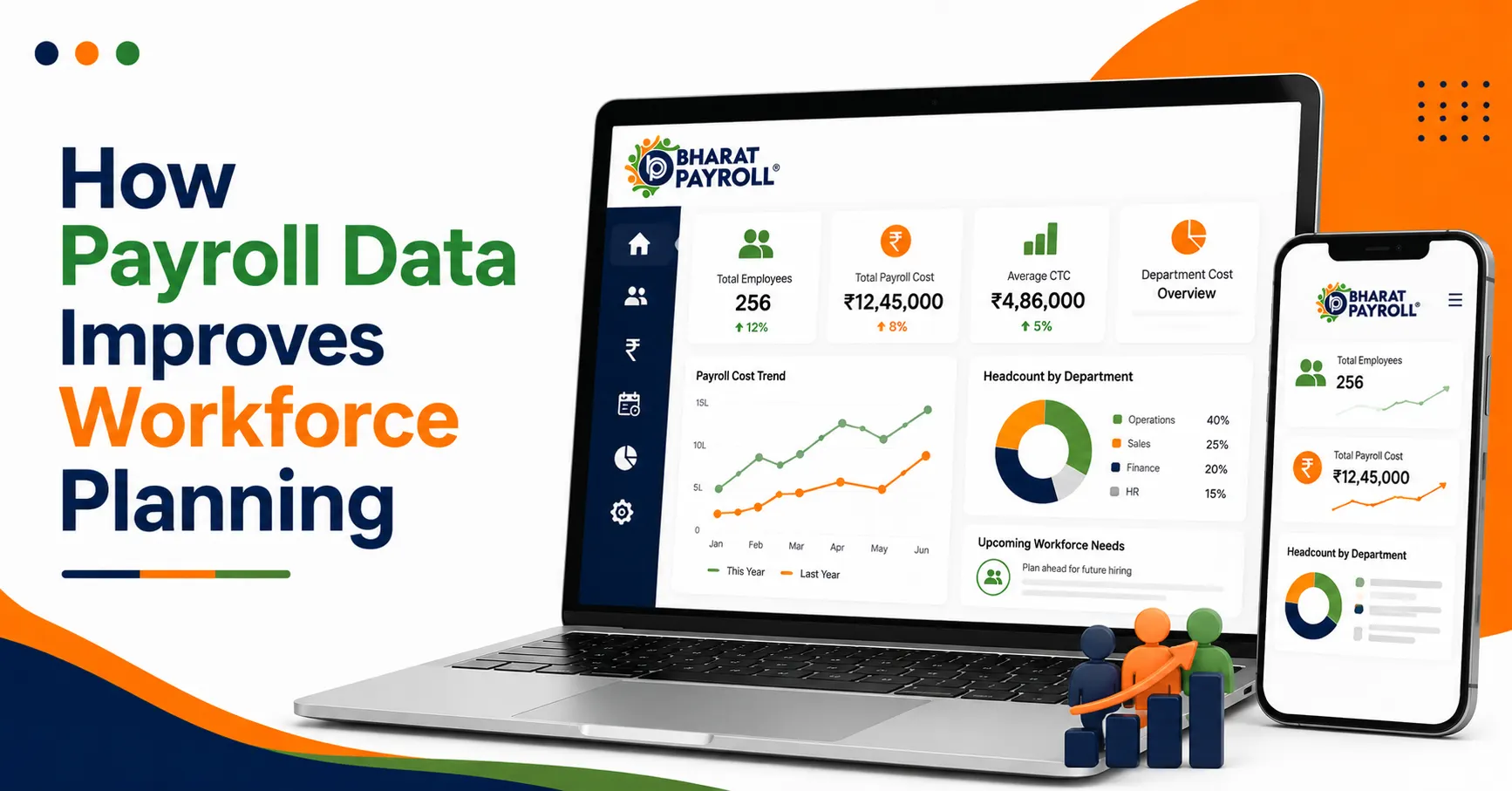
Bharat Payroll’s salary info reports are positioned exactly in this direction, with detailed breakdowns of employee earnings, deductions, and benefits for transparent payroll handling. Its salary-on-hold and base-pay content also shows how the platform supports salary revision visibility and payroll-linked compensation accuracy.
Compensation Structure in India: What Employers Need to Account For
- base pay and salary structure logic
- allowances and tax treatment
- EPF and gratuity value
- paid leave as compensation value
- payroll visibility of earnings and deductions
This section is needed because the article says “in India” often, but does not consolidate the India-specific structure into one useful employer section.
Types of Compensation in Human Resource Management
In HR practice, compensation is not only about what gets paid. It is about how pay is designed, approved, communicated, and reviewed.
That means types of compensation in human resource management usually cover:
- direct pay design
- indirect benefit design
- salary benchmarking
- internal pay consistency
- performance-linked pay decisions
- offer design
- retention support
- payroll and statutory alignment
This is where many companies struggle. They may have payroll. They may even have salary structures. But they do not yet have a proper compensation framework.
That gap shows up in offer inconsistencies, confused appraisal outcomes, weak benefit communication, and messy salary breakups that employees do not trust.
How Employers Should Build Compensation More Carefully
A better compensation structure usually starts with five questions.
What does the market expect for this role?
Compensation without a role and market context creates offer friction quickly.
What must remain fixed, and what can vary?
Base pay, allowance design, incentive rules, and bonus treatment should not be mixed casually.
Which benefits actually matter to this workforce?
A younger workforce, a field-heavy workforce, and a senior leadership team may value very different things.
How will payroll handle the structure every month?
A compensation design that looks neat in a policy deck but creates payroll confusion is not a good design.
Can the employee understand the structure without explanation every month?
If the answer is no, the structure needs work.
How Bharat Payroll Supports Compensation Management
Bharat Payroll becomes relevant here because compensation management is only useful when it can be translated into working payroll, salary reporting, and employee-level visibility.
Its public product pages position the platform around:
- salary structure visibility
- earnings and deductions reporting
- payroll accuracy
- employee data handling
- salary revision support
- compensation-linked reporting clarity
That helps employers use compensation structures more effectively across payroll cycles, salary reviews, and employee communication. Bharat Payroll also presents itself as a broader HR and payroll platform built for compliant and efficient payroll operations across industries.
For employers, the commercial value is simple. A better compensation system helps them:
- Create cleaner salary structures
- Process pays more accurately
- Explain the salary breakup more clearly
- Reduce confusion across HR, payroll, and finance
- Support stronger employee trust around pay
Why a Balanced Compensation Mix Works Better
A company that relies only on a fixed salary usually loses flexibility. A company that relies too heavily on incentives creates instability. A company that ignores benefits weakens its offer strength. A company that has benefits but poor salary clarity still creates mistrust.
Balance is what makes compensation believable. That balance usually means:
- fair fixed pay
- selected performance-linked pay
- statutory and long-term value
- useful benefits
- a structure payroll can be handled cleanly
Final Word
Compensation is one of the clearest signals an employer sends. It tells employees what the company values, how seriously it takes retention, and whether growth is being handled with fairness or improvisation.
The strongest employers do not treat compensation as only salary plus bonus. They treat it as a structured mix of direct pay, indirect value, long-term support, and role-specific reward logic.
That is why understanding the types of compensation, the types of compensation in HRMS, and the wider types of compensation management matters. Once employers get that structure right, payroll becomes cleaner, offers become easier to explain, and employee trust becomes easier to hold.
Turn Compensation Structures into Clear Payroll Records
Use Bharat Payroll to manage salary structures, earnings, deductions, and compensation-linked reports with better payroll clarity.
Frequently Asked Questions
1. What are the main types of compensation?
The main types of compensation are direct compensation and indirect compensation. Direct compensation includes salary, wages, bonuses, incentives, and commission. Indirect compensation includes benefits, paid leave, retirement-linked value, and selected non-cash rewards.
2. What are the types of compensation in HRMS?
Types of compensation in HRMS usually include base pay, allowances, bonuses, incentives, deductions, benefits, revisions, and employee-level reporting around total compensation.
3. What are the types of compensation in human resource management?
In human resource management, compensation covers pay design, benefits, retention-linked rewards, performance-linked payments, promotion-linked pay decisions, and payroll-aligned reward structures.
4. Why is compensation important for employers?
Compensation affects hiring, retention, employee trust, payroll clarity, and budget control. A weak structure usually creates offer friction and pay dissatisfaction.
5. How does Bharat Payroll help with compensation management?
Bharat Payroll supports compensation handling through salary structure visibility, salary reports, earnings and deductions breakdowns, payroll accuracy, and salary revision support.