
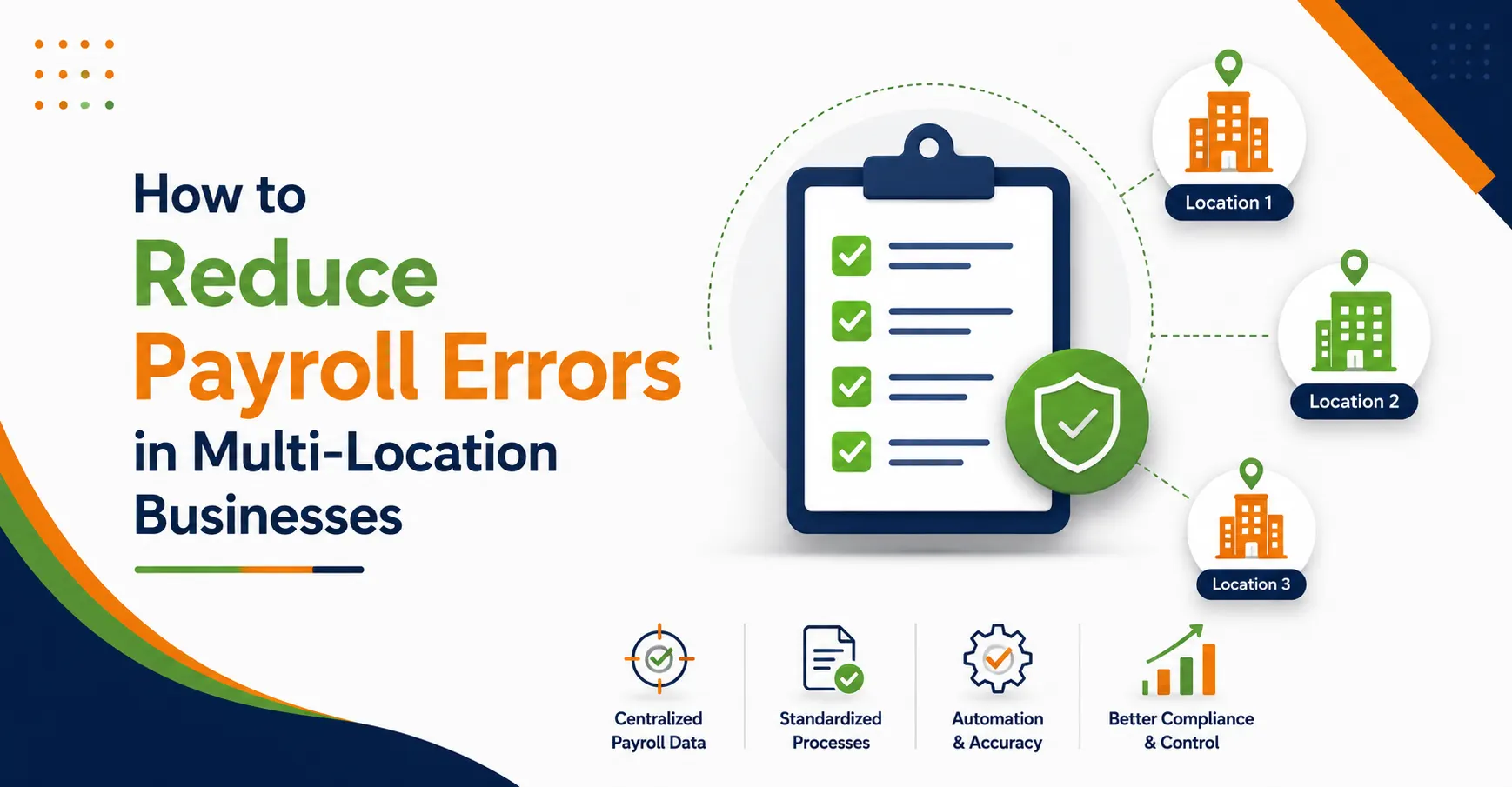
Managing payroll across several offices, stores, factories, or project sites creates more opportunities for errors. Different attendance practices, delayed approvals, employee transfers, and state-specific rules can affect salary calculations and statutory deductions.
Effective multi location payroll compliance combines centralised control with location-specific configurations. Businesses need one payroll process, but they must still account for professional tax, minimum wages, Labour Welfare Fund requirements, working-hour rules, and other regional obligations applicable to each employee.
Why Do Payroll Errors Increase Across Locations?
Multi-location payroll errors rarely result from one major failure. They usually develop through several small inconsistencies across branches.
Common causes include:
- Different attendance formats across locations
- Delayed overtime and incentive submissions
- Incorrect employee-location mapping
- Manual salary calculations
- Outdated statutory configurations
- Unapproved payroll adjustments
- Missed employee transfer updates
- Different payroll cutoff dates
- Duplicate employee records
- Limited branch-level visibility
BIPO’s analysis of multi-location attendance explains that inconsistent time records, delayed approvals, overtime miscalculations, and disconnected systems can increase payroll risk. Connecting attendance data with payroll can reduce repeated data entry and improve consistency.
What Makes Multi-State Payroll in India Complex?
The challenge with Indian multi-state payroll operations is that businesses must manage central obligations alongside state-specific requirements.
Central payroll responsibilities may include applicable EPF, ESI, income tax, and wage-related obligations.
State-level requirements can differ in areas such as:
- Professional tax rates and filing schedules
- Labour Welfare Fund contributions
- Minimum wage categories
- Overtime and working-hour rules
- State holiday requirements
- Payroll registers and documentation
- Shops and Establishments Compliance
Bharat Payroll’s multi-state payroll compliance guide explains that professional tax, minimum wages, Labour Welfare Fund contributions, and documentation requirements may vary according to the employee’s work location.
The Ministry of Labour and Employment’s Compliance Handbook for Employers also highlights the need to follow wage rates notified by the appropriate government and maintain prescribed attendance, wage, overtime, and deduction records.
These statutory differences prevent businesses from applying one unrestricted payroll rule to every employee.
Common Payroll Risks and Recommended Controls
| Payroll risk | Common cause | Recommended control |
| Incorrect salary calculation | Inaccurate attendance or leave data | Integrate attendance, leave, and payroll records |
| Wrong professional tax | Employee mapped to the wrong state | Maintain verified work-location mapping |
| Missed overtime | Branch submits data after cutoff | Use a common payroll calendar and approval workflow |
| Duplicate employee payment | Multiple employee records | Maintain one centralised employee master |
| Incorrect minimum wage | Outdated state wage configuration | Track location-specific wage notifications |
| Unapproved salary change | Weak authorisation controls | Require digital approval and retain change history |
| Delayed statutory payment | Decentralised compliance tracking | Use a central compliance calendar with alerts |
| Incorrect final settlement | Late exit information | Connect resignation and clearance workflows with payroll |
1. Maintain One Centralised Employee Database
Every branch should use the same verified employee database. Separate spreadsheets create conflicting records and make payroll reconciliation difficult.
The employee master should include:
- Employee and payroll ID
- Branch and department
- Current work location
- State of employment
- Salary structure
- Statutory eligibility
- Bank and tax details
- Shift and attendance policy
- Joining and transfer dates
- Exit and settlement status
The central record should update whenever an employee joins, transfers, receives a salary revision, or leaves the organisation.
2. Create a State Wise Payroll Compliance Matrix
A state wise payroll matrix helps payroll teams document the rules applicable to every operating location.
The matrix should track:
- Professional tax applicability and slabs
- Labour Welfare Fund requirements
- Minimum wage classifications
- Working-hour and overtime rules
- State holidays
- Filing and payment dates
- Required payroll registers
- Responsible compliance owner
The payroll team should review this matrix whenever the business opens a new branch or hires employees in another state.
3. Standardise Attendance Across Locations
Attendance is one of the most common sources of payroll errors. Manual timesheets, missed punches, inconsistent shifts, and delayed approvals directly affect payable days and overtime.
Businesses should standardise:
- Clock-in and clock-out methods
- Shift schedules
- Grace periods
- Weekly offs
- Leave approvals
- Overtime authorisation
- Missed-punch correction
- Attendance regularisation
- Payroll cutoff dates
A centralised time and attendance system can connect biometric records, geolocation, work shifts, overtime, and approvals with payroll. Bharat Payroll lists biometric integration, attendance rules, geolocation, time tracking, and overtime management among its attendance capabilities.
4. Use Centralised Payroll Processing
Centralised payroll processing brings payroll calculations, approvals, reporting, and compliance controls into one structured workflow.
Centralisation helps businesses maintain:
- One payroll calendar
- Consistent salary components
- Standard approval levels
- Consolidated employee records
- Branch-wise payroll summaries
- Central compliance monitoring
- Complete change histories
- Standard salary validation
However, centralisation should not remove legitimate location-specific rules. The payroll system must still apply the appropriate configuration based on the employee’s branch, state, establishment, and statutory category.
Bharat Payroll’s payroll software supports automated payroll processing, configurable payroll components, payroll previews, TDS calculations, compliance reporting, and centralised payroll records.
5. Establish a Common Payroll Calendar
Every branch should follow the same payroll calendar.
The calendar should clearly define:
- Attendance cutoff date
- Variable-pay submission date
- Overtime approval deadline
- New-joiner documentation deadline
- Transfer update deadline
- Salary revision deadline
- Payroll review period
- Final approval date
- Salary payment date
- Statutory filing deadlines
A common calendar reduces late submissions and prevents the central payroll team from processing incomplete branch data.
6. Control Employee Transfers
Employee transfers create errors when payroll continues applying the previous branch or state configuration.
Every transfer workflow should capture:
- Effective transfer date
- Previous and new location
- New work state
- Revised salary or allowance
- Professional tax implications
- Labour Welfare Fund applicability
- Attendance policy changes
- Cost-center changes
- Required approvals
This control is especially important for a distributed workforce that includes remote employees, field teams, project-based workers, and employees assigned to client locations.
7. Automate Payroll Approvals
Businesses should not process branch payroll inputs through informal emails or untracked spreadsheets.
A structured workflow should define:
- Who submits payroll inputs
- Who verifies attendance and variable pay
- Who approves exceptions
- Who reviews statutory deductions
- Who authorises final payroll
The system should retain timestamps, approver details, supporting documents, and modification histories.
8. Run Pre-Payroll Validation Checks
Payroll teams should validate all major changes before final processing.
Important checks include:
- New joiners and exits
- Employee transfers
- Missing attendance
- Excessive overtime
- Unapproved incentives
- Salary revisions
- Negative net pay
- Duplicate bank accounts
- Statutory deduction mismatches
- Employees assigned to inactive branches
- Unusual salary variations
- Pending final settlements
Variance reports help payroll teams review exceptions instead of manually checking every calculation.
Bharat Payroll’s payroll reporting and analytics includes salary information, variance, audit, statutory, missing-information, TDS, and other payroll reports.
9. Define Branch-Level Accountability
A major challenge in managing multi branch payroll is unclear ownership.
Branch managers may expect the central team to correct inaccurate information, while the payroll team may assume that branch data has already been verified.
Businesses should assign clear responsibility for:
- Attendance verification
- Overtime approval
- Incentive submission
- Employee transfer updates
- New-joiner documents
- Exit information
- Payroll exception resolution
- Final branch confirmation
Clear accountability reduces last-minute corrections and repeated follow-ups.
10. Maintain Audit-Ready Payroll Records
Businesses should retain organised payroll records for internal reviews, employee queries, statutory inspections, and financial audits.
Important records include:
- Salary registers
- Attendance summaries
- Overtime records
- Deduction reports
- Statutory contribution reports
- Bank transfer records
- Salary revision approvals
- Employee transfer records
- Payroll variance reports
- Exit and settlement documents
Centralised records make it easier to trace when an error occurred, who approved the data, and how the amount was calculated.
How Does Standardising Payroll Reduce Errors?
Standardising payroll creates one repeatable process across all branches while preserving valid regional compliance variations.
It allows businesses to:
- Collect payroll inputs in one format
- Apply common approval controls
- Reduce manual calculations
- Identify errors before payment
- Maintain accurate location records
- Monitor compliance deadlines centrally
- Generate consistent branch reports
- Resolve payroll questions faster
- Scale payroll as the business expands
The most effective model combines centralised governance with configurable location-specific rules.
Simplify Multi-Location Payroll Without Errors
Centralize payroll, automate compliance, and eliminate costly mistakes across every branch.
Frequently Asked Questions
1. What is multi-location payroll compliance?
Multi-location payroll compliance means processing payroll across branches while following central and state-specific wage, tax, deduction, and reporting requirements.
2. Why do payroll errors increase across locations?
Different attendance systems, delayed inputs, manual calculations, and incorrect employee-location mapping often cause payroll errors.
3. How can businesses manage state-wise payroll?
Businesses should maintain location-specific compliance rules for professional tax, minimum wages, Labour Welfare Fund, overtime, and statutory deadlines.
4. How does centralised payroll processing help?
Centralised payroll processing standardises employee data, attendance, approvals, calculations, compliance tracking, and reporting across all business locations.
5. How can attendance automation reduce payroll errors?
Attendance automation transfers approved attendance, leave, shifts, and overtime directly into payroll, reducing manual entry and calculation mistakes.
6. How does Bharat Payroll support multi-location businesses?
Bharat Payroll centralises payroll processing, applies location-specific rules, manages branch data, and improves compliance visibility.