
For many organisations, payroll is treated as a monthly operational task—calculate salaries, process payments, and generate reports. But as companies grow, this approach becomes insufficient.
Payroll is not just about accuracy in numbers; it is about understanding whether those numbers make sense over time.
Businesses often struggle with questions like:
- Why did payroll costs increase this month?
- Which departments are driving cost growth?
- Are overtime and incentives under control?
- Are deductions consistent across employees?
Traditional systems cannot answer these questions effectively. They show what happened, but not why it happened.
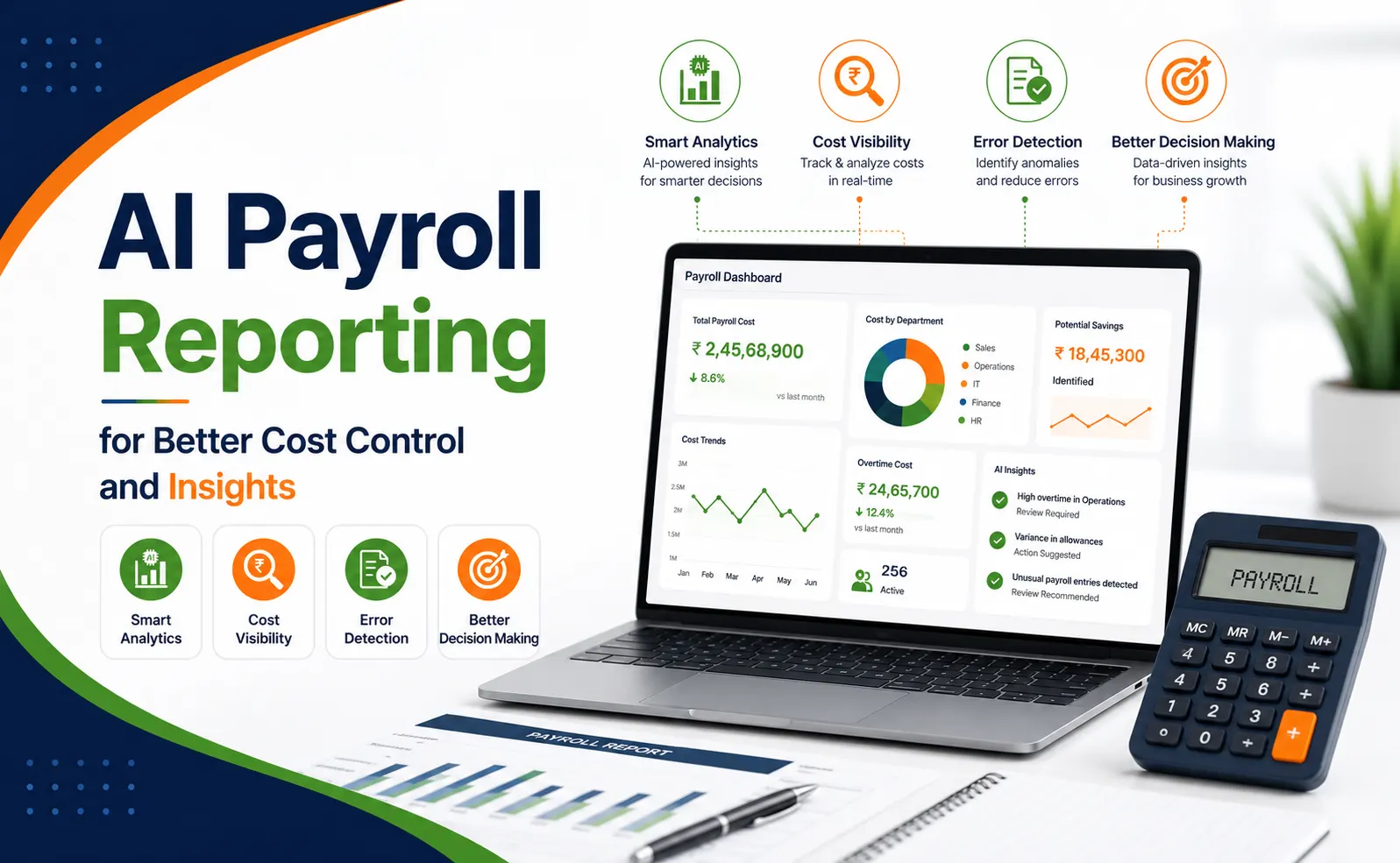
AI payroll reporting addresses this gap by turning payroll data into meaningful insights. Instead of reviewing static reports, businesses gain clarity on trends, variations, and cost drivers.
To understand how payroll errors are prevented before processing, read:
How AI Detects Payroll Anomalies Before Salary Processing
This article focuses on the next layer—how businesses can analyse payroll data after processing to improve decisions and maintain control.
What Is AI Payroll Reporting Software?
AI payroll reporting software uses advanced data analysis techniques to evaluate payroll information across multiple cycles. It identifies patterns, detects variations, and highlights factors that influence payroll costs.
Unlike traditional reporting tools, AI-powered systems provide:
- Real-time data analysis
- Automated variance detection
- Predictive insights
- Context-driven reporting
This means businesses can move beyond basic summaries and understand the reasoning behind payroll changes.
To see how reporting fits into a complete payroll system, explore:
Why Traditional Payroll Reports Fall Short
Conventional payroll reports are primarily static and retrospective. They typically include:
- Total salary disbursement
- Employee-wise salary breakdown
- Tax and deduction summaries
While useful for record-keeping, these reports lack analytical depth. They do not explain:
- The cause of payroll fluctuations
- Trends in employee compensation
- Department-level cost behaviour
- Long-term payroll patterns
As a result, decision-makers rely on manual analysis, which is time-consuming and prone to oversight.
AI payroll reporting eliminates these limitations by automatically identifying trends and presenting them in an understandable format.
How AI Payroll Reporting Improves Business Decisions
1. Converts Payroll Data Into Actionable Insights
AI systems analyse large volumes of payroll data and highlight meaningful patterns. For example, instead of reviewing spreadsheets, businesses receive insights such as:
- Payroll increased due to higher incentives in sales teams
- Overtime costs are rising in operations
- Certain locations have higher compensation growth
This allows faster decision-making with minimal manual effort.
2. Tracks Payroll Variance Across Periods
Payroll variance analysis is essential for identifying inconsistencies. AI compares payroll data across:
- Months and quarters
- Departments and teams
- Locations and business units
- Employee categories
This enables organisations to quickly detect unexpected changes and take corrective action.
3. Enhances Workforce Cost Visibility
Understanding workforce costs is critical for financial planning. AI reporting provides detailed breakdowns such as:
- Fixed vs variable pay
- Department-wise salary expenses
- Location-based cost distribution
- Permanent vs contract workforce costs
4. Supports Strategic Financial Planning
AI payroll reporting helps businesses forecast and plan effectively. It enables:
- Estimation of future payroll expenses
- Analysis of salary increment impact
- Hiring cost projections
- Monitoring of overtime trends
This transforms payroll from an operational function into a strategic financial tool.
5. Improves Compliance Monitoring
Payroll compliance is a critical requirement for businesses. AI reporting helps ensure:
- Accurate tax deductions
- Consistent statutory contributions
- Compliance with labour regulations
Key AI Payroll Reports Every Business Should Use
1. Payroll Variance Report
This report compares payroll across different cycles and highlights differences in costs. It helps identify sudden increases or reductions in payroll expenses.
2. Workforce Cost Report
Provides a breakdown of payroll expenses across departments, locations, and employee categories. This is essential for budgeting and cost control.
3. Deduction and Contribution Report
Tracks statutory deductions such as taxes, provident fund, and insurance contributions to ensure consistency and compliance.
4. Payroll Trend Report
Analyses payroll data over time to identify patterns in salaries, incentives, and overtime.
5. Audit and Approval Report
Maintains transparency by recording payroll changes and approvals, which is important for internal audits.
How AI Payroll Reporting Complements Payroll Accuracy
Payroll accuracy depends on two key components:
- Error prevention before payroll processing
- Insight generation after payroll processing
AI anomaly detection identifies potential errors before salaries are processed. AI reporting, on the other hand, explains trends and variations after payroll is completed.
Together, they create a comprehensive payroll management system that improves both accuracy and control.
Common Challenges Without AI Payroll Reporting
Many organisations face recurring issues due to lack of advanced reporting:
- Limited visibility into payroll trends
- Difficulty identifying cost drivers
- Delayed decision-making
- Increased risk of financial inefficiencies
- Manual effort in analysing payroll data
These challenges become more significant as the organisation grows.
AI reporting addresses these problems by providing real-time insights and reducing dependency on manual processes.
How Bharat Payroll Helps You Gain Complete Payroll Visibility
Bharat Payroll offers an integrated platform that connects all aspects of payroll management, including:
- Employee information
- Attendance and leave tracking
- Salary structures
- Compliance and statutory deductions
- Payroll processing
- Advanced reporting and analytics
By consolidating these components into a single system, businesses can:
- Monitor payroll in real time
- Analyse workforce costs instantly
- Generate structured reports automatically
- Reduce manual intervention
- Improve decision-making accuracy
Why AI Payroll Reporting Is Essential for Growing Businesses
As organisations expand, payroll complexity increases significantly.
This includes:
- Larger workforce
- Multiple locations
- Diverse salary structures
- Increased compliance requirements
Without advanced reporting tools, managing this complexity becomes difficult.
Businesses may experience:
- Reduced visibility into costs
- Higher chances of errors
- Inefficient financial planning
AI payroll reporting provides the necessary tools to manage growth effectively by offering clarity and control over payroll data.
Best Practices for Implementing AI Payroll Reporting
To maximise the benefits of AI payroll reporting, businesses should follow these best practices:
1. Focus on Key Metrics
Identify critical payroll metrics such as total cost, variance, and department-wise expenses.
2. Review Reports Regularly
Analyse payroll reports on a monthly or quarterly basis to identify trends early.
3. Integrate With Other Systems
Ensure payroll reporting is connected with HR and finance systems for comprehensive insights.
4. Train Teams
Equip HR and finance teams with the knowledge to interpret AI-generated insights effectively.
5. Use Insights for Decision-Making
Apply payroll insights to budgeting, hiring, and cost optimisation strategies.
The Future of Payroll Reporting
Payroll reporting is evolving from static documentation to dynamic intelligence systems.
Future advancements may include:
- Real-time predictive analytics
- Automated decision recommendations
- Integration with financial planning tools
- Enhanced visualisation dashboards
Businesses that adopt AI payroll reporting early will be better positioned to manage workforce costs and maintain financial stability.
Ready to Transform Your Payroll Reporting
If your organisation still relies on spreadsheets or traditional reports, it may be missing critical insights.
AI-powered payroll reporting helps businesses:
- Detect cost trends early
- Improve accuracy indirectly
- Make faster and better decisions
- Reduce financial risks
Take Control of Your Payroll with AI-Powered Insights
Get complete visibility into payroll trends, costs, and compliance with Bharat Payroll
FAQs
1. What is AI payroll reporting?
AI payroll reporting analyses payroll data to identify trends, variations, and insights across payroll cycles.
2. How does it differ from payroll processing?
Payroll processing calculates salaries, while reporting analyses payroll data for decision-making.
3. Can AI payroll reporting reduce errors?
Yes, it highlights inconsistencies and trends that may indicate potential errors.
4. Is AI payroll reporting suitable for small businesses?
Yes, it helps small businesses improve cost control and scale efficiently.
5. Do businesses need both anomaly detection and reporting?
Yes, anomaly detection prevents errors, while reporting provides insights for decision-making.