
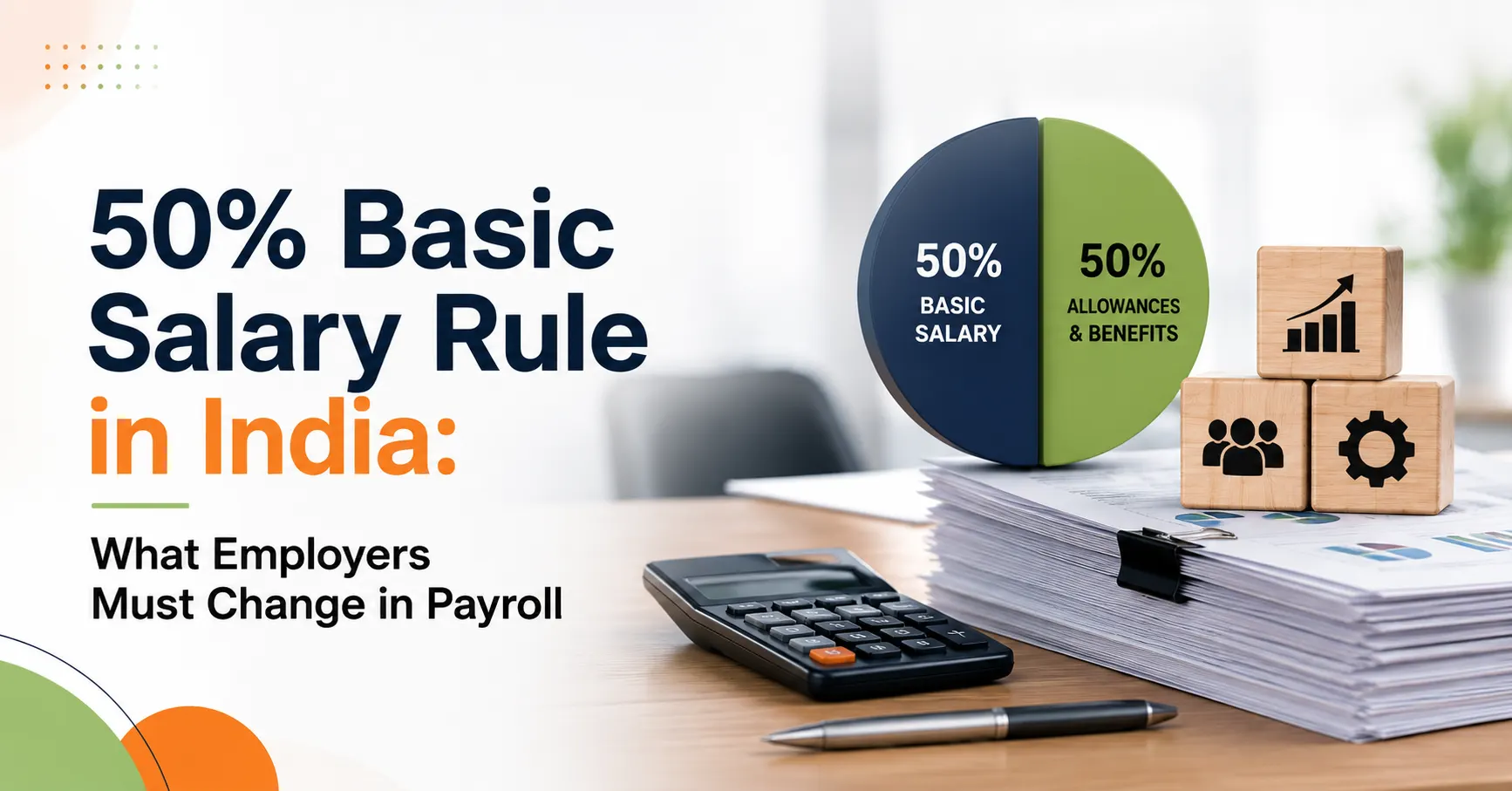
The 50% basic salary rule in India is now a serious payroll discussion for employers, HR leaders, finance teams, and founders. It affects how wages are understood, how salary structures are reviewed, and how statutory benefits may be calculated.
In simple terms, wages include basic pay, dearness allowance, and retaining allowance. If other allowances cross 50% of total remuneration, the excess amount may be added back to wages for statutory purposes. The Ministry of Labour FAQ explains this 50% allowance rule and confirms that the excess allowance is treated as wages for statutory calculations.
For employers, this is not just a payroll formula. It can affect PF, gratuity, leave salary, employee take-home pay, CTC planning, payslips, payroll reports, and compliance records.
What Is the 50% Basic Salary Rule in India?
The 50% basic salary rule in India means salary structures can no longer depend too heavily on allowances while keeping basic pay very low.
Technically, it is better understood as a wage definition and allowance add-back rule. The official definition of wages includes basic pay, dearness allowance, and retaining allowance. If allowances and benefits, except specific excluded items, exceed 50% of total remuneration, the amount above 50% is added back to wages.
This creates a more uniform wage base for statutory calculations. It also helps reduce artificial salary splitting where employers keep basic salary low and move more money into allowances.
Why Should Employers Take This Rule Seriously?
Many salary structures in India were built with lower basic pay and higher allowances. This made CTC flexible, improved take-home salary in some cases, and helped manage statutory cost exposure.
The new wage definition changes that approach. PIB notes that wages now include basic pay, DA, and retaining allowance, and that 50% of total remuneration may be added back to compute wages for benefits such as gratuity, pension, and social security.
That means employers may need to review:
- Basic salary percentage
- Allowance-heavy salary structures
- PF and gratuity cost impact
- Employee take-home salary
- CTC breakup and reporting
- Payroll compliance documentation
- HRMS and payroll configuration
This is why salary planning should not stay only with HR. Finance, compliance, payroll, and leadership teams should review the impact together.
How Does the 50% Rule Work?
Here is a simple example.
| Salary Component | Amount |
| Monthly remuneration | ₹60,000 |
| Basic + DA | ₹22,000 |
| Other allowances | ₹38,000 |
| 50% of remuneration | ₹30,000 |
| Excess allowance over 50% | ₹8,000 |
| Revised wage base | ₹30,000 |
In this case, allowances are higher than 50% of total remuneration. So the excess allowance amount is added back to wages.
This does not always mean the total CTC increases. It means the statutory wage base may change. If the employer keeps the same CTC, employee take-home may reduce because wage-linked contributions and provisions may increase.
For a deeper salary breakup review, employers should connect this rule with their salary structure in India planning.
Which Salary Components Need Review?
Employers should not look only at basic salary. The complete salary structure needs to be checked.
The Ministry of Labour FAQ explains that wages cover remuneration by salary, allowances, or otherwise, while basic pay, DA, and retaining allowance are directly included. It also clarifies that performance-based incentives, ESOPs, variable components, and reimbursement-based payments are not part of wages.
Key components to review include:
- Basic salary
- Dearness allowance
- Retaining allowance
- House rent allowance
- Special allowance
- Conveyance allowance
- Overtime allowance
- Bonus
- Commission
- Reimbursements
- Variable pay
- Employer PF contribution
- Gratuity provision
The later Labour Ministry FAQ also clarifies that overtime allowance forms part of the wage calculation where applicable, and if such allowance exceeds 50% of remuneration, the excess is added to wage calculation.
What Is the Payroll Impact of the 50% Basic Salary Rule?
The payroll impact depends on how the current CTC is structured. Companies with low basic salary and high allowances may see a bigger impact than companies that already maintain balanced salary structures.
| Payroll Area | Possible Impact |
| PF calculation | Wage base may increase for eligible employees |
| Gratuity | Provisioning may increase from the applicable date |
| Leave salary | Wage-linked calculations may change |
| Payslips | Salary breakup may need revision |
| CTC reports | Employer cost visibility becomes more important |
| Employee take-home | Net pay may reduce if CTC remains fixed |
| Payroll audit | Documentation must clearly explain calculations |
| HR communication | Employees need clarity on why net pay changed |
The additional Labour Ministry FAQ confirms that the revised definition of wages came into effect from 21 November 2025 and that gratuity based on the revised wage definition applies from that date.
Does Basic Salary Have to Be Exactly 50% of CTC?
Not exactly.
This is the most common misunderstanding. The rule is not only about making basic salary exactly 50% of CTC. It is about how wages are defined and how excluded allowances are treated when they cross the 50% limit.
In everyday payroll language, people call it the “50% basic salary rule.” But the more accurate explanation is this:
If allowances outside basic pay, DA, and retaining allowance exceed 50% of total remuneration, the excess amount may be added back to wages for statutory calculations.
That is why employers should avoid quick changes without proper payroll simulation. A simple percentage change can affect PF, gratuity, take-home salary, CTC reporting, and employee communication.
For CTC impact planning, employers should also review CTC restructuring before changing salary templates.
What Should HR and Finance Teams Do First?
The first step is a payroll impact audit. Employers should identify employees whose salary structures are allowance-heavy and calculate the possible statutory impact.
A practical review can follow this flow:
- Export current salary structure data.
- Separate basic, DA, retaining allowance, and other allowances.
- Compare allowances with 50% of total remuneration.
- Identify employees where excess allowance may be added back.
- Recalculate PF, gratuity, and wage-linked benefits.
- Compare old take-home and revised take-home salary.
- Check employer cost impact by department and grade.
- Update payroll rules, payslips, and salary templates.
- Prepare employee communication before rollout.
- Keep records ready for audit and future review.
This process should happen before the payroll cycle, not after salary processing. Once payroll is released, corrections can create confusion, rework, and employee trust issues.
Old Salary Process vs 2026 Employer Action
| Old Payroll Approach | 2026 Employer Action |
| Low basic salary and high allowances | Review wage definition and allowance limit |
| Manual salary breakup checks | Use structured salary component mapping |
| CTC viewed only as total cost | Check CTC, take-home, and statutory impact |
| Payroll changes done after errors | Run pre-payroll compliance checks |
| Limited employee explanation | Communicate salary impact clearly |
| Spreadsheet-based calculations | Maintain audit-ready payroll records |
The 50% rule makes payroll more transparent, but it also increases the need for careful planning. Employers need clean data, correct salary mapping, and consistent calculations.
How Bharat Payroll Helps Employers Manage Wage Rule Changes
Bharat Payroll helps businesses manage salary components, payroll calculations, statutory reports, payslips, employee records, and compliance workflows from one connected system.
With payroll software, employers can reduce manual errors, standardize salary structures, generate reports, and manage payroll changes with better visibility.
For teams preparing for the 50% basic salary rule in India, Bharat Payroll supports:
- Salary component mapping
- Payroll calculation automation
- PF, ESI, TDS, and statutory reporting
- Payslip generation
- Employee self-service access
- Payroll reports and CTC visibility
- HRMS and payroll workflow integration
- Audit-ready payroll records
This helps HR and finance teams move away from scattered spreadsheets and toward a more controlled payroll process.
Employer Checklist Before Restructuring Salaries
Before changing salary structures, employers should check:
- Is basic pay too low compared with total remuneration?
- Are allowances crossing the 50% threshold?
- Which employees will see PF or gratuity impact?
- Will take-home salary change after restructuring?
- Has finance reviewed the employer cost impact?
- Are payroll rules updated in the system?
- Are payslips and reports aligned with the new structure?
- Is employee communication ready before rollout?
- Are compliance records stored for future audit?
Get the salary restructuring checklist before updating payroll templates for the 50% wage rule.
Conclusion
The 50% basic salary rule in India is not just a payroll adjustment. It changes how employers should think about salary structures, statutory wages, PF, gratuity, CTC planning, and employee communication.
Companies with allowance-heavy salary structures should review their payroll data carefully. A rushed change can affect take-home salary, employer cost, compliance reports, and employee trust.
The best approach is to audit current structures, calculate the wage impact, review CTC scenarios, update payroll systems, and explain changes clearly to employees. With the right payroll process, employers can stay compliant and avoid last-minute salary calculation issues.
Ready to Make Your Payroll 50% Wage Rule Compliant?
See how Bharat Payroll helps automate salary structures, statutory calculations, payroll processing, and compliance without manual spreadsheets.
FAQs
1. What is the 50% basic salary rule in India?
The 50% basic salary rule means wages include basic pay, DA, and retaining allowance. If other allowances exceed 50% of total remuneration, the excess may be added back to wages for statutory calculations.
2. Does basic salary need to be exactly 50% of CTC?
No. The rule is about wage definition and allowance limits. If excluded allowances cross 50% of remuneration, the excess amount may be added back to wages.
3. Will the 50% rule reduce employee take-home salary?
It may reduce take-home salary if CTC remains the same and statutory contributions or provisions increase. The exact impact depends on the salary structure.
4. Does the rule affect gratuity calculation?
Yes. The revised wage definition applies to gratuity from 21 November 2025, according to the Labour Ministry FAQ.
5. Why should employers review salary structures now?
Employers should review salary structures to avoid payroll errors, incorrect statutory calculations, employee confusion, and compliance gaps during payroll processing.