
The income tax act 2025 payroll transition is now a practical HR and finance issue, not just a tax department update. From April 1, 2026, salary TDS, employee declarations, form references, payroll templates, and statutory reporting workflows need cleaner mapping under the new Act.
For employers, the real question is simple: will payroll be ready before the first salary cycle under the new rules?
What are the payroll updates employers must know?
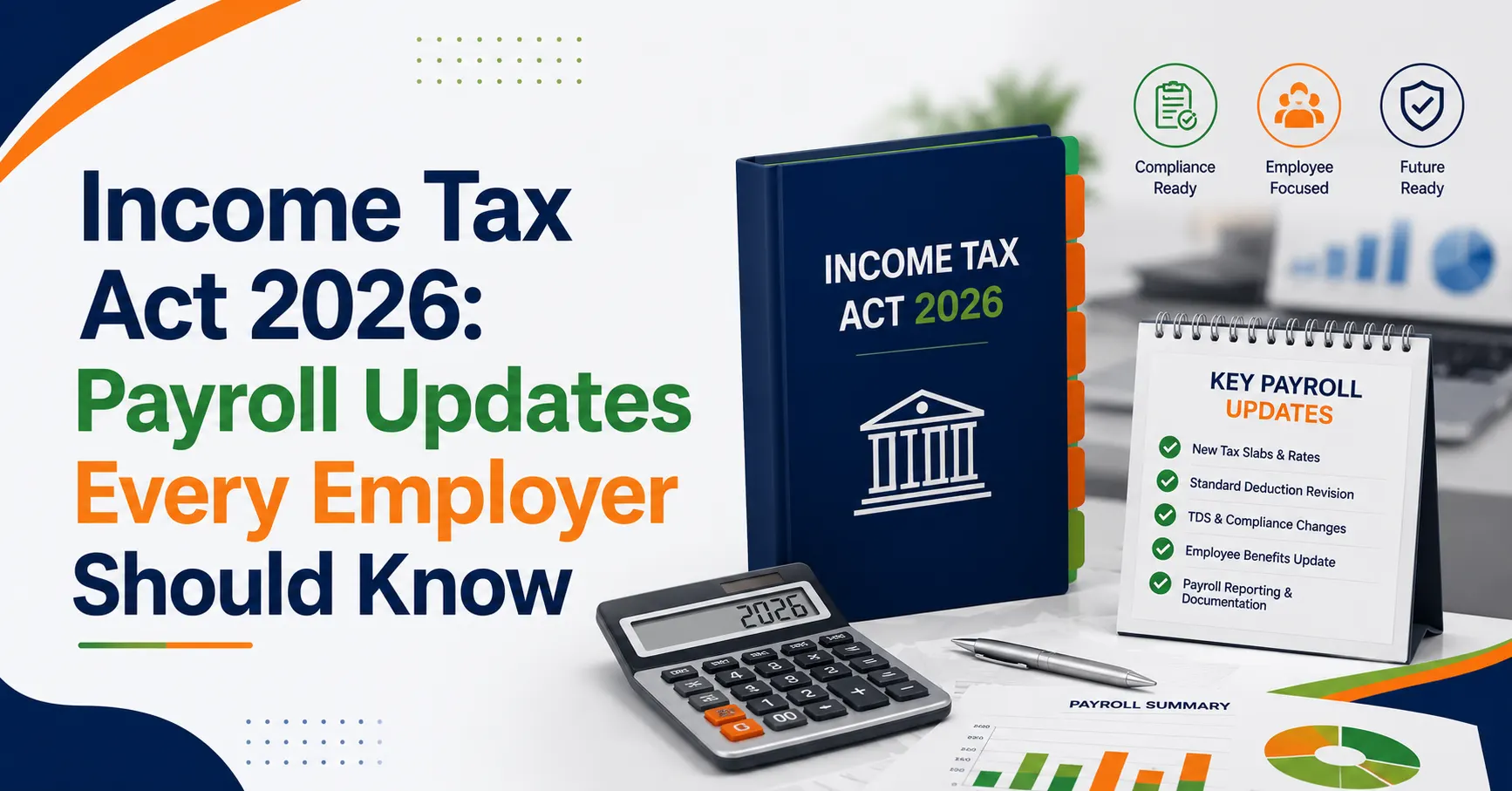
Employers should update salary TDS calculations, tax declaration forms, payroll section references, Form 130 workflows, Form 124 claim collection, statutory reporting, and employee communication templates for Tax Year 2026-27. The Income-tax Act, 2025 applies to salary paid on or after April 1, 2026.
This does not mean every salary structure changes overnight. It means every payroll process that touches income tax, TDS, declarations, proofs, tax regime selection, and year-end certificates must be reviewed before payroll teams process April 2026 salaries.
Why does the Income-tax Act, 2025 affect payroll in 2026?
The Income-tax Department states that the 1961 Act is repealed from April 1, 2026, but it continues to govern tax years that began before that date. This creates a transition period where old and new references may both matter, depending on the tax year and payment timeline.
For payroll teams, this matters because salary is generally handled month by month. March 2026 salary paid before April 1 follows the old Act. April 2026 salary paid on or after April 1 follows the Income-tax Act, 2025. The department’s TDS compliance guidance specifically says employers should reset TDS computation from April 1, 2026 for Tax Year 2026-27.
That one reset affects projected income, deductions, tax regime selection, declaration formats, payslip logic, TDS reports, and employee-facing tax summaries.
What changes for salary TDS from April 2026?
Salary TDS remains a core employer responsibility, but the references and reporting framework change. Under the transition guidance, salary for FY 2025-26 paid up to March 2026 follows Section 192 of the old Act, while salary for Tax Year 2026-27 paid from April 2026 onward follows Section 392(1) of the new Act.
That means payroll teams should not simply copy last year’s tax configuration. They need to check whether salary tax rules 2026, deduction references, employee declarations, and system labels are aligned with the new Act.
A practical payroll update should include:
- Reset employee TDS calculations from April 2026.
- Update tax regime selection fields for the new tax year.
- Replace old section labels where new references apply.
- Recheck salary component taxability inside payroll templates.
- Communicate new form references clearly to employees.
- Match statutory reports with new form numbers and due dates.
This is where a dedicated TDS calculation payroll system helps HR and finance teams avoid manual formula errors across large employee groups.
Old forms vs new payroll forms employers should track
The Income Tax Department’s form guidance for the Income-tax Rules, 2026 lists several old-to-new form mappings that directly affect payroll and TDS operations. For payroll teams, Form 124, Form 130, and Form 138 are especially important.
| Payroll Area | Earlier Form | New Form under Income-tax Rules, 2026 | Employer Action |
| Employee deduction claims | Form 12BB | Form 124 | Update declaration collection and proof validation workflow. |
| Salary TDS certificate | Form 16 | Form 130 | Prepare year-end certificate process under new format. |
| Quarterly salary TDS statement | Form 24Q | Form 138 | Align statutory reporting files and payroll reports. |
| Non-salary TDS certificate | Form 16A | Form 131 | Update vendor/non-salary TDS references if handled internally. |
| Lower or nil deduction certificate | Form 13 | Form 128 | Update payroll checks for employees submitting certificates. |
Form 130 is not just a renamed Form 16. The official FAQ says it certifies that tax has been deducted from salary income and deposited with the government. It includes Part A for employer and employee details, Part B for summary-level reconciliation, and Part C for detailed salary computation, deductions, taxable income, tax payable, and TDS/TCS details.
How should employers update employee declarations?
Employee declaration workflows need special attention because they are usually messy even before a tax transition. Employees may submit rent details, deductions, previous employer salary, tax regime preference, and proof documents at different times.
For Tax Year 2026-27, the Income Tax Department says investment declarations should reference the provisions of the Income-tax Act, 2025. It gives the example that old Section 80C will now be referenced as Schedule XV read with Section 123 of the new Act.
This means employers should update:
- Declaration forms and employee self-service screens.
- Deduction labels and help text.
- Proof upload categories.
- Payroll approval rules.
- Tax projection reports.
- Employee communication emails.
- Year-end proof verification checklists.
A good payroll system should also keep a record of what was declared, what was approved, what was rejected, and what changed before final TDS calculation.
Where do payroll teams usually make mistakes?
Most errors happen during the gap between law, software, and employee communication. HR may update declaration forms, but finance may still use old report names. Payroll may change TDS formulas, but employee emails may still say Form 16. A manager may approve reimbursement data late, which affects taxable salary after TDS has already been calculated.
Common risk areas include:
- Using old form names in employee communication.
- Missing April 2026 TDS reset.
- Carrying forward old tax projections without review.
- Not mapping deduction proofs to new references.
- Manually editing payroll reports before filing.
- Treating the change as a year-end task instead of an April payroll task.
Employers should also keep statutory reporting clean. Bharat Payroll’s statutory reports can support teams that need organized EPF, ESI, TDS, and payroll compliance reporting from one place.
What should HR and finance do before the April 2026 payroll cycle?
Payroll readiness should start before the first salary run under the new Act. Waiting until certificate season can create avoidable cleanup work.
Employer checklist:
- Review all salary TDS settings for Tax Year 2026-27.
- Map old form names to new form names in payroll software.
- Update employee declaration fields for Form 124 references.
- Check TDS certificate process for Form 130.
- Align quarterly salary TDS reporting with Form 138.
- Update payslip notes, tax summaries, and employee FAQs.
- Train HR, payroll, and finance users on new references.
- Run a test payroll before final April 2026 salary processing.
- Keep audit-ready records of declarations, proofs, and approvals.
- Review internal links between payroll, tax, and statutory reports.
Employers also need to connect this tax transition with wider payroll compliance changes. If the organization is already preparing for labour-code updates, it should review the new labour codes 2026 payroll checklist and salary structure changes under the 50% basic salary rule.
How can Bharat Payroll help with tax-ready payroll?
Bharat Payroll helps employers keep salary TDS, declarations, payroll reports, and statutory records organized in one workflow. Instead of handling tax updates through spreadsheets, payroll teams can centralize employee data, deductions, monthly payroll runs, reports, and compliance documents.
For employers, this is useful because the Income Tax Act 2026 transition is not only about knowing the new form number. It is about applying the right payroll logic at the right time, keeping records clean, and giving employees clear tax information.
Make Your Payroll Ready for Income Tax 2026
Simplify TDS, declarations, and compliance with a system built for the new tax framework.
FAQs
1. Does the Income-tax Act, 2025 apply to April 2026 salary?
Yes. Salary paid on or after April 1, 2026 is governed by the Income-tax Act, 2025, even if employers are still filing earlier-year returns under the old Act.
2. Is Form 16 replaced by Form 130?
Yes. Under the Income-tax Rules, 2026 guidance, Form 130 corresponds to earlier Form 16 for salary TDS certificates. It is issued for tax deducted on salary paid to employees under the new framework.
3. What is Form 124 in payroll?
Form 124 corresponds to earlier Form 12BB. It is used for employee claims related to deduction of tax under salary TDS provisions, so employers should update declaration and proof workflows.
4. Should employers change payroll templates in 2026?
Yes. Employers should update tax declarations, TDS reports, certificate references, employee communications, and statutory payroll reports so the April 2026 payroll cycle follows the new Act properly.
5. Will the new Act automatically reduce take-home salary?
Not automatically. Take-home salary depends on salary structure, tax regime, deductions, exemptions, and monthly TDS calculation. The main payroll change is the updated legal and reporting framework.
6. Is this legal advice?
No. This article is for employer payroll awareness. Employers should verify final rules, notifications, and tax positions with qualified tax or legal advisors before implementation.