
Imagine an inspector asks for last year’s wage register, one employee’s salary revision approval, PF challan proof, overtime record, and final settlement file.
Now imagine HR has to search emails, payroll sheets, attendance exports, WhatsApp approvals, and old folders to find them.
That is not a record-keeping problem. That is a compliance risk.
In 2026, payroll record keeping compliance is no longer about storing files somewhere. It is about proving every salary decision, deduction, approval, statutory payment, and employee record with clean digital evidence.
For Indian businesses, digital payroll records are becoming the backbone of audit-ready payroll. They help HR and finance teams move faster during payroll inspections, internal audits, employee disputes, tax reviews, and statutory compliance checks.
This checklist explains what payroll records to maintain digitally, how long to retain key documents, which statutory records matter most, and how Bharat Payroll helps teams keep payroll documentation organized, traceable, and inspection-ready.
What Is Payroll Record Keeping Compliance?
Payroll record keeping compliance means maintaining accurate, updated, secure, and retrievable payroll records in the format required by applicable wage, tax, labour, and statutory rules.
In simple terms, it answers one question:
Can the company prove how every payroll decision was made?
That proof may include salary structures, attendance records, payslips, wage registers, deductions, PF and ESI records, TDS details, bonus records, overtime entries, and exit settlement files.
Under the Code on Wages (Central) Rules, 2026, employers must maintain employee registers, wage records, overtime records, deductions, fines, and attendance registers either electronically or in physical form. The rules also mention that prescribed registers should be preserved for five years after the last entry.
That is why payroll record keeping compliance is not just an HR admin task. It is part of payroll governance.
Why Digital Payroll Records Matter in 2026
Payroll compliance has always needed documentation. What has changed is the pressure to produce records quickly, clearly, and with proper audit trails.
When records are scattered, every review becomes a chase. HR asks finance for challans. Finance asks payroll for deductions. Payroll asks managers for attendance approval. Managers search old messages. By the time the records are collected, the team has already lost time and confidence.
Digital HR records solve this by keeping important payroll proof in one structured system.
A strong digital payroll record system helps teams:
- Find employee payroll records without searching multiple folders.
- Keep attendance, leave, and salary inputs connected.
- Store payslips, registers, challans, and reports securely.
- Track who changed payroll data and when.
- Prepare faster for payroll inspection or compliance audit prep.
- Reduce employee disputes caused by missing salary proof.
For employers preparing for new labour code changes and salary structure reviews under the 50% Basic Salary Rule in India, payroll documentation needs to be cleaner than before.
Which Payroll Records Should Companies Maintain Digitally?
A company’s payroll record system should not stop at payslips. Payroll begins from employee joining and continues until final settlement.
Here is a practical record list HR and finance teams should maintain digitally.
| Payroll Record Type | What to Maintain | Why It Matters |
| Employee records | KYC, PAN, bank, UAN, ESI, joining details | Supports payroll accuracy and statutory mapping |
| Attendance records | Present days, leave, holidays, overtime, LOP | Helps calculate wages, deductions, and overtime |
| Salary records | CTC, wage structure, revisions, arrears | Supports payroll audit and wage register accuracy |
| Statutory records | PF, ESI, PT, LWF, gratuity, bonus | Helps prove compliance during inspections |
| Tax records | TDS, declarations, proofs, Form 16 data | Supports income tax reporting and employee queries |
| Exit records | Resignation, FnF, recovery, gratuity, approval | Reduces separation-related payroll disputes |
TheIncome Tax Department’s TDS compliance guidance also highlights employer responsibility around salary TDS handling for FY 2025-26 and Tax Year 2026-27. This makes accurate salary, deduction, and tax documentation essential.
What Should Be Included in a Statutory Compliance Checklist?
A statutory compliance checklist should help HR review payroll before errors become notices, disputes, or audit gaps.
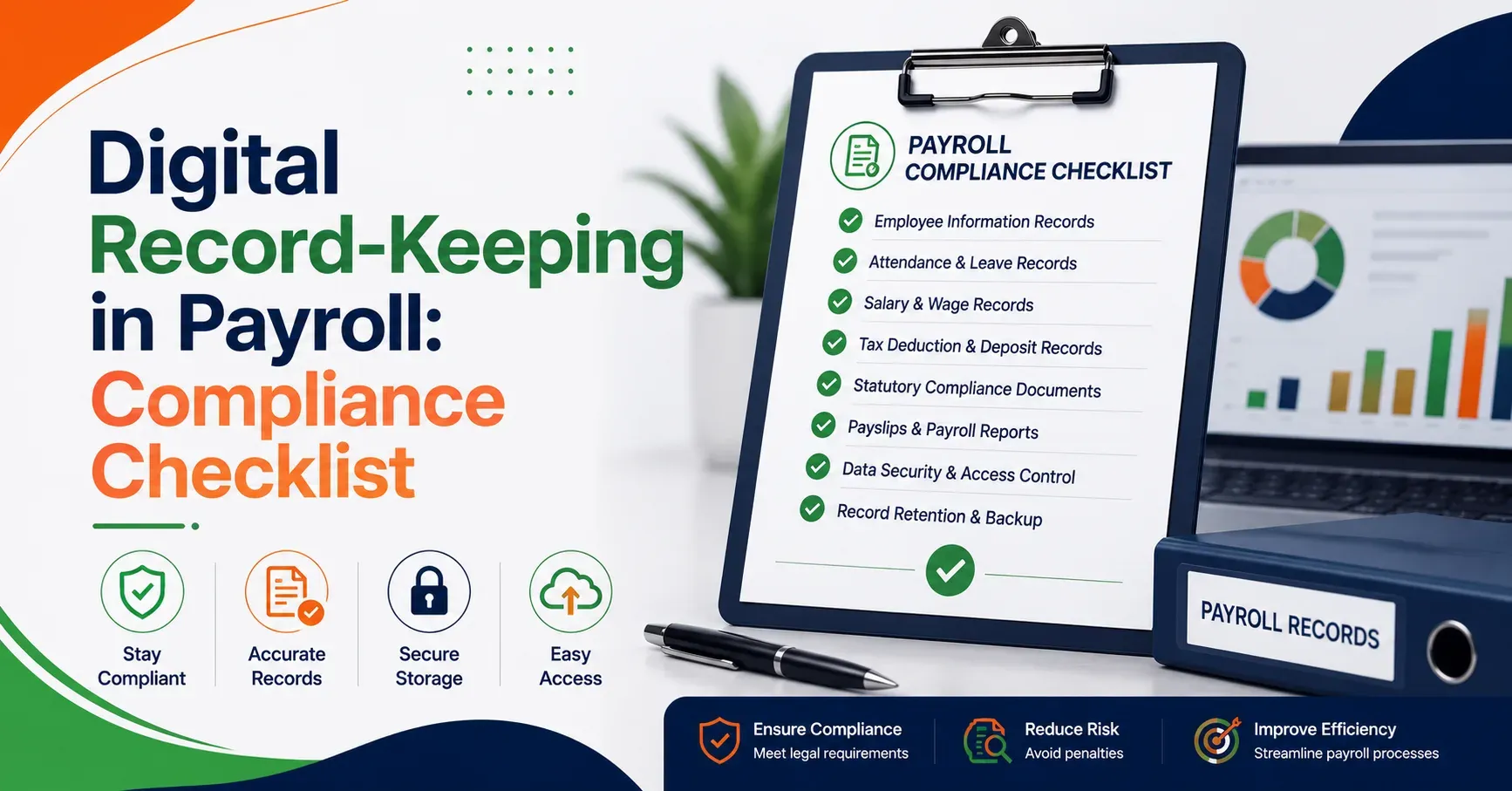
Use this monthly checklist before payroll closure.
Monthly Payroll Records Checklist
- Employee master data is updated before payroll processing starts.
- New joinees and exits are added with approved effective dates.
- Attendance, leave, overtime, and loss of pay are verified.
- Salary revisions and arrears have approval history attached.
- Payslips are generated and stored for every paid employee.
- Bank advice, UTR, and salary payment proof are saved.
- PF, ESI, PT, LWF, and TDS calculations are reviewed.
- Challans, returns, and acknowledgement files are archived.
- Payroll reports are saved after final salary processing.
- All payroll changes are traceable with proper audit logs.
For a broader review, teams can also use this Payroll Compliance Checklist for Indian Employers in 2026 to check payroll tax, PF, ESI, TDS, wages, records, and filing readiness.
Quarterly and Annual Payroll Records Checklist
Payroll records should also be reviewed beyond the monthly cycle.
HR and finance teams should check:
- TDS filing records and correction statements.
- Form 16-related salary and deduction data.
- Bonus eligibility and payment records.
- Gratuity and leave encashment records.
- Minimum wage and salary structure updates.
- Payroll audit reports and action notes.
- Employee declarations and tax proof documents.
- Year-end payroll reconciliation files.
This is whereBharat Payroll’s compliance reporting solution can help teams organize statutory reports, payroll documentation, and compliance workflows in a more structured way.
How Long Should Payroll Documents Be Retained?
Payroll document retention depends on the law, record type, state rules, company policy, and industry requirements. However, short retention periods are risky because payroll queries can come much later.
For wage-related records under the Code on Wages framework, the Code on Wages (Central) Rules, 2026 refer to preserving prescribed registers for five years after the last entry.
A practical payroll document retention policy should define:
- Which payroll records must be retained.
- Minimum statutory retention period.
- Internal retention period.
- Record owner.
- Storage location.
- Access rights.
- Archive process.
- Deletion or disposal process.
This matters even more because payroll records include personal employee data. The Digital Personal Data Protection Rules, 2025 make data security, purpose limitation, accuracy, storage limitation, and accountability important for businesses handling digital personal data.
Payroll record keeping compliance should therefore balance two things: keeping required records long enough and protecting employee data properly.
How Can Digital Payroll Records Help During Payroll Inspection?
Payroll inspections become stressful when proof is scattered.
Even if the company has processed payroll correctly, missing records can make the team look unprepared. That is why audit-ready payroll is not just about calculations. It is about evidence.
During payroll inspection, HR may need to produce:
- Employee register
- Attendance register
- Wage register
- Overtime register
- Deduction records
- Payslips
- Salary payment proof
- PF and ESI records
- TDS records
- Bonus and gratuity records
- Exit settlement records
- Payroll approval history
The Compliance Handbook for Employers under the Four Labour Codes also highlights the need to maintain registers, keep them updated, preserve records, and issue wage slips.
The real benefit of digital records is speed. HR should be able to pull the right record without depending on one person’s laptop, old email, or month-end folder.
Common Payroll Record-Keeping Mistakes to Avoid
Many businesses do not struggle because they ignore payroll compliance. They struggle because records are incomplete, inconsistent, or hard to prove.
Common mistakes include:
- Keeping salary revisions only in email threads.
- Processing payroll before attendance is locked.
- Storing payslips without calculation backup.
- Saving PF, ESI, and TDS files in separate folders.
- Not keeping approval proof for payroll changes.
- Not mapping exits with FnF settlement records.
- Not tracking who edited employee payroll data.
- Not maintaining a document retention policy.
- Sharing payroll files without access control.
- Not preparing records before audit or inspection.
These gaps may seem small during normal operations. They become serious during audits, payroll inspection, employee disputes, or tax reviews.
How Bharat Payroll Helps Maintain Audit-Ready Payroll Records
Bharat Payroll helps HR and finance teams bring employee records, salary inputs, attendance data, payroll processing, statutory reports, and compliance documentation into one connected workflow.
Instead of depending on scattered spreadsheets and manual folders, teams can manage payroll with better control over records, calculations, approvals, and reports.
With Bharat Payroll, businesses can:
- Maintain employee salary and statutory details in one place.
- Connect attendance, leave, and payroll inputs before salary closure.
- Generate payslips, payroll reports, and statutory summaries faster.
- Track payroll changes with cleaner review and approval records.
- Keep electronic payroll records ready for audits and inspections.
- Reduce manual dependency during monthly payroll processing.
For companies reviewing new labour code changes, salary restructuring under the 50% Basic Salary Rule, and payroll compliance workflows, Bharat Payroll helps move record keeping from reactive searching to planned compliance.
Payroll Record Keeping Compliance Checklist for 2026
Use this final checklist before every payroll cycle is closed.
Employee Data Checklist
- Employee name, PAN, Aadhaar, bank, UAN, and ESI details are updated.
- Joining, confirmation, department, location, and reporting details are correct.
- Salary structure and effective dates are approved and recorded.
- Employee documents are stored with role-based access control.
- Personal employee data is protected under internal data security rules.
Payroll Processing Checklist
- Attendance and leave inputs are locked before payroll processing.
- Overtime, arrears, incentives, and deductions are reviewed.
- Salary calculations match approved structures and payroll rules.
- Payslips are generated and archived for each employee.
- Salary payment proof is saved after bank processing.
- Payroll reports are stored after final approval.
Statutory Records Checklist
- PF, ESI, PT, LWF, and TDS are calculated correctly.
- Challans, filings, and acknowledgement records are saved.
- Wage register, attendance register, and deduction records are updated.
- Statutory reports are available for audit or inspection.
- Compliance owners know where every payroll record is stored.
Data Security Checklist
- Payroll access is limited to authorized users.
- Sensitive employee data is not shared through open files.
- Payroll edits are traceable with date, user, and reason.
- Old records follow a clear retention and deletion policy.
- Digital HR records are backed up securely.
Ready to Make Payroll Records Audit-Ready?
Manual payroll folders may work for a small team. They become risky when employee count, locations, salary changes, statutory filings, and inspection requirements grow.
Bharat Payroll helps businesses manage digital payroll records, statutory reports, employee data, payroll workflows, and compliance documentation with better accuracy and visibility.
Make Your Payroll Records Audit-Ready in 2026
Keep employee records, payslips, statutory data, and compliance documents organized in one place with Bharat Payroll.
FAQs
1. What are digital payroll records?
Digital payroll records are electronic records of employee salary, attendance, deductions, payslips, statutory contributions, tax details, payroll approvals, and compliance reports. They help HR teams retrieve proof quickly during audits, inspections, and employee queries.
2. Is electronic payroll record keeping allowed in India?
Yes. The Code on Wages (Central) Rules, 2026 allow prescribed payroll registers to be maintained electronically or in physical form. Employers should still confirm the exact format applicable to their establishment, state, and industry.
3. What payroll records should be audit-ready?
Audit-ready payroll should include employee master data, attendance records, wage registers, payslips, salary payment proof, PF, ESI, TDS, bonus, overtime, deductions, approvals, and exit settlement records.
4. How long should payroll records be kept?
Retention depends on the law and record type. For prescribed wage-related registers, the Code on Wages (Central) Rules, 2026 refer to preserving records for five years after the last entry. Companies should also follow applicable tax, social security, state, and internal retention policies.
5. How does Bharat Payroll support payroll compliance?
Bharat Payroll helps businesses connect employee records, payroll processing, attendance inputs, statutory calculations, payslips, reports, and approval records so HR teams can maintain cleaner payroll documentation.