
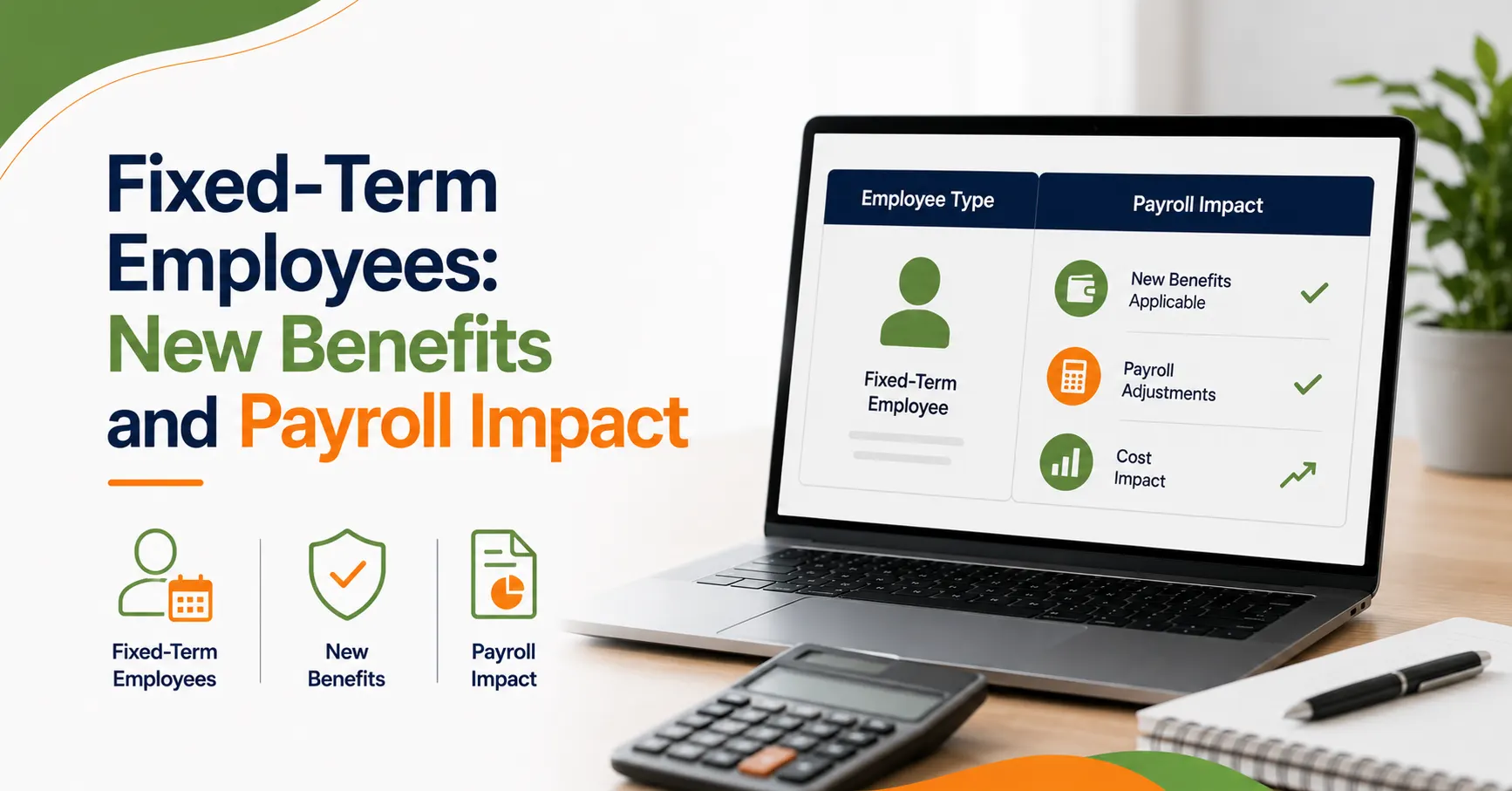
Fixed term employee gratuity is now a serious payroll planning issue for Indian employers.
Companies that hire project-based, seasonal, contractual, or temporary staff can no longer treat fixed-term employment as a simple short-term hiring arrangement. The payroll impact now reaches gratuity, benefits, wage parity, documentation, and exit processing.
For HR and finance teams, the real question is not whether fixed-term hiring is useful. It is whether the payroll system is ready to handle it correctly.
What Is Fixed-Term Employment?
Fixed-term employment means hiring a worker through a written employment contract for a specific period. The contract has a clear start date, end date, role, wage structure, and employment terms.
Under the Industrial Relations Code, fixed-term employment is defined as engagement through a written contract for a fixed period. The Code also states that hours of work, wages, allowances, and other benefits should not be less than those of a permanent worker doing the same or similar work.
That means employers must treat fixed-term employees as a structured workforce category, not as informal temporary help.
A fixed-term employee may be hired for:
- Project-based work with a defined completion timeline
- Seasonal demand in retail, logistics, hospitality, or manufacturing
- Replacement staffing during maternity leave or long absence
- Contract-based expansion roles in growing businesses
- Temporary staffing needs where the role is still business-critical
The key point is simple. If the role is fixed-term, the contract and payroll setup must clearly prove it.
Are Fixed-Term Employees Eligible for Gratuity After One Year?
Yes. A fixed-term employee becomes eligible for gratuity if they render service under the contract for one year. The Industrial Relations Code specifically provides gratuity eligibility for fixed-term employees after one year of service.
This is where many HR teams need to update their old assumptions.
For regular permanent employees, gratuity is generally linked to five years of continuous service. But fixed-term employment has a different treatment under the new labour framework. The Code on Social Security also provides that employees on fixed-term employment should receive gratuity on a pro-rata basis.
The Ministry of Labour FAQ further clarifies that gratuity calculation applies from 21.11.2025, the implementation date of the Codes, and that an FTE is eligible for gratuity if they render service under the contract for one year from the contract start date.
For payroll teams, this means every fixed-term contract must be tracked from day one.
Why Fixed-Term Employee Gratuity Changes Payroll Planning
Fixed term employee gratuity changes how HR and finance teams budget for short-term staffing.
Earlier, many businesses treated temporary staffing costs as direct salary cost only. Now, if the worker qualifies as a fixed-term employee and completes the required period, gratuity becomes part of the payroll liability.
That affects:
- CTC planning for fixed-term roles
- Monthly gratuity provisioning
- Contract renewal decisions
- Exit settlement workflows
- Payroll reports and finance forecasting
- Employee benefit parity checks
This is especially important for companies that hire fixed-term workers in batches. A few one-year contracts may not create pressure. But 100 or 500 fixed-term workers across locations can create a visible gratuity liability if payroll is not planned correctly.
For salary structure clarity, HR teams should also review payroll components in India before creating fixed-term offer letters.
What Benefits Should Fixed-Term Employees Receive?
Fixed-term employees should not be placed into a weaker benefits category simply because their contract has an end date.
The Industrial Relations Code states that fixed-term workers should receive statutory benefits available to permanent workers proportionately according to their service period, even when their employment period does not reach the usual qualifying period required under the statute.
Here is how HR should look at the benefit structure:
| Payroll Area | What HR Should Check | Why It Matters |
| Wages and allowances | Match with similar permanent roles | Avoids wage parity disputes |
| Gratuity | Track one-year eligibility for FTEs | Prevents missed statutory payout |
| PF and ESI | Apply based on eligibility rules | Keeps statutory deductions correct |
| Leave and attendance | Define rules in the contract | Supports accurate final settlement |
| Bonus or incentives | Clarify if pro-rated or excluded | Avoids exit-stage disagreement |
| Exit payout | Include unpaid wages, leave, and gratuity | Ensures clean contract closure |
This table should become part of the HR checklist before issuing any fixed-term contract.
How Does Fixed-Term Employment Affect CTC?
Fixed-term employment changes CTC because the employer must look beyond monthly salary.
A proper fixed-term CTC structure may include salary, allowances, statutory contributions, bonus eligibility, paid leave, and gratuity provisioning if the contract period reaches the qualifying threshold.
The mistake many companies make is issuing a simple monthly salary contract without mapping the full cost. That may look easier during hiring, but it creates confusion during exit.
A cleaner approach is to define:
- Monthly gross salary
- Basic wage and allowance split
- Employer statutory contributions
- Leave eligibility and encashment rules
- Gratuity treatment if the employee completes one year
- Any project incentive, bonus, or completion payout
This helps both sides understand the real value of the employment arrangement.
For deeper gratuity and bonus handling, link this article with Bharat Payroll’s guide on payroll software for gratuity and bonus management.
Where Do Payroll Teams Usually Go Wrong?
Most fixed-term payroll errors happen because HR treats the employee correctly during hiring, but payroll does not track the contract correctly after onboarding.
Common mistakes include:
- Contract end dates are stored in documents, not the HRMS
- Employee category is marked as temporary instead of fixed-term
- Gratuity eligibility is checked manually only during exit
- Renewed contracts are not connected to previous service history
- Benefits are not mapped proportionately in payroll
- Finance does not provision for gratuity liability in advance
- Exit settlement is delayed because contract data is incomplete
These are not small administrative issues. They can lead to underpayment, employee disputes, compliance gaps, and finance-side surprises.
This is why HR and payroll integration matters. Employee category, contract dates, attendance, leave, salary structure, and exit settlement should work from one connected record. Read more on payroll and HRMS integration.
What Should a Fixed-Term Contract Include for Payroll Accuracy?
A fixed-term contract should be written in a way payroll can actually process.
At minimum, it should include:
- Contract start date and end date
- Job role, department, and work location
- Salary structure with basic wage and allowances
- Working hours, leave rules, and holiday applicability
- PF, ESI, tax, and other statutory deduction treatment
- Gratuity eligibility rule for fixed-term employment
- Bonus, incentive, or project completion payout terms
- Notice period or early termination terms
- Renewal, extension, or non-renewal conditions
- Exit settlement and document handover process
The goal is not to make the contract longer. The goal is to make it payroll-ready.
When contract terms are vague, payroll teams are forced to interpret policy at the worst possible time, usually when the employee exits and expects settlement.
How Should HR Manage Fixed-Term Employee Exit?
Fixed-term employee exit should not be treated like an ad hoc offboarding case.
When the contract expires, payroll must check pending salary, leave balance, reimbursements, deductions, gratuity eligibility, statutory records, and final settlement documentation.
The workflow should look like this:
- Confirm the contract end date in HRMS
- Freeze attendance and leave records
- Check whether the employee has completed one year
- Validate gratuity eligibility and pro-rata calculation
- Review pending salary, bonus, and reimbursements
- Apply deductions, if any, with documentation
- Generate final settlement statement
- Release payout through the payroll workflow
- Store exit records for compliance review
Manual spreadsheets make this harder because the payroll team has to chase HR, admin, finance, and reporting data separately.
A connected system helps HR close the loop without repeated follow-ups.
Mid-blog CTA: Managing fixed-term contracts across teams or locations? Book a Bharat Payroll demo to see how employee records, benefits, payroll, and exits can stay connected.
How Bharat Payroll Helps Manage Fixed-Term Employee Benefits
Bharat Payroll helps businesses manage fixed-term employee payroll with better structure, visibility, and compliance control.
HR teams can maintain employee records, contract details, salary structures, attendance, leave, statutory deductions, and payroll reports in one place. This reduces the risk of missing key details like contract end dates, gratuity eligibility, and benefit treatment.
For fixed-term employees, Bharat Payroll supports:
- Centralized employee records and contract data
- Salary structure setup based on employee category
- Attendance and leave integration for payroll accuracy
- Statutory deduction handling for eligible employees
- Payroll reports for HR, finance, and compliance teams
- Exit workflow support for final settlement processing
- Better visibility into employee benefits and payroll costs
This is especially useful for companies with project teams, seasonal staff, distributed branches, or high-volume hiring cycles.
To explore the product fit, visit Bharat Payroll’s payroll software page.
What Should Employers Do Before Hiring Fixed-Term Employees in 2026?
Before hiring fixed-term employees, HR should update its contract templates, payroll rules, CTC planning, and exit workflows.
A practical checklist:
- Classify fixed-term employees separately in HRMS
- Use written contracts with clear start and end dates
- Map fixed-term benefits against permanent-role benefits
- Configure gratuity eligibility tracking from day one
- Create payroll reports for upcoming contract expiries
- Review CTC impact before issuing bulk fixed-term offers
- Align HR, finance, and payroll on provisioning rules
- Keep audit-ready records for every contract cycle
The biggest shift is mindset. Fixed-term employment is flexible, but it is not casual. It needs the same discipline as permanent employment, with an added focus on contract dates and pro-rata benefits.
Final Thoughts
Fixed-term employment gives Indian businesses hiring flexibility, but it also brings clear payroll responsibilities.
Fixed term employee gratuity, benefit parity, statutory deductions, contract tracking, and exit settlement must now be handled with accuracy. Companies that still manage temporary staff through spreadsheets will struggle as contract volumes grow.
Bharat Payroll helps HR and finance teams bring fixed-term employee records, salary structures, benefits, attendance, and payroll workflows into one connected system.
Avoid Payroll Errors in Fixed-Term Employment
Get complete visibility into contracts, benefits, and gratuity with Bharat Payroll.
FAQs
1. What is fixed-term employment?
Fixed-term employment is a written employment arrangement where a worker is hired for a specific period. The contract includes the role, salary terms, start date, end date, and employment conditions.
2. Are fixed-term employees eligible for gratuity?
Yes. Fixed-term employees are eligible for gratuity if they render service under the contract for one year. Payroll teams should track this from the contract start date.
3. Is fixed term employee gratuity different from a permanent employee’s gratuity?
Yes. Permanent employee gratuity is generally linked to five years of continuous service, while fixed-term employees can become eligible after one year under the current labour framework.
4. What benefits should fixed-term employees receive?
Fixed-term employees should receive wages, allowances, and statutory benefits proportionately, based on their service period and eligibility rules.
5. How can payroll software help with fixed-term employee compliance?
Payroll software can track contract dates, salary structures, statutory deductions, leave, attendance, gratuity eligibility, and final settlement records in one connected system.