
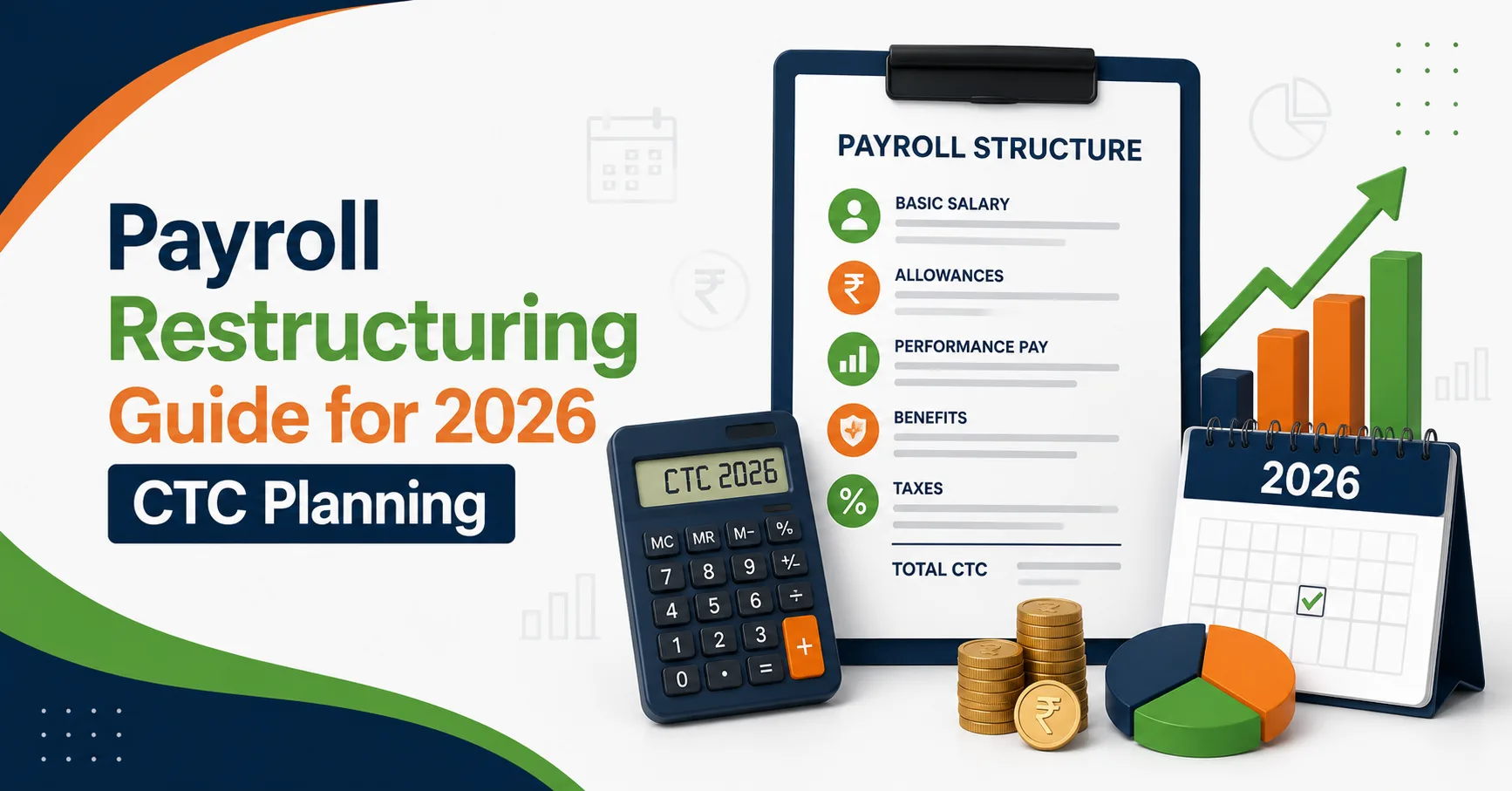
The salary breakup that worked last year could increase payroll costs or reduce employee take-home pay in 2026.
Payroll restructuring 2026 is therefore not a routine increment exercise. The revised wage definition changes how employers must review allowances, statutory calculations, gratuity provisions, and total compensation costs.
HR, payroll, and finance teams now need a CTC structure that protects compliance, controls employer costs, and avoids unpleasant surprises for employees.
Planning a company-wide CTC revision? Explore Bharat Payroll’s HRMS and payroll software to manage salary structures, statutory calculations, employee records, and payroll reports through one system.
What Does Payroll Restructuring Mean in 2026?
Payroll restructuring means reviewing and revising the components within an employee’s compensation package without treating the annual CTC figure as the only consideration.
A restructuring exercise may change the allocation between:
- Basic pay
- Dearness allowance
- House rent allowance
- Special allowance
- Variable pay
- Employer contributions
- Gratuity provisions
- Reimbursements
- Insurance and other benefits
The objective is not necessarily to increase or reduce total CTC. It is to create a salary breakup that reflects the revised wage definition, statutory requirements, business costs, and employee impact.
Companies should therefore avoid making one percentage change across every salary grade. A new CTC structure must account for employee category, current compensation, statutory coverage, location, benefit policy, and contractual terms.
Why Must Companies Review Their CTC Structures in 2026?
Companies must review their CTC structures because the revised definition of wages came into effect on 21 November 2025.
Under the Code on Wages, wages include basic pay, dearness allowance, and retaining allowance, where applicable. When specified excluded components exceed 50% of remuneration, the excess is added back to wages for statutory purposes.
The Ministry of Labour and Employment has also clarified that the revised wage definition applies to gratuity calculations from 21 November 2025.
This makes 2026 the first full compensation planning cycle in which employers must consider the revised framework while preparing:
- Annual increments
- Promotion revisions
- New-hire salary offers
- Payroll budgets
- Gratuity provisions
- Statutory contribution estimates
- Employee compensation policies
A company that carries forward an allowance-heavy salary structure without assessment may understate its wage base or miscalculate future payroll liabilities.
Does the Wage Code Require Basic Salary to Be 50% of CTC?
No. The law does not simply state that every employee’s basic salary must equal 50% of CTC.
The rule is better understood as an allowance add-back test.
If specified excluded allowances and benefits exceed 50% of remuneration, the amount above that limit is added back to wages for statutory calculations. This may result in wages becoming 50% or more of the relevant remuneration, but it is not the same as blindly fixing basic salary at 50% of the CTC shown in an offer letter.
Employers should also distinguish between CTC and remuneration. CTC may include employer-side costs, insurance, gratuity provisions, or benefits that require separate treatment under the statutory definition.
Before completing a CTC restructure, payroll teams should map every earning and benefit component instead of applying a flat formula.
For a detailed explanation, read the 50% Basic Salary Rule in India: 2026 Guide.
How Does the Wage Code Affect CTC and Salary Breakups?
The Wage Code impact on CTC depends on how much of the current compensation package sits in basic pay, allowances, variable components, reimbursements, and employer-paid benefits.
The Ministry’s official illustration shows how excess allowances may be added back to the statutory wage base.
| Component in the Official Illustration | Monthly Amount |
| Total remuneration | ₹76,000 |
| Basic pay plus dearness allowance | ₹20,000 |
| Allowances | ₹40,000 |
| Other stated components | ₹16,000 |
| Maximum allowance considered at 50% | ₹38,000 |
| Excess over the 50% threshold | ₹2,000 |
| Revised wage amount for statutory purposes | ₹22,000 |
This example shows why payroll restructuring should begin with component classification.
A company should not assume that an existing basic salary percentage automatically determines compliance. The amount treated as wages can change after the allowance test is applied.
The revised wage base may require employers to reassess calculations connected with gratuity and other applicable statutory benefits. The effect on PF, ESI, bonus, overtime, and similar payroll items will depend on employee coverage, statutory thresholds, applicable provisions, and the company’s existing practices.
Which Salary Components Should HR Teams Review?
HR teams should begin with components that form a significant part of monthly gross salary or annual CTC.
1. Basic pay and dearness allowance
Basic pay is a core wage component. Any proposed change must be tested against employee deductions, employer costs, gratuity provisions, and take-home salary.
2. House rent allowance
HRA may continue to form part of a salary structure, but its tax treatment and wage classification should not be confused. Income tax exemptions and labour-law wage calculations serve different purposes.
3. Special allowance
Special allowance is often used as the balancing figure in a salary breakup. A large special allowance can affect the allowance add-back calculation and should be reviewed carefully.
4. Variable and performance-linked pay
The Ministry has clarified that annual performance-based incentives do not form part of wages for computation under the Labour Codes. However, employers should clearly distinguish genuine performance-linked payments from fixed monthly earnings labelled as variable pay.
5. Reimbursements
Expense reimbursements should be supported by a clear policy, approval workflow, and documentation. Simply renaming a fixed allowance as a reimbursement does not create a reliable payroll structure.
6. Employer contributions and benefits
Employer PF, gratuity provisions, insurance, retirement benefits, and other company-paid items should be separately mapped before the 50% calculation is applied.
A detailed component-level review is available in the Guide to Payroll Components in India.
Will Payroll Restructuring Reduce Employees’ Take-Home Salary?
Payroll restructuring can reduce take-home salary, but it does not automatically do so in every case.
Take-home pay may change when a revised wage base results in higher employee-side deductions. The effect depends on existing contribution practices, statutory ceilings, employee eligibility, tax declarations, and the final compensation design.
For example, increasing basic pay while keeping annual CTC unchanged may increase certain deductions or employer provisions. The amount available for cash allowances may consequently reduce.
However, employees may receive stronger long-term benefits through higher retirement-linked or gratuity-related provisions.
HR teams should therefore prepare three calculations before approving a new CTC structure:
- Current monthly take-home salary
- Revised monthly take-home salary
- Revised annual employer cost
This employee-level simulation is more reliable than communicating that “basic pay is increasing” without showing the full impact.
Do not restructure salaries using a single spreadsheet formula. Book a Bharat Payroll demo to review how salary configurations, deductions, reports, and payroll records can be managed centrally.
How Should Employers Plan Compensation Restructuring?
A structured compensation restructuring project should move through five stages.
1. Audit the current salary breakup
List every earning, deduction, reimbursement, employer contribution, and annual benefit. Identify components used inconsistently across employee grades or business entities.
2. Classify components correctly
Separate wage components, excluded components, variable pay, reimbursements, and employer-side costs. Review employment contracts and payroll policies alongside the component master.
3. Build multiple cost scenarios
Do not finalise the first compliant structure. Model at least three scenarios:
- Compliance-first structure
- Take-home-protection structure
- Balanced employer-cost structure
Each scenario should show the impact on gross salary, net pay, statutory deductions, gratuity provision, and total employer cost.
4. Test employee groups separately
Senior employees, entry-level staff, fixed-term employees, sales teams, factory employees, and employees covered by statutory thresholds may not experience the same result.
Testing only one sample salary can hide problems across the wider workforce.
5. Obtain payroll, finance, and legal approval
HR may design the compensation strategy, but finance must validate cost implications and payroll must confirm calculation feasibility.
Legal or compliance specialists should review interpretation-sensitive decisions before revised structures are issued.
What Should a 2026 CTC Planning Model Include?
A 2026 salary planning model should include more than revised salary percentages.
At minimum, the working file or payroll system should capture:
- Employee category and location
- Existing annual CTC
- Existing monthly gross salary
- Current salary components
- Proposed salary components
- Wage amount before the allowance test
- Excess allowance added back, where applicable
- Revised statutory wage base
- Employee deduction impact
- Employer contribution impact
- Gratuity provision impact
- Revised take-home salary
- Increment amount
- Final employer cost
Finance should also prepare a workforce-level summary showing the annual increase in payroll cost by department, entity, location, and salary band.
This turns compensation planning into a measurable business decision rather than a component-editing exercise.
What Mistakes Should Companies Avoid During a CTC Restructure?
The most common mistake is treating payroll restructuring 2026 as a universal 50% basic-pay exercise.
Other risks include:
- Applying the rule directly to CTC without classifying remuneration
- Changing salary components without employee-level simulations
- Ignoring gratuity and long-term liability changes
- Treating fixed monthly pay as a reimbursement
- Reducing take-home salary without advance communication
- Using different component definitions across entities
- Updating payslips but not employment letters or HR policies
- Keeping old salary templates active for new hires
- Failing to reconcile payroll reports after implementation
A post-restructuring payroll audit should compare revised salary masters, payslips, payroll registers, accounting entries, and statutory reports.
Companies can use this Payroll Compliance Audit Checklist for Indian Businesses to organise the wider review.
How Should Employers Communicate the New CTC Structure?
Employees should receive a clear explanation of what is changing, why it is changing, and how it affects them.
The communication should show:
- Previous annual CTC
- Revised annual CTC
- Previous salary breakup
- Revised salary breakup
- Monthly gross salary
- Expected deductions
- Estimated take-home salary
- Employer contributions
- Effective date
- Contact point for questions
Avoid presenting higher basic pay as an automatic salary increase when total CTC remains unchanged.
Employees are more likely to accept compensation restructuring when they can see both the immediate take-home impact and the long-term benefit implications.
HR should also provide managers with a standard explanation so employees do not receive conflicting information across departments.
How Can Payroll Software Support CTC Restructuring?
Payroll software can make restructuring easier by keeping salary components, employee records, deductions, attendance-linked inputs, payslips, and reports within a controlled process.
It can help organisations:
- Configure revised salary templates
- Apply structures by employee group
- Calculate gross-to-net salary
- Compare old and new payroll results
- Maintain revision histories
- Generate updated payslips
- Review employer payroll cost
- Produce payroll and statutory reports
- Reduce manual formula errors
Bharat Payroll provides an integrated HRMS and payroll environment for salary processing, attendance, compliance records, reports, and employee management.
Payroll software does not replace legal interpretation. It helps apply an approved compensation structure consistently after HR, finance, payroll, and compliance teams have agreed on the rules.
Payroll Restructuring Checklist for 2026
Before releasing revised compensation letters, confirm that the company has completed the following:
- Audited every active salary component
- Mapped CTC separately from statutory remuneration
- Applied the allowance add-back test
- Reviewed employee take-home impact
- Calculated revised employer cost
- Assessed gratuity and statutory implications
- Tested different employee categories
- Updated salary templates
- Revised payroll policies and approval workflows
- Prepared employee communication
- Completed a parallel payroll run
- Reconciled payslips and payroll reports
- Obtained final compliance approval
Final Thoughts
Payroll restructuring 2026 requires more than moving values between basic pay and allowances.
A dependable HR compensation strategy should align the revised wage definition with take-home salary, statutory costs, employment terms, payroll systems, and workforce communication.
Companies that complete the exercise before their next increment or hiring cycle will be better prepared to control costs and avoid repeated salary corrections.
Disclaimer: This article provides general payroll information and should not be treated as legal, tax, or financial advice. Employers should obtain professional guidance based on their workforce, jurisdiction, and applicable statutory provisions.
Simplify Your Payroll Restructuring for 2026
Plan compliant salary structures, automate calculations, and avoid payroll errors with Bharat Payroll.
Frequently Asked Questions
1. What is payroll restructuring in 2026?
Payroll restructuring in 2026 means reviewing salary components under the revised wage definition while balancing statutory compliance, take-home salary, employer cost, and compensation policies.
2. Is the basic salary required to be exactly 50% of CTC?
No. The rule concerns excluded allowances exceeding 50% of remuneration. Any excess may be added back to wages for statutory calculations.
3. Can payroll restructuring reduce take-home salary?
Yes. Take-home salary may reduce when revised wage calculations increase applicable employee deductions. The effect depends on salary structure, coverage, thresholds, and contribution practices.
4. Does payroll restructuring require changing total CTC?
Not necessarily. Employers may restructure components within the same CTC, increase the total package, or absorb additional statutory costs based on their compensation strategy.
5. When should employers complete CTC restructuring?
Employers should complete it before annual increments, promotion revisions, new hiring cycles, or payroll-system changes. A parallel payroll run should be conducted before implementation.
6. How can Bharat Payroll support CTC restructuring in 2026?
Bharat Payroll helps companies configure revised salary structures, apply them by employee group, calculate gross-to-net pay, and maintain payroll records through one system.
7. Can Bharat Payroll help compare existing and revised salary structures?
Yes. Bharat Payroll can help teams review salary components, deductions, employer costs, payroll reports, and employee records while implementing an approved compensation structure.