

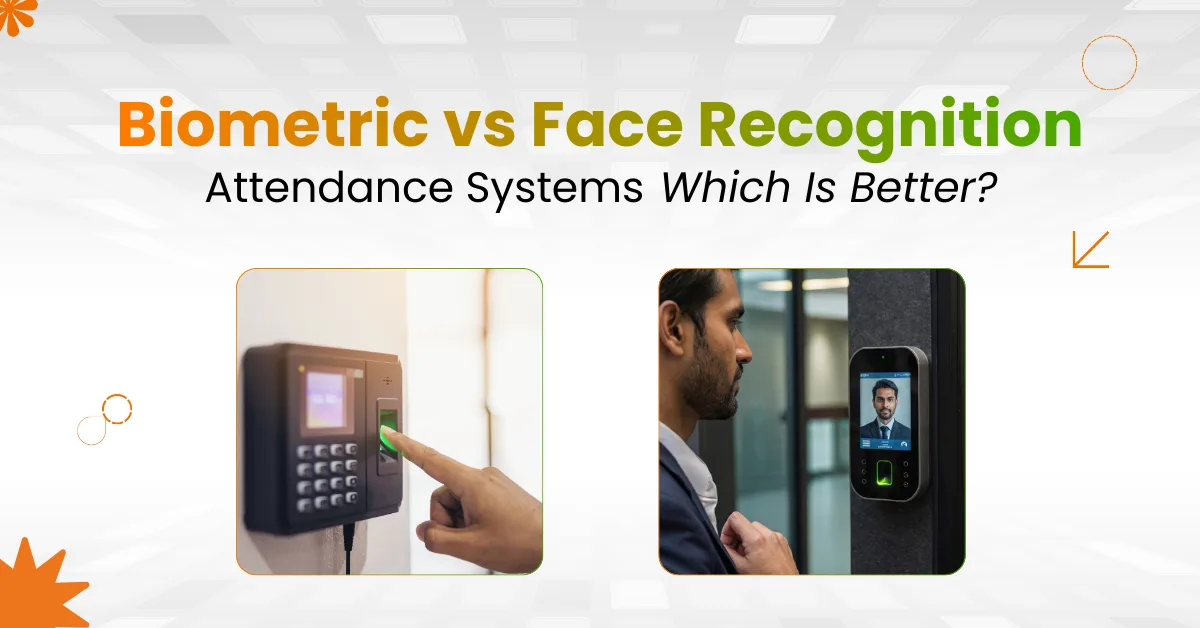
Is Your Attendance System Causing Payroll Errors?
Late salary disputes. Manual payroll corrections.
Compliance confusion. Buddy punching.
Incorrect overtime payouts.
For many Indian businesses, attendance errors quietly disrupt payroll accuracy, increase compliance risks, and damage employee trust.
What looks like a small attendance issue often becomes a payroll problem — and payroll problems quickly become management headaches.
Choosing the wrong attendance system can cost far more than the device itself. It can cost time, money, compliance stability, and credibility.
Introduction
Employee attendance directly impacts salary processing, statutory compliance, audits, and employee satisfaction in Indian workplaces.
At Bharat Payroll, we work with growing businesses that want accurate attendance data fully aligned with payroll automation. One question consistently arises during these discussions:
Should organizations continue using biometric fingerprint systems, or is it time to adopt facial recognition attendance systems?
This decision is more critical than ever.
Hybrid work models, larger workforce sizes, multi-location operations, and rising security expectations are forcing businesses to rethink traditional attendance tracking.
In this guide, we compare biometric fingerprint systems and face recognition attendance systems clearly — so you can choose a solution that protects payroll accuracy, compliance, and long-term operational efficiency.
Why Attendance Systems Matter for Indian Businesses
In India, attendance data connects directly to salary processing, statutory compliance, and audits. Even small errors in attendance tracking can lead to payroll disputes and employee dissatisfaction.
Manual registers and card-based systems no longer scale well. They allow buddy punching and data manipulation. This creates compliance risks and weakens workplace security.
Modern attendance systems solve these issues by using biometric authentication and recognition technology. They ensure that only authorized personnel can mark attendance while maintaining accurate attendance management records.
The Hidden Cost of Inaccurate Attendance
Even a 2% attendance error can lead to:
Payroll disputes
Incorrect statutory deductions
Overtime miscalculations
Audit risks
Employee dissatisfaction
Attendance accuracy is not just operational.
It directly affects compliance and business credibility.
What Is a Biometric Attendance System?
A biometric attendance system uses biological traits to verify identity. These traits are unique and cannot be easily shared.
In Indian offices, fingerprint systems are the most commonly used biometric devices. They rely on fingerprint recognition to mark attendance accurately.
Common Biometric Technologies Used in India
- Fingerprint systems use fingerprint scanners for reliable identity verification
- Fingerprint biometrics store unique fingerprint data securely
- Other biometric systems include iris and palm recognition technologies
Biometric systems store biometric data and compare it during every attendance entry.
How Fingerprint Attendance Systems Work
Fingerprint attendance systems use fingerprint technology to verify identity. Employees place their fingers on a scanner to mark attendance.
The fingerprint scanner captures fingerprint data and compares it with stored data. If the match is successful, the system records attendance instantly.
Advantages of Fingerprint Systems
- Fingerprint systems offer proven reliability across Indian office environments
- Fingerprint recognition prevents duplicate attendance effectively
- Biometric devices are widely available and cost-effective
Limitations of Fingerprint Systems
- Fingerprint scanning requires physical contact with shared devices
- Fingerprint data accuracy reduces due to worn fingerprints
- The machine requires maintenance for consistent optimal performance
What Are Face Recognition Attendance Systems?
Face recognition attendance systems use facial recognition technologies instead of physical contact. They scan facial features using cameras and artificial intelligence.
Employees simply walk past a facial recognition device. The system verifies the person’s face automatically and records attendance.
This contactless process improves speed and hygiene, which is increasingly important in Indian workplaces.
How Face Recognition Attendance Systems Work
Face recognition attendance systems rely on facial recognition software and advanced algorithms. Cameras capture the person’s face in real time.
The system analyzes facial features and compares them with stored data. Once verified, attendance tracking happens instantly without physical interaction.
Key Benefits of Face Recognition Attendance
- Employees simply walk without stopping to mark attendance
- Face recognition attendance systems eliminate physical contact completely
- Recognition attendance improves speed during peak office hours
Biometric vs Face Recognition Attendance Systems: Key Differences
The core difference between these systems lies in how employees interact with them. This directly affects hygiene, speed, and user experience.
Fundamental Differences Explained
- Biometric systems require physical interaction during attendance marking
- Face recognition technology works without physical contact
- Fingerprint systems depend on fingerprint scanning accuracy
- Facial recognition systems rely on advanced algorithms
Accuracy Comparison in Indian Office Conditions
Indian workplaces often face dust, humidity, and heavy daily usage. These conditions impact attendance system performance.
Fingerprint systems perform well in clean environments but may struggle when fingerprints are worn or dirty. Environmental factors affect fingerprint scanning accuracy.
Face recognition attendance systems perform better in high-traffic offices. Advanced facial recognition algorithms adapt to lighting and facial changes over time.
Workplace Security and Access Control
Attendance systems also function as security systems in offices, factories, and educational institutions.
Security in Fingerprint Systems
- Fingerprint biometrics restrict access to authorized personnel only
- Traditional fingerprint systems offer basic enhanced security features
- Fingerprint recognition prevents casual misuse
Security in Face Recognition Systems
- Face recognition technology provides advanced security protection
- Facial recognition systems prevent buddy punching completely
- Enhanced security features support multi-factor authentication
Hygiene and Physical Contact Concerns
Hygiene is now a major concern in Indian offices with shared infrastructure.
Fingerprint systems require physical contact and frequent cleaning. Contact-based attendance systems increase hygiene risks in crowded environments.
Face recognition attendance systems eliminate physical interaction. This makes them ideal for modern offices, hospitals, and educational institutions.
Employee Experience and Daily Usage
Attendance systems must be easy for employees to use. Complex systems slow down entry and reduce adoption.
Fingerprint systems require correct finger placement. Errors increase during peak office hours.
Face recognition attendance systems provide seamless identification. Employees simply walk in, making attendance tracking smooth and fast.
Hardware, Maintenance, and Reliability
Hardware quality affects long-term reliability and costs.
Fingerprint scanners experience physical wear and tear. The machine requires maintenance and periodic replacement.
Facial recognition devices involve complex hardware but experience less physical damage. Software updates improve performance over time.
Cost Comparison for Indian Businesses
Cost is a key decision factor in India.
Fingerprint systems have lower upfront costs and are widely adopted. However, maintenance costs increase over time.
Face recognition attendance systems involve a higher upfront investment. They offer lower maintenance costs and better scalability for growing organizations.
Performance Across Different Indian Use Cases
Office Environment
- Face recognition performs well in modern indoor office spaces
- Fingerprint systems suit small offices with limited employees
Educational Institutions
- Face recognition attendance manages large student volumes efficiently
- Recognition attendance reduces entry congestion significantly
Remote and Hybrid Teams
- Face recognition supports remote access attendance tracking
- Fingerprint systems fail for remote workers
Comparison Table: Fingerprint vs Face Recognition Attendance
| Feature | Fingerprint Attendance Systems | Face Recognition Attendance Systems |
|---|---|---|
| Physical Contact | Required | Not required |
| Hygiene | Lower | High |
| Security | Moderate | Advanced |
| Speed | Slower | Faster |
| Maintenance | Higher | Lower |
| Remote Workers | Not suitable | Suitable |
When Fingerprint Attendance Systems Are Suitable
Fingerprint systems still work well in specific Indian business scenarios.
- Small offices with a limited workforce size
- Cost-sensitive organizations seeking proven reliability
- Fixed office environments with low daily traffic
When Face Recognition Attendance Systems Are Better
Face recognition attendance systems align with modern Indian workplaces.
- Large organizations with high employee movement
- Businesses prioritizing advanced security and hygiene
- Hybrid teams and remote workers
How to Decide: 4 Questions to Ask Before Choosing
How large is your workforce?
Do you support hybrid or remote employees?
Is hygiene and contactless access a priority?
Do you need integration with payroll software?
If your organization is scaling, managing multiple locations, or integrating payroll automation, facial recognition attendance systems typically provide better long-term value.
Real Scenario: Manufacturing Company in India
A 300-employee manufacturing firm shifted from fingerprint to face recognition.
Results within 3 months:
80% reduction in buddy punching
Faster entry during shift changes
Improved payroll accuracy
Reduced attendance disputes
Conclusion
Attendance systems are essential for payroll accuracy and compliance in Indian workplaces. Choosing the right technology impacts long-term efficiency and employee trust.
Fingerprint systems offer proven reliability and affordability. Face recognition attendance systems deliver advanced security, hygiene, and scalability.
At Bharat Payroll, we help Indian businesses adopt modern attendance management solutions that align with today’s workforce needs. If you are evaluating biometric vs face recognition attendance systems, choose a solution that supports growth, security, and operational clarity with Bharat Payroll.
Get a Free Attendance & Payroll Assessment
Not sure which system fits your business?
Frequently Asked Questions
1. Biometric vs face recognition attendance systems: Which is better?
Face recognition attendance systems are better for large Indian workplaces, hygiene, and advanced security. Fingerprint systems remain cost-effective for small offices. The right choice depends on workforce size, budget, and long-term attendance management needs.
2. Are face recognition attendance systems accurate in India?
Yes. Modern facial recognition systems use advanced algorithms and artificial intelligence. They adapt well to Indian office conditions, such as lighting variations and high foot traffic, delivering reliable attendance tracking when quality cameras are used.
3. Do biometric systems create privacy concerns?
Biometric systems store sensitive biometric data, including fingerprint data or facial features. Privacy concerns can be managed through encryption, access control, compliance policies, and transparent employee communication regarding data usage and storage.
4. Can face recognition attendance work for remote workers?
Yes. Face recognition attendance systems support remote access using mobile devices and face id technology. This makes them suitable for hybrid teams, remote workers, and distributed office environments across India.
5. Which attendance system is more cost-effective long term?
Fingerprint systems have lower upfront costs but higher maintenance expenses. Face recognition attendance systems require higher initial investment but offer lower maintenance, better scalability, and improved security, making them more cost-effective long term.