

Many employees in India see a high salary offer but receive a lower amount in their bank account. This difference creates confusion and affects financial planning. The gap exists because the cost to the company (CTC) is not the same as the take-home salary.
At Bharat Payroll, we help employers and employees understand how to calculate CTC vs. take-home salary in India, with examples that include tax deductions, provident fund contributions, and the impact of salary structure.
This guide explains everything clearly using simple words and real salary calculations.
What Is Cost to Company (CTC)?
Cost to the company CTC is the total amount an employer spends on an employee annually. It includes direct salary payments and indirect benefits provided by the company.
CTC does not represent the money an employee receives monthly.
What CTC Includes
- Basic salary paid as fixed compensation
- House rent allowance (HRA) for accommodation needs
- Dearness allowance linked to inflation changes
- Conveyance allowance for daily travel expenses
- Medical allowance to cover medical expenses
- Special allowance varies across the compensation structure
- Employer’s contribution to the employee provident fund
- Health insurance and retirement benefits scheme
- Other indirect benefits paid by the employer
CTC reflects the total compensation package offered by companies.
What Is Take-Home Salary?
Take-home salary is the net pay credited to the employee’s bank account after deductions. It is also called net salary or monthly take-home salary.
This is the amount employees use for expenses, savings, and investments.
Take-Home Salary Formula
Take-home pay = Gross salary − All deductions
Deductions include income tax, provident fund, and professional tax.
Difference Between CTC, Gross Salary, and Net Salary
These terms are often confused but mean different things.
| Term | Meaning |
|---|---|
| Cost to the company | The total amount the employer spends |
| Gross salary | Salary before tax deductions |
| Net salary | Salary after all deductions |
| Take-home salary | Amount credited to the bank account |
Correct salary calculations depend on understanding these differences.
Salary Structure in India Explained
Every Indian salary follows a defined salary structure. Each component affects tax and net pay.
Core Salary Components
- Basic pay forms the foundation of total salary
- House rent allowance supports rental accommodation
- Dearness allowance offsets inflation impact
- Conveyance allowance covers travel expenses
- Medical allowance supports healthcare costs
- Special allowance balances a fixed amount
- Other allowances depend on company policy
A well-planned structure improves tax benefits and compliance.
Direct and Indirect Benefits in CTC
CTC contains direct benefits and indirect benefits.
Direct Benefits
- Basic salary and fixed allowances
- Performance bonuses and incentives
Indirect Benefits
- Employer spends on epf contribution
- Health insurance premium payments
- Retirement benefits scheme contributions
Indirect benefits increase long-term value but reduce immediate cash flow.
Employee Provident Fund and Employer Contribution
Employee Provident Fund (EPF) is mandatory for most salaried employees.
Employer and employee contributions follow the employee provident fund contribution rules issued by the Employees’ Provident Fund Organisation.
EPF Contribution Rules
- Employee contributes twelve percent of basic pay
- Employer contributes twelve percent of basic pay
- Employer contribution includes pension allocation
EPF reduces the monthly take-home salary but builds retirement savings.
Income Tax and Salary Deductions in India
Taxes create the largest gap between CTC and net salary.
Common Deductions
- Income tax amount based on the tax regime
- Professional tax is deducted according to state rules
- Employee Provident Fund Contribution
- Deductions applicable under income tax act
These deductions reduce gross pay to net take-home salary.
Income tax deductions applicable under the Income Tax Act provisions determine how much taxable income is reduced before calculating the net take-home salary.
Old Tax Regime vs New Tax Regime
Choosing the right tax regime impacts net pay.
Old Tax Regime
- Allows income tax deductions
- Supports tax-saving investments
- Provides tax exemption on hra
- Suitable for structured financial planning
New Tax Regime
- Offers lower tax rates
- Allows fewer tax deductions
- Simplifies salary calculations
- Suitable for minimal exemptions
Employees should compare both regimes annually.
Example: How to Calculate CTC vs Take-Home Salary
Below is a simple annual salary example.
Salary Details
- Cost to company ctc: ₹6,00,000
- Basic salary: ₹2,40,000
- House rent allowance: ₹1,20,000
- Special allowance: ₹1,80,000
- Employer epf contribution: ₹36,000
- Health insurance: ₹24,000
Salary Calculation Table
| Component | Amount |
|---|---|
| Total salary package | ₹6,00,000 |
| Gross salary | ₹5,40,000 |
| Provident fund deduction | ₹28,800 |
| Professional tax | ₹2,400 |
| Income tax amount | ₹12,000 |
| Net take-home salary | ₹4,96,800 |
This clearly shows ctc cost to the company vs take home pay.
How Time Tracking Software Reduces Payroll Errors
Attendance errors directly impact salary calculations.
Benefits of Time Tracking Software
- Accurate work hours improve salary calculations
- Automated attendance reduces payroll errors
- Overtime calculations remain compliant
- Salary slip accuracy improves significantly
- Payroll processing becomes faster
Bharat Payroll integrates attendance with payroll seamlessly.
Why Salary Calculators Matter
A salary calculator helps employees understand real earnings.
Common Salary Calculators
- Salary calculator India for local taxation
- Ctc calculator for offer evaluation
- In hand salary calculator for budgeting
- Pay calculator for tax planning
- Salary calculator 10K – 100K ranges
Using calculators improves financial planning accuracy.
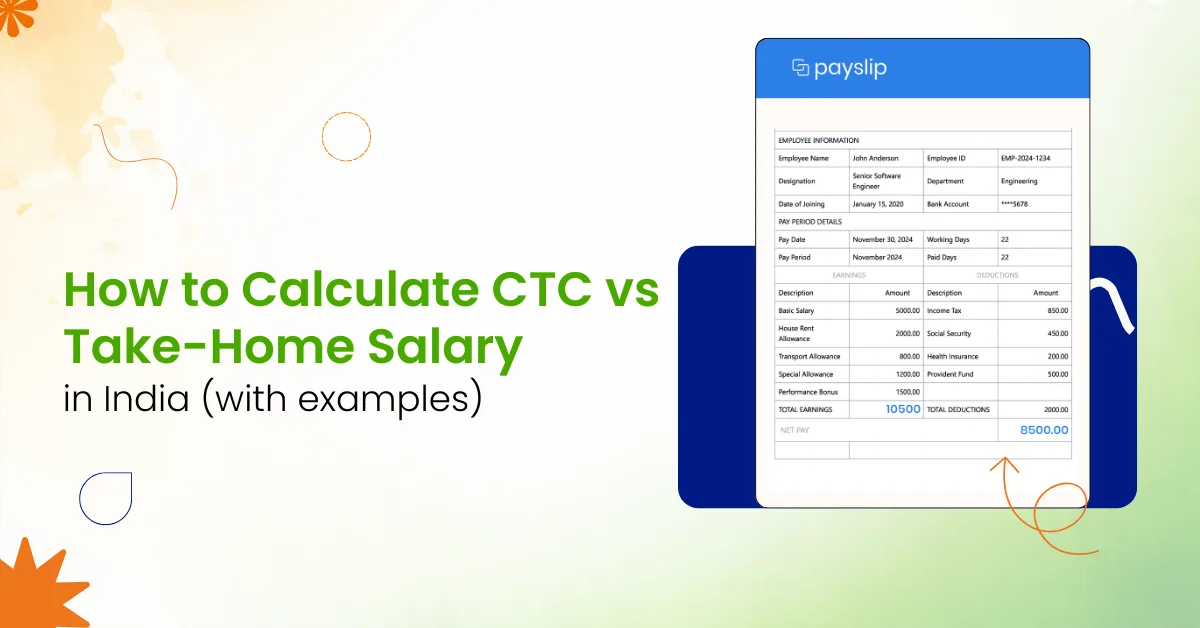
How Salary Slips Reflect CTC and Take-Home Salary
A salary slip is the official monthly document that shows how CTC converts into actual take-home pay. Many employees overlook salary slips, but they provide the clearest view of salary components, deductions, and net salary credited to the bank account.
What a Salary Slip Typically Shows
- Basic pay and fixed allowances are paid monthly
- House rent allowance HRA) is mentioned separately
- Special allowance and other allowances are listed clearly
- Employee Provident Fund Contribution Deduction
- Professional tax is deducted as per state rules
- The income tax amount is deducted monthly
- Net take-home salary credited to bank account
Reviewing the salary slip monthly helps employees track deductions, identify errors early, and understand how their total salary package translates into actual income.
How CTC Impacts Long-Term Financial Planning
CTC is not just about the monthly salary. It also influences long-term financial planning, savings, and retirement security. Employees who focus only on net salary often miss the long-term value of indirect benefits.
Long-Term Financial Impact of CTC
- Provident fund contributions build a retirement corpus
- Employer contributions increase long-term savings
- Health insurance reduces out-of-pocket medical expenses
- Tax benefits improve annual income efficiency
- Structured compensation supports predictable cash flow
Understanding how CTC supports long-term goals helps employees make smarter career decisions while balancing immediate income needs and future financial security.
How Allowances Impact Taxable Income
Allowances play a major role in determining taxable income.
Some allowances are fully taxable, while others offer tax benefits.
Tax Treatment of Common Allowances
- House rent allowance offers a partial tax exemption
- Conveyance allowance is fully taxable now
- Medical allowance is fully taxable post-reforms
- Travel allowance is exempt only for official travel
- Special allowance remains fully taxable
Proper allowance structuring reduces income tax burden legally.
How Employers Design Salary Structures
Employers design salary structures to balance cost, compliance, and employee retention.
Employer Salary Design Factors
- Compliance with income tax act
- Provident fund and statutory rules
- Cost control for the total compensation package
- Employee retention and satisfaction goals
- Simplicity of payroll processing
A well-designed structure benefits both employer and employee.
How Employees Should Evaluate Salary Offers
Employees should never judge offers by CTC alone.
Smart Salary Evaluation Checklist
- Compare net take-home salary, not CTC
- Review tax regime impact carefully
- Check the provident fund contribution percentage
- Understand the indirect benefits value
- Confirm salary slip transparency
This approach avoids future dissatisfaction.
Common Mistakes Employees Make With CTC
Misunderstanding CTC leads to poor decisions.
Frequent Errors
- Comparing ctc instead of net salary
- Ignoring the indirect benefits value
- Missing income tax deductions impact
- Overlooking provident fund savings
- Forgetting professional tax deductions
Clarity prevents salary-related disappointment.
Conclusion
Understanding CTC vs take-home salary in India is essential for accurate salary planning. CTC represents what the employer spends, while take-home salary shows what the employee receives.
Bharat Payroll simplifies salary calculations, tax deductions, and payroll compliance for Indian businesses and employees.
Calculate Your Real Salary With Bharat Payroll
Calculate CTC, tax deductions, and take-home salary accurately using Bharat Payroll’s compliant Indian salary calculator.
FAQs
1. How is CTC different from take-home salary?
Cost to the company represents the total amount an employer spends annually on an employee, including salary and indirect benefits. Take-home salary is the net amount credited to the employee’s bank account after income tax, provident fund, and professional tax deductions.
2. Does higher CTC always mean higher take-home salary?
No, a higher CTC does not guarantee a higher take-home salary. CTC may include indirect benefits like insurance, retirement contributions, and an employer provident fund. Actual net salary depends on deductions, tax regime selection, and overall salary structure design.
3. How does income tax reduce take-home salary in India?
Income tax is calculated on taxable income after allowed exemptions and deductions. Higher taxable income results in a higher income tax amount, which reduces the net take-home salary credited to the employee’s bank account every month.
4. Is the employee’s provident fund part of take home salary?
Employee Provident Fund is deducted from gross salary before calculating net pay. Although it reduces the monthly take-home salary, it acts as a long-term retirement benefits scheme that supports savings and financial security after employment.
5. Should employees focus more on CTC or net salary while evaluating offers?
Employees should focus primarily on net take-home salary for monthly expenses and budgeting. CTC is useful for comparing total compensation packages, understanding employer spending, and evaluating long-term benefits like provident fund and insurance coverage.