
Growth is exciting with more employees, departments, locations, and work. But behind all that, HR starts to feel the heat.
Attendance can become a herculean task to track; leave approvals get delayed, salary inputs come from different teams, payroll corrections keep piling up, new joiners are left waiting for documents, access, or onboarding updates, and managers keep asking for reports from scattered data in sheets, emails, and systems.
This is where HR operations metrics come into the picture.
These metrics help businesses understand how well their HR processes are running. For growing organisations, tracking the right HR KPIs, payroll metrics, and workforce data through an HR dashboard can make a huge difference. An effective HRMS and payroll software can save time, improve accuracy, and support better decision-making.
What Are HR Operations Metrics?
HR operations metrics are the numbers that show how efficiently HR is handling all the nitty-gritty of everyday employee processes.
They cover areas like hiring, onboarding, attendance, leave, salary processing, payroll compliance, employee records, retention, and HR support.
Without these numbers, HR teams tend to work on the fly, only reacting to problems as they crop up. With the right metrics, they can spot issues before they start to cause trouble for employees or the business.
Why Growing Businesses Need HR Metrics
Small HR issues such as one missed attendance entry or a delayed manager approval can snowball into bigger problems when the team grows.
Tracking HR KPIs helps businesses:
- Cut down on payroll errors
- Get salaries right on the button
- Keep attendance and leave in line
- Keep hiring costs under control
- Improve employee retention
- Reduce all the unnecessary HR follow-up work
- Get our statutory compliance in order
- Give the leadership team a clear view of the workforce
HR doesn’t need more reports; they need the right numbers that lead to action.
1. Employee Headcount
Employee headcount is the total number of active employees in the organisation, and it should be tracked by:
- Department
- Location
- Designation
- Employment type
- Reporting manager
- Full-time, contract, or temporary status
This metric helps HR see how the workforce is growing, and it also supports salary planning, manpower budgeting, compliance reporting, and department-wise staffing decisions.
An HR dashboard should clearly show the total number of employees, new joiners, exits, and department-wise headcount.
2. Time to Fill
Time to fill shows how long it takes to close an open position
Time to fill = Date of offer acceptance – Date the position was opened
A high time to fill suggests there are delays in approvals, interview scheduling, candidate shortlisting, or offer release.
For growing businesses, this metric is super important because open positions add pressure on existing employees. If key positions stay vacant for too long, productivity and service delivery can take a hit.
3. Cost per Hire
Cost per hire shows how much the company spends to recruit one employee.
It can include:
- Job portal charges
- Recruitment consultant fees
- Referral bonuses
- Background verification costs
- Interview time
- Assessment tools
- Onboarding expenses
Cost per hire = Total recruitment cost / Number of hires
This is one of the most useful HR KPIs for growing organisations. It helps HR compare hiring sources and cut down on unnecessary recruitment expenses.
4. Offer Acceptance Rate
The offer acceptance rate shows how many selected candidates accept the job offer
Offer acceptance rate = Accepted offers / Total offers made x 100
A low offer acceptance rate might mean the salary isn’t competitive, the hiring process is way too slow, or candidates aren’t getting enough clarity about the role.
This metric helps HR get compensation planning, candidate communication, and employer branding on track.
5. Onboarding Completion Rate
Onboarding completion rate shows how many new employees complete all joining formalities on time
This includes:
- Document submission
- Bank details update
- PAN and Aadhaar details
- PF, ESI, PT, and tax-related forms
- Policy acknowledgement
- System access
- Training completion
- Manager introduction
Onboarding completion rate = Completed onboarding tasks / Total onboarding tasks x 100
Poor onboarding sets a new employee up for confusion – and can delay salary processing, compliance updates, and employee productivity.
A good HR dashboard should make it easy to see what’s pending in onboarding.
6. New Hire Retention Rate
New hire retention rate shows how many employees stay with the company after joining, usually measured after 30, 60, 90, or 180 days.
New hire retention rate = New hires still employed / Total new hires × 100
A low rate may point to poor onboarding, role mismatch, weak manager support, salary concerns, or hiring quality issues. Early exits also increase recruitment, training, and team replacement costs.
7. Employee Turnover Rate
Employee turnover rate is a measure of how many employees leave the company over a certain period of time.
Formula:
Turnover rate = number of employees who left / average number of employees x 100
To track turnover, look at:
- Which departments are losing the most staff
- Where are your losses happening – in different locations or with specific managers?
- What types of roles are being lost?
- How long have the employees been with the company?
- Why are they leaving
High turnover can be a sign that your staff is feeling overwhelmed, underpaid, or that something’s not working with your management style or work culture. It can also show that there aren’t opportunities for growth or progression.
This is one of the most important HR metrics around, because it can have a big impact on how much you spend on recruiting new staff and whether you’ve got the right people in place to keep the business running smoothly.
8. Employee Retention Rate
Retention rate is a measure of how many employees are staying with the company over a certain period of time.
Retention rate = number of employees who are still working / number of employees at the start of the period x 100
You can work out turnover by seeing how many people are leaving, but retention shows you how stable your workforce is.
If your retention rate starts to slip, it’s time for HR to check employee satisfaction, manager behaviour, compensation, career growth, and workload balance.
9. Absenteeism Rate
The absenteeism rate is a measure of how often employees are missing from work.
Formula:
Absenteeism rate = total number of days missed / total available working days x 100
This metric should be broken down by department, location, manager, and the reason for the absence.
High absenteeism can be a real problem. It can affect productivity, customer service, project timelines, and team morale. It may also indicate burnout, poor scheduling, health concerns, or workplace dissatisfaction.
For businesses with shift work, keeping on top of absenteeism is especially important.
10. Attendance Regularisation Requests
Attendance regularisation requests are a measure of how many employees are asking for corrections to their attendance records. This can be due to a forgotten clock-in or because of a technical glitch in the biometric system.
If you’re getting a lot of requests like this, it may be a sign that there’s a problem with your attendance system or that staff are just not clear on the rules of clocking in or working from home.
This metric is important because it can affect the accuracy of pay and the entire payroll process.
11. Leave Approval Time
Leave approval time is a measure of how quickly managers approve or reject leave requests.
If leave is being approved slowly, it can cause confusion for staff and the payroll team – and it may even lead to the wrong pay being issued, or a salary correction being needed.
To track this metric, look at leave approval time by department and manager. This can help you identify any bottlenecks and make sure everyone is getting the information they need to do their job.
12. Overtime Cost
Overtime cost is a measure of how much extra the company is paying staff for working beyond their scheduled hours.
Track overtime by department, shift, location, manager, role, and business unit.
High overtime costs can be a sign that there’s a problem with staffing levels, shift planning, or workload management.
This is both an HR metric and a payroll metric – and if it’s not being tracked, it can lead to higher salary costs and more exhausted staff.
13. Payroll Accuracy Rate
Payroll accuracy rate is a measure of how often salaries are processed correctly without errors.
Payroll accuracy rate = number of error-free payslips / total payslips processed x 100
This is a super important metric for any business that’s growing, because it can affect how much staff trust the company to do the right thing.
Common payroll errors include things like:
- Wrong pay periods
- Incorrect leave accruals
- Missed overtime
- Wrong tax or insurance deductions
- Delayed salary increases
- Duplicate reimbursements
- Missed bonuses or incentives
- Incorrect arrears payments
Payroll errors can cause staff to lose trust in the company – and even one mistake can lead to a lot of friction and extra work for HR.
14. Payroll Processing Time
Payroll processing time is a measure of how long it takes the HR or payroll team to complete salary processing every month.
A long payroll process can be a sign that the team is still using old-fashioned manual methods to collect data from attendance, leave, reimbursements, and other inputs.
Track the time taken for each stage of the payroll process, including:
- Finalising attendance records
- Approving leave requests
- Approving reimbursements
- Updating salary information
- Processing payroll calculations
- Reviewing payroll for errors
- Generating payslips
Reducing payroll processing time can help HR avoid last-minute stress and delays in getting staff paid on time.
15. Payroll Query Volume
Payroll query volume is a measure of how many salary-related questions staff are asking every month.
Common questions include things like:
- Why was my salary deducted?
- Where’s my overtime pay?
- Why is my leave marked as LOP?
- Why wasn’t my reimbursement added?
- Why’s my payslip amount different?
If you are getting a lot of these types of questions, it may be a sign that there’s a problem with payroll itself or that staff are just not getting the information they need in a timely way.
Tracking this metric can help HR figure out what’s going on and make changes to avoid the same problems happening every month.
16. HR Ticket Resolution Time
HR ticket resolution time is a key measure of how quickly HR resolves employee requests – and that’s a big deal.
These requests can include all sorts of things such as:
- Leaves of absence queries
- Issues with paying people on time
- Fixing attendance records
- Docs and forms
- Clarifying the rules on benefits and policies
- Figuring out benefit claims
- Keeping employee data up to date
- General queries around pay and leave
Average resolution time = The total time taken to resolve all the tickets / The total number of tickets resolved
The faster HR can resolve these issues, the better. Longer resolution can annoy the employees, especially those waiting for answers about their pay, leave, or benefits.
17. Compliance Completion Rate
The compliance completion rate shows if all the required HR and payroll compliance tasks are being completed on time.
This includes things like:
- Getting all employee paperwork in order
- Doing the right paperwork for tax and regulatory stuff
- Getting tax declarations done
- Making sure all the statutory forms are filled out
- Getting employees to confirm that they’ve read the policies
- Keeping track of training records
- Making sure all contracts are up to date
- Doing the right paperwork for audits
Compliance completion rate = The number of compliance tasks that are completed on time / The total number of compliance tasks x 100
This gives you a good idea if there are any gaps or problems with compliance that need to be addressed.
18. Employee Data Accuracy
Employee data accuracy is how accurate employee records are – are they complete and correct?
HR needs to regularly check things like:
- The employee’s name
- The date they started
- What department do they work in? What job are they doing
- Who their manager is
- Where they work
- Bank details
- PAN and Aadhaar numbers
- Salary structure
- PF and ESI details
- Emergency contact details
19. Training Completion Rate
The training completion rate is a measure of how many employees are completing the training programs they’re assigned to.
The Formula:
Training completion rate = Employees who completed the training / Employees assigned to the training x 100
This is a really useful metric to track – as it can help you understand if the training is being properly scheduled, if it’s too long, or if the content is relevant to the employees.
20. Employee Engagement Score
The employee engagement score is how connected employees feel to their job, manager, team, and organisation.
This can be tracked through all sorts of surveys, feedback forms, manager reviews, and other checks.
Low engagement can often be an early warning sign that employees are unhappy and thinking of leaving.
Track engagement by department, location, manager, role, and tenure to see where you need to focus on improving things.
What Should an HR Dashboard Include?
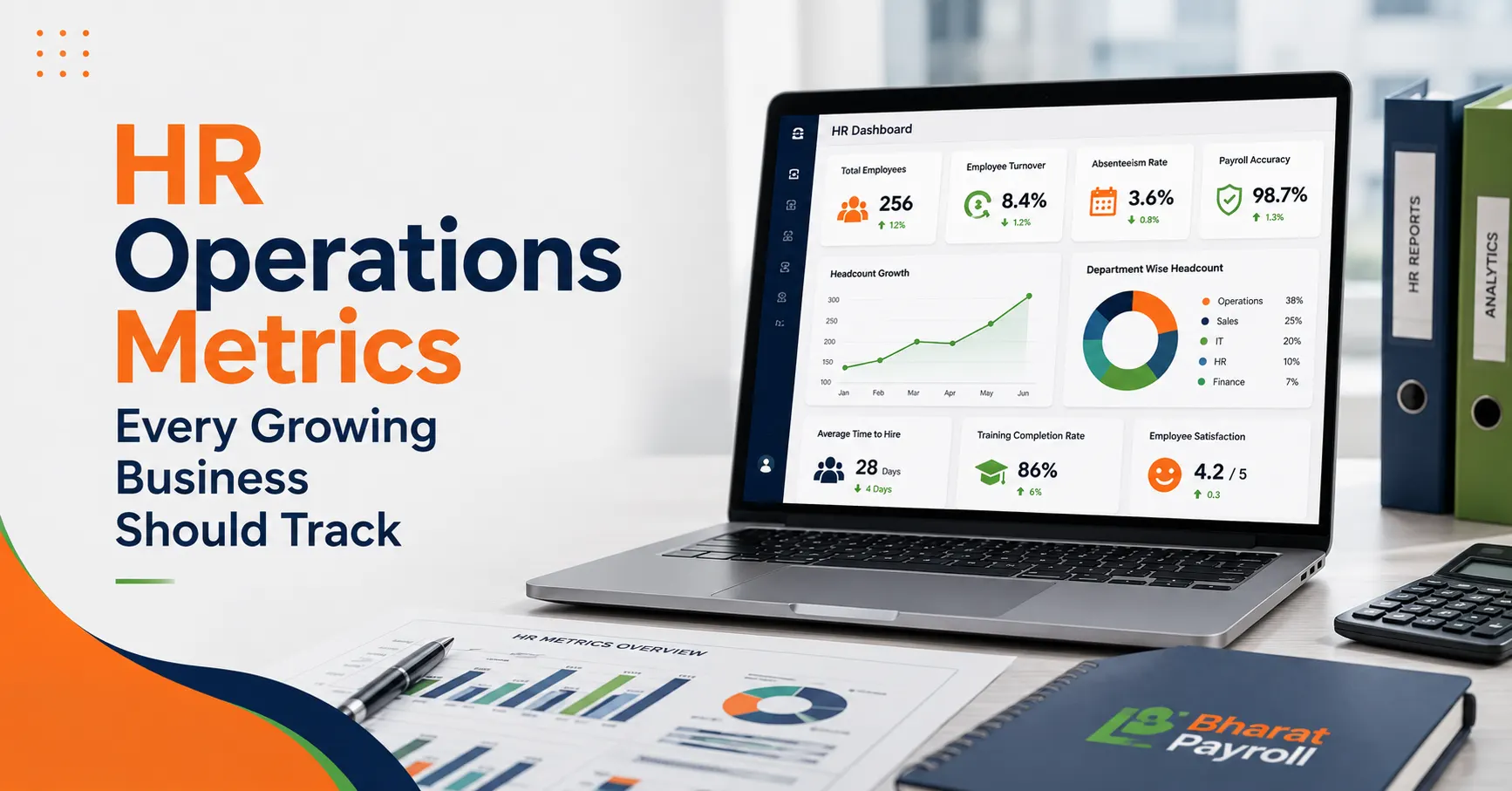
An HR dashboard brings important HR operations metrics into one view. Instead of checking spreadsheets, emails, and multiple systems, HR leaders can see live workforce data in one place.
A useful HR dashboard should include:
- Total employees
- New hires and exits
- Attendance trends
- Leave status
- Payroll status
- Pending approvals
- HR ticket volume
- Compliance tasks
- Department-wise workforce data
- Employee turnover
- Payroll errors and corrections
The best dashboards are simple. They do not overload HR teams with unnecessary charts.
How Often Should HR Metrics Be Reviewed?
Not every metric needs daily review. Businesses should set a practical review cycle.
| Review Frequency | Metrics to Track |
| Daily | Attendance, leave requests, HR tickets, pending approvals |
| Weekly | Hiring progress, onboarding tasks, absenteeism, open HR issues |
| Monthly | Payroll metrics, turnover, compliance, department reports |
| Quarterly | Workforce cost, retention, hiring quality, HR process efficiency |
This review rhythm keeps HR proactive without making reporting feel overwhelming.
Final Thoughts
You can’t manage HR on spreadsheets and follow-ups – as the number of employees grows, HR needs better visibility across hiring, attendance, leave, payroll, compliance, and employee support.
Having the right HR operations metrics helps organisations reduce errors, get payroll right on time, control costs, and support employees better. In the end, HR metrics aren’t just numbers – they are signals that show if the organisation is ready to grow smoothly.
Turn HR Metrics into Better Business Decisions
Track attendance, payroll, leave, compliance, and workforce insights from one powerful HRMS built for growing businesses.
FAQs
1. What are HR operations metrics?
HR operations metrics track how well HR manages hiring, attendance, leave, payroll, compliance, and employee support.
2. Which HR KPIs should growing businesses track?
Growing businesses should track headcount, turnover, retention, onboarding, attendance, payroll accuracy, and HR ticket resolution time.
3. Why are payroll metrics important?
Payroll metrics help reduce salary errors, delays, compliance gaps, and repeated employee payroll queries.
4. How does Bharat Payroll help track HR metrics?
Bharat Payroll helps businesses track attendance, leave, payroll, compliance, and employee data from one HRMS dashboard.
5. Can Bharat Payroll improve payroll accuracy?
Yes. Bharat Payroll reduces manual errors by connecting attendance, leave, salary inputs, statutory deductions, and payroll reports.