

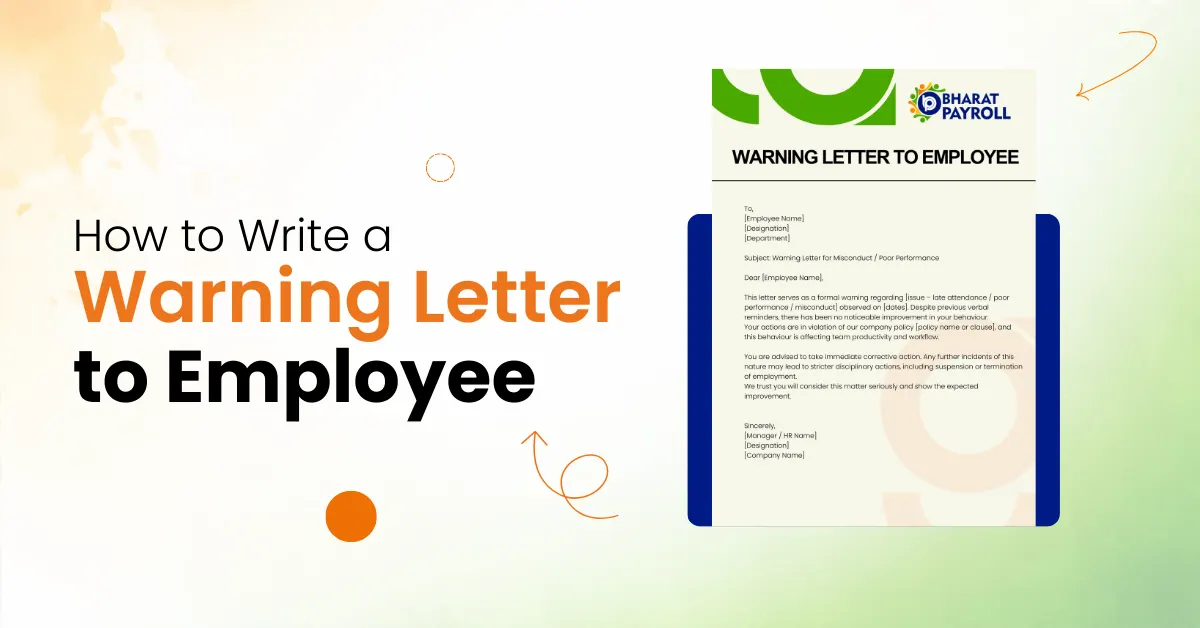
Employees help a company grow when they follow company standards, follow rules, and complete their work on time. When unacceptable behaviour, poor performance, or employee issues continue even after reminders, HR must take the next step. A clear warning letter helps the employee understand the concern and take corrective action.
A proper employee warning letter also protects the company, supports the team, and keeps the disciplinary process compliant. It creates proper documentation and provides clear guidelines for improvement. HR teams using Bharat Payroll can manage warning notices, track employee records, and follow a structured approach with accuracy. This guide explains how to write a warning letter to an employee, when to issue a verbal warning or written warning, what details to include, how to outline expectations, and how to maintain a neutral tone while following company policy. You will also find a simple formal warning letter format and a sample letter for easy use.What Is a Warning Letter to an Employee?
Contents
hide
- The behaviour or performance issue
- What was discussed in previous meetings
- Expected improvements
- Next steps if behaviour continues
- Possible consequences and further disciplinary action
Why Companies Use Warning Letters
Indian companies use warning letters to address concerns early and maintain discipline at work. Written notice helps the company document issues and support the HR representative during disciplinary matters. It also ensures that employees are aware of expectations and consequences. Warning letters help companies:- Address employee misconduct or poor performance early
- Maintain proper documentation for future disciplinary procedures
- Use a structured approach recommended in the employee handbook
- Protect the company during legal action or disputes
- Guide employees back to the right workplace behaviour
- Keep other employees aware that rules apply equally
When Should HR Issue a Warning Letter?
A warning letter should not be the first step. HR usually begins with a verbal warning, followed by documentation of what was discussed. If the employee does not improve, HR issues a written warning. HR issues warning letters when employees:- Are frequently late or miss work without notice
- Shows poor performance in certain tasks
- Show unprofessional behaviour or misconduct
- Fail to follow company policy or workplace guidelines
- Affect the team’s productivity or team morale
- Ignore the instructions given by their manager
- Continue behaviour after a verbal warning or formal meeting
Types of Warning Notices Used in India
Indian companies commonly use three types of warning notices:1. Verbal Warning
A conversation between the manager and employee. HR records the date, issue, and discussion. This is the first step in the disciplinary process.2. Written Warning
A formal written warning describing the issue in clear language, outlining expectations, and explaining next steps. This becomes an official part of the employee’s record.3. Final Warning
A strong written notice stating that failure to improve may lead to termination. This is used when earlier warnings did not work. These steps ensure HR follows a structured approach before any major disciplinary action.How to Write a Warning Letter to an Employee (Step-by-Step Guide)
Here is a simple, clear method for HR teams to write a strong employee warning notice while keeping the tone neutral and professional.1. Start With Employee Details
Every warning letter should begin with:- Employee’s name
- Job title
- Company name
- Department
- Date
- Name of manager or HR representative
2. Explain the Issue Clearly
Use simple words to explain what happened. Keep the tone neutral and avoid emotional or personal remarks. Common examples include:- “You were frequently late without informing the manager.”
- “Your work performance has not met company expectations.”
- “You behaved in a manner that affected the team’s productivity.”
- “You failed to complete certain tasks even after reminders.”
3. Mention Previous Discussion or Verbal Warning
Show that the disciplinary process has been followed correctly. Include details such as:- Date of the earlier meeting
- What was discussed
- Guidance given to the employee
- Any support or training offered
4. Describe the Impact on Work or Team
The letter must show why the issue matters. Examples:- “Your behaviour has affected team morale.”
- “Client deadlines were delayed due to incomplete tasks.”
- “Team members are unable to plan work due to your absence.”
5. Outline Expected Improvements
The warning letter must clearly state what the employee must improve. Examples:- “Report to work on time as per company policy.”
- “Complete assigned tasks within the expected timelines.”
- “Follow workplace rules and maintain professional behaviour.”
6. Explain Consequences
A warning letter must explain what will happen if the behaviour continues. Examples:- “Further disciplinary action may be taken.”
- “You may receive a final warning.”
- “Continued issues may lead to termination of employment.”
7. Request Employee’s Signature
Ask the employee to acknowledge receipt of the letter. The employee’s signature confirms they received the letter, not that they agree with it. HR must store the signed letter for future reference.8. Keep Proper Documentation
Every warning letter, verbal warning, or written notice must be saved for future disciplinary matters. Bharat Payroll helps HR teams store documents, track meeting dates, and maintain a clear record of employee issues.Warning Letter Format for Employee (India Sample)
Subject: Warning Letter for Employee Misconduct / Poor Work Performance Date: [Insert Date] Employee Name: [Name] Job Title: [Title] Department: [Department] Company Name: [Company] Dear [Employee Name], This letter is a formal written warning regarding your behaviour and work performance. On [date], we discussed that you were [explain issue]. A verbal warning was given earlier, but the issue continues. This behaviour does not comply with company policy and affects the team’s productivity. You are expected to improve in the following areas: [list expected improvements] If this behaviour continues, further disciplinary action may be taken as per company policy. Please sign below to acknowledge receipt of this letter. Sincerely, [Manager / HR Representative] Human Resources DepartmentCommon Mistakes HR Should Avoid
HR must avoid the following when writing a warning notice:- Using emotional or harsh language
- Leaving out dates, details, or examples
- Writing unclear expectations
- Blaming the person instead of the behaviour
- Skipping proper documentation
- Forgetting to request the employee’s signature
How Bharat Payroll Helps HR Teams During the Disciplinary Process
Bharat Payroll is primarily a payroll and employee management system, so it does not create or automate warning letters. However, it still supports HR teams during the disciplinary process in simple and practical ways:- Storing employee documents, such as warning letters or HR notes, which HR uploads manually
- Maintaining a basic employee profile where HR can track important employment details
- Providing attendance and leave records that HR may refer to when evaluating issues
- Keeping all employee information in one place for easy access during HR reviews
- Allowing HR to update remarks or general notes about an employee, if required
- Ensuring secure, role-based access so that only authorised HR staff can view sensitive information
Why Clear Warning Letters Improve Workplace Culture
A well-written warning letter guides employees, protects the company, and supports teamwork. It keeps the disciplinary process fair and gives employees a chance to correct their behaviour. When expectations are clear, it improves morale and builds trust among other employees.Improve Your HR Documentation with Bharat Payroll
Clear warning letters improve performance and fairness. Bharat Payroll helps companies stay organised and maintain smooth disciplinary processes.