
Compa ratio is one of those compensation metrics that can look small in a spreadsheet and still change how a business thinks about pay. When HR teams, founders, finance leaders, or compensation managers want to know whether salaries are sitting too low, too high, or close to the intended pay point, the compa ratio gives them a practical way to read that picture.
At its simplest, the compa ratio compares an employee’s current salary with the midpoint of the salary range for that role. That single comparison can open up larger questions. Is the role underpaid for the market? Is one team drifting above the structure? Are strong employees being held too close to entry-level pay? Is the company rewarding experience fairly, or just paying by habit?
For businesses in India, these questions are no longer side conversations. Hiring has become sharper, retention costs more than it used to, and employees are more aware of salary positioning than many companies assume. This is where the compa ratio moves from being a compensation term to a decision-making tool.
What Is Compa Ratio in Salary Planning?
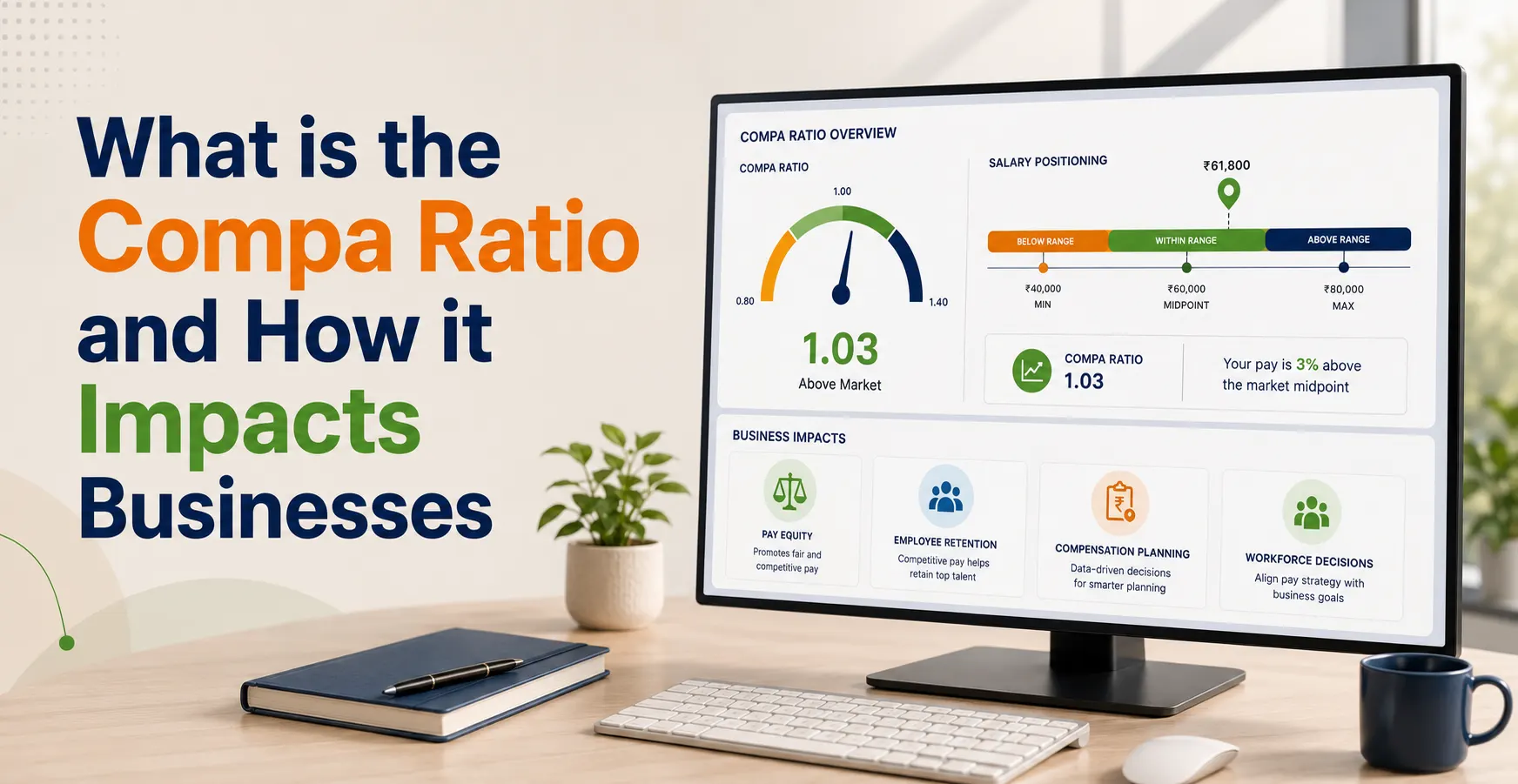
Compa ratio is a pay comparison metric that shows how an employee’s actual salary compares with the midpoint of a defined pay range. It is usually expressed as a percentage.
If the ratio is 100%, the employee is paid exactly at the midpoint. If the number is below 100%, the salary sits below the midpoint. If the number goes above 100%, the salary sits above it. In standard compensation practice, compa ratio is built around the midpoint of a pay range or a similar market reference point.
In day-to-day HR language, this helps answer a simple question: where does this person’s pay stand in relation to what the role is supposed to pay?
That matters far more than many companies realise. A salary may look decent on its own. It may even look generous in isolation. Yet once you compare it with the range midpoint, a different story can appear.
What is Compa Compensation and Why It Matters
When teams talk about compa compensation, they are usually talking about how salaries line up with internal pay ranges, market benchmarks, and performance expectations. A business cannot keep compensation fair just by checking gross salary once a year. It needs a repeatable way to review how each salary sits inside the structure.
That is where compa ratio proves useful. It helps businesses:
- review whether pay is aligned with market and role value
- identify gaps across departments or grades
- improve pay review discussions with clearer numbers
- support better budgeting before increment cycles
- reduce avoidable pay inequity across similar roles
A business that never checks compa ratio salary patterns often finds pay issues late, usually during appraisals, exits, offer negotiations, or leadership reviews.
How to Calculate Compa Ratio
The formula is direct:
| Compa Ratio = Actual Salary ÷ Salary Midpoint × 100 |
That means you take the employee’s current annual salary, divide it by the midpoint of the salary range for the role, and multiply the result by 100.
The midpoint itself is the centre point of the pay range. In compensation work, the midpoint is used as a benchmark value inside the range.
Calculate Compa Ratio With a Simple Example
Let us say an employee in Hyderabad earns ₹7,20,000 per year. The midpoint for that role is ₹8,00,000.
So the formula becomes:
₹7,20,000 ÷ ₹8,00,000 × 100 = 90%
This means the employee is paid at 90% of the midpoint.
That does not automatically mean the pay is wrong. It may be fully reasonable if the employee is new in the role, recently moved into a wider scope, or is still building job depth. The number becomes useful when it is read with context.
Another Example of Compa Ratio Salary Positioning
Assume a payroll manager in Bengaluru earns ₹12,60,000 annually, and the midpoint for that level is ₹12,00,000.
₹12,60,000 ÷ ₹12,00,000 × 100 = 105%
This tells you the employee is above midpoint. That may reflect stronger experience, a scarce skill mix, a retention move, or a premium location adjustment.
The number itself does not make the final call. It starts the review.
How to Interpret Compa Ratio
A compa ratio only becomes useful when the business knows how to read it. Most organisations treat 100% as the pay midpoint. Many compensation teams work with a broader working band around that level, often reading roughly 80% to 120% as a common operating range in compensation discussions.
Here is the practical reading:
80% to 90%
This usually fits employees who are new to the role, still developing in the job, or have recently entered a new pay grade.
90% to 110%
This usually reflects employees who are established in the role and performing as expected.
110% to 120%
This often points to strong performers, specialists, long-tenured staff, or employees with skills that are harder to replace.
A number outside these working bands does not always mean something is broken. Still, it usually deserves a closer look. A high-performing employee sitting at 82% year after year tells one story. A new recruit at 115% tells another.
What a Compa Ratio of 90 Means
A compa ratio of 90 means the employee is paid at 90% of the midpoint for that role. In plain words, the salary is slightly below the midpoint. This is common for developing employees, recent hires, or staff who have moved into a larger role and have not yet progressed to central range positioning.
What a Compa Ratio of 120 Means
A compa ratio of 120 means the employee is paid well above the midpoint. That can happen when the person has rare skills, strong business impact, high tenure, or when the company has used pay as a retention tool.
This is where leadership should pause and ask the right question. Is this salary position intentional, or did it happen through disconnected increments over time?
Types of Compa Ratio
A lot of businesses begin with one employee at a time. That helps, though it is only one part of the picture. Compa ratio becomes far more useful when viewed at more than one level.
Individual Compa Ratio
This is the most common type. It compares one employee’s salary against the midpoint for that role.
Individual compa ratio is useful during:
- appraisal discussions
- salary correction reviews
- promotion planning
- offer benchmarking for similar jobs
- retention conversations with critical employees
When managers ask whether someone is paid fairly for the level they are in, this is often the first metric compensation teams pull up.
Group Compa Ratio
Group compa ratio compares the salaries of a department, grade, or employee cluster against the total of the relevant midpoint values. It is useful for seeing whether one team is sitting above or below intended pay positioning.
For example, if a finance team, sales support team, or technology unit is drifting below target, that can show up in group compa ratio before attrition tells the same story in a more expensive way.
This is useful in:
- annual budget planning
- department-level pay reviews
- gender pay and internal parity reviews
- post-merger compensation alignment
- leadership reporting
Average Compa Ratio
An average compa ratio gives a broad view of how a workforce segment sits against midpoint on average. It is not as sharp as an individual review, though it is useful for spotting wider movement.
For instance, if a whole job family sits below the target zone, the issue may not be manager judgement alone. The range itself may be stale. That means the business may need to revisit the pay structure, not just individual salaries.
Why Businesses Use Compa Ratio
Compa ratio is used because pay decisions are rarely about one salary. They are about patterns. A company may think its pay structure is fair, balanced, and controlled. Once the numbers are reviewed, it may find one unit compressed at the lower end, another stretched above midpoint, and a third carrying inconsistencies between similar roles.
This is why businesses use compa ratio in the first place.
It helps them read pay competitiveness
Salary decisions should not be based on instinct, title comfort, or past offer history. Compa ratio gives a cleaner view of where pay stands against the intended range.
It helps them review internal fairness
Two employees may have similar responsibilities and very different pay positions. A comparative ratio review makes those gaps visible faster.
It supports appraisal planning
A manager may want to recommend a 15% raise. Finance may want to cut it back. HR may want to understand whether the current salary is already above midpoint. Compa ratio helps make that discussion less emotional and more grounded.
It improves salary budgeting
When a company knows which teams are sitting low, which are already well paid, and which roles are near pay compression, salary budgets become more focused.
Compa Ratio and Pay Equity in India
Compa ratio is also useful when a business wants to review pay fairness with more discipline. It is not a legal verdict by itself, and it cannot replace a full compensation audit. What it does well is flag positions that deserve a closer review.
For Indian employers, fair wage treatment and equal pay principles remain relevant in current wage-rule framing, especially when comparable work is reviewed across employee groups.
A compa ratio review can help identify questions such as:
- If similar roles are being paid very differently without a clear justification
- Are women and men in like-for-like roles clustering in different pay positions
- If some locations consistently offer lower pay without a proper structured basis
- If the increments keep pace with role progression, or only with manager’s preference
This is why the compa ratio should not be treated as a maths exercise. It is one of the cleaner entry points into a serious compensation review.
Compa Ratio vs Position in Range
Many people mix these up. They are connected, though they are not the same.
Comp ratio compares salary to the midpoint of the range.
Position in range, also called range penetration, shows how far the salary has moved between the minimum and maximum of the range. Range penetration uses the full salary range, while compa ratio centres on the midpoint.
That difference matters.
An employee may be at the centre of the compa ratio and still have room to grow in the overall range. Another employee may be above the midpoint and close to the upper end of the band. Those are two different compensation stories.
For pay reviews, promotion readiness, and range movement planning, businesses often need both numbers, not just one.
Limitations of the Compa Ratio as a Compensation Metric
Compa ratio is useful, though it should never run the whole compensation conversation on its own. It looks only at fixed salary against a midpoint. It does not include bonuses, incentives, stock, insurance value, retention pay, or the wider reward mix. That means an employee may look low on the compa ratio and still receive a stronger total package than the number suggests.
It also depends heavily on the quality of the range itself. If the midpoint is outdated, loosely benchmarked, or built on weak market data, the ratio will still produce a neat percentage, but the answer will not be reliable. The metric is only as strong as the structure behind it.
There is another practical limit that many businesses overlook. Two employees may carry the same title and still do meaningfully different work. One may manage a more difficult client set, another may handle more revenue-sensitive work, and a third may hold deeper functional knowledge. The Compa ratio cannot explain all of that. It can point to a pattern. It cannot tell the full story by itself.
This is why compensation teams usually read compa ratio alongside other pay indicators, not in isolation. Salary range penetration, market positioning, tenure, performance, and job scope all matter if the business wants a pay review that stands up to scrutiny.
How to Use the Compa Ratio in Your Compensation Strategy
A lot of companies first look at the compa ratio during appraisal season. By then, the number is useful, but the timing is late. A stronger approach is to use it throughout the year as part of compensation planning, hiring discipline, and manager review.
Review the Compa Ratio Regularly, Not Occasionally
Salary positioning shifts faster than many teams expect. New joiners come in at different rates. Managers apply inconsistent increases. Retention adjustments happen in pockets. Promotions land without a full range review. By the time HR notices, internal balance may already be off.
A scheduled compa ratio review helps the business catch those shifts earlier. This can be quarterly for fast-moving teams, half-yearly for stable workforces, or before every major increment cycle.
Read Comparative Ratio With Context
A comparative ratio is useful only when read with surrounding data. If an employee is at 88%, that number needs context. Are they a new join? Were they hired into a stretch role? Are they still building role depth? Have they been under-incremented for two cycles? The same percentage can mean very different things.
The strongest compensation reviews usually layer compa ratio with:
- tenure in role
- performance record
- current job scope
- promotion readiness
- location-based salary realities
- external market movement
That is where the number becomes useful to leadership, not just tidy for HR.
Use Compa Ratio During Hiring and Offer Planning
Many companies create a salary imbalance before the employee even joins. One candidate negotiates harder. Another is hired in a rush. A third is brought in through referral and offered more than an existing team member in the same range. Six months later, the same business is trying to explain pay gaps internally.
Compa ratio helps hiring teams test whether the offered salary sits sensibly within the intended pay structure. That does not mean every candidate should land at the same point. It means the business should know why it is choosing that point.
Use It During Increment Planning
Compa ratio is particularly useful during salary reviews. Employees below the midpoint may need larger corrective movement, while employees already above the midpoint may need a more selective pay decision. This is often how businesses keep salary growth controlled without flattening recognition.
That does not mean high-ratio employees should be ignored. It means rewards may need to be structured more carefully, especially where the salary is already ahead of the midpoint.
Use Group Reviews to Spot Structural Gaps
A business that reviews only individual cases will miss wider problems. Group compa ratio helps reveal whether one function, grade, location, or demographic segment is consistently sitting low or high.
This is one of the simplest ways to surface questions like:
- Is one department regularly hired below the intended range?
- Are managers applying salary decisions unevenly?
- Has one pay band gone stale against the market?
- Are experienced employees stuck at lower range positions than they should be?
Those questions matter much earlier than attrition data.
Compa Ratio Salary Reviews and the India Context
In India, salary positioning is often shaped by a mix of market offers, city benchmarks, legacy increments, retention counteroffers, and role title inflation. That combination can make compensation structures look ordered on paper and uneven in practice.
A company may believe its pay approach is fair because it has salary bands in place. Yet once compa ratio salary data is reviewed by role, gender, location, and tenure, a different pattern may show up. This is where compensation review becomes more valuable than compensation assumption.
For businesses operating across cities such as Hyderabad, Bengaluru, Pune, Chennai, Gurugram, or Mumbai, salary structure discipline matters even more. Local hiring pressure can shift pay quickly. Without a compensation metric in the background, teams often end up reacting case by case.
Compa ratio helps create a stronger starting point for those discussions. It does not replace human judgement. It gives human judgement a firmer base.
Compa Ratio and Bharat Payroll
A compensation metric only becomes useful when a business can actually work with the data. That is where many teams run into a practical problem. The formula is simple. The inputs are scattered.
Salary data may sit in payroll. Designation and reporting structure may sit somewhere else. Increment history may live in approval trails or offline files. The result is that even a basic pay review takes too much manual stitching.
Bharat Payroll helps businesses bring more order to that process. Employee salary records, pay structures, payroll visibility, reporting flows, and people data already sit inside one operating environment through modules such as employee records, payroll-linked payslip access, reports, declarations, attendance-linked data points, and consolidated reporting workflows documented in the platform manuals.
That matters for compensation planning because businesses can review salary movement with better clarity, rather than pulling fragments from disconnected sheets. Where salary reviews need stronger discipline, cleaner employee records, and better reporting support, that structure reduces friction before the compensation discussion even begins.
Why HR Teams Need Better Salary Visibility
Compa ratio is not just for compensation consultants. It is useful for HR heads, founders, finance teams, and business leaders who want salary decisions to stay explainable.
In practical terms, better compensation visibility helps teams:
- review salary movement before appraisal cycles
- compare role pay more consistently
- prepare cleaner promotion and increment discussions
- spot gaps between legacy pay and current structure
- reduce ad hoc salary corrections later
When salary reviews become reactive, payroll pressure rises too. When pay reviews are better planned, the business gets more control.
Common Mistakes to Avoid While Using Compa Ratio
A lot of businesses start using compa ratio and get value from it quickly. Then they make one of a few familiar mistakes.
Treating 100% as the only “correct” answer
A midpoint is a reference point, not a rule that every employee must sit on. Newer employees may reasonably sit below it. High-value specialists may reasonably sit above it. The business should focus on intent and consistency, not artificial uniformity.
Reviewing one employee without reviewing peers
One employee at 94% may seem fine until you see that everyone else in the same role is above 105%. Salary review works better when it includes the surrounding peer set.
Ignoring market updates
If the range midpoint is stale, the ratio will still calculate cleanly and still mislead decision-makers. This is why market review and structure review matter as much as the formula.
Using compa ratio as proof of pay equity
Compa ratio can help flag potential pay issues. It cannot by itself prove or disprove fairness. It should be treated as a signal for review, not the final legal or ethical answer.
What Is a Good Compa Ratio?
A good compa ratio is usually one that fits the employee’s role stage, performance level, and the company’s salary philosophy. Many organisations read a range around 80% to 120% as workable, with 100% representing midpoint. Ratios below that can point to early-career placement or underpayment risk. Ratios above that can reflect strong experience, scarce skills, or budget pressure if the pattern becomes widespread.
That is why the better question is not “What is the perfect compa ratio?” It is “Does this salary position make sense for this role, this employee, and this business structure?”
That is the question good compensation teams keep returning to.
Final Word on Compa Ratio
Compa ratio looks like a single calculation, though it reveals much more than a percentage. It shows whether salaries are clustering below structure, sitting close to target, or stretching above it. It also helps businesses see where compensation decisions have become inconsistent, outdated, or difficult to defend.
For Indian employers, that matters across hiring, retention, promotion planning, and internal pay reviews. Salary structures are not held together by policy documents alone. They hold together when the business can see clearly where people are paid and why.
That is why the compa ratio remains useful. It gives the business a cleaner starting point for fairer pay decisions.
Keep Pay Reviews Structured Before Salary Gaps Turn Costly
Bring salary records, employee data, and payroll visibility into one place with Bharat Payroll.
Frequently Asked Questions
1. Why is the compa ratio used?
Comp ratio is used to compare an employee’s salary with the midpoint of the pay range for their role. Businesses use it to review salary positioning, pay consistency, and compensation planning.
2. How do you calculate the compa ratio?
To calculate the compa ratio, divide the actual salary by the salary midpoint and multiply by 100. For example, if the salary is ₹9,00,000 and the midpoint is ₹10,00,000, the compa ratio is 90%.
3. What does a compa ratio of 90 mean?
A compa ratio of 90 means the employee is paid at 90% of the midpoint for that role. This usually places the salary below midpoint, which may be reasonable for a newer or developing employee.
4. What is the difference between compa ratio and range penetration?
Compa ratio compares salary with the midpoint only. Range penetration shows how far the employee has moved across the full pay range from minimum to maximum.
5. Is the compa ratio enough to decide fair pay?
No. Compa ratio is a useful starting point, though it should be read with performance, tenure, job scope, market movement, and other compensation factors before any final pay decision is made.