
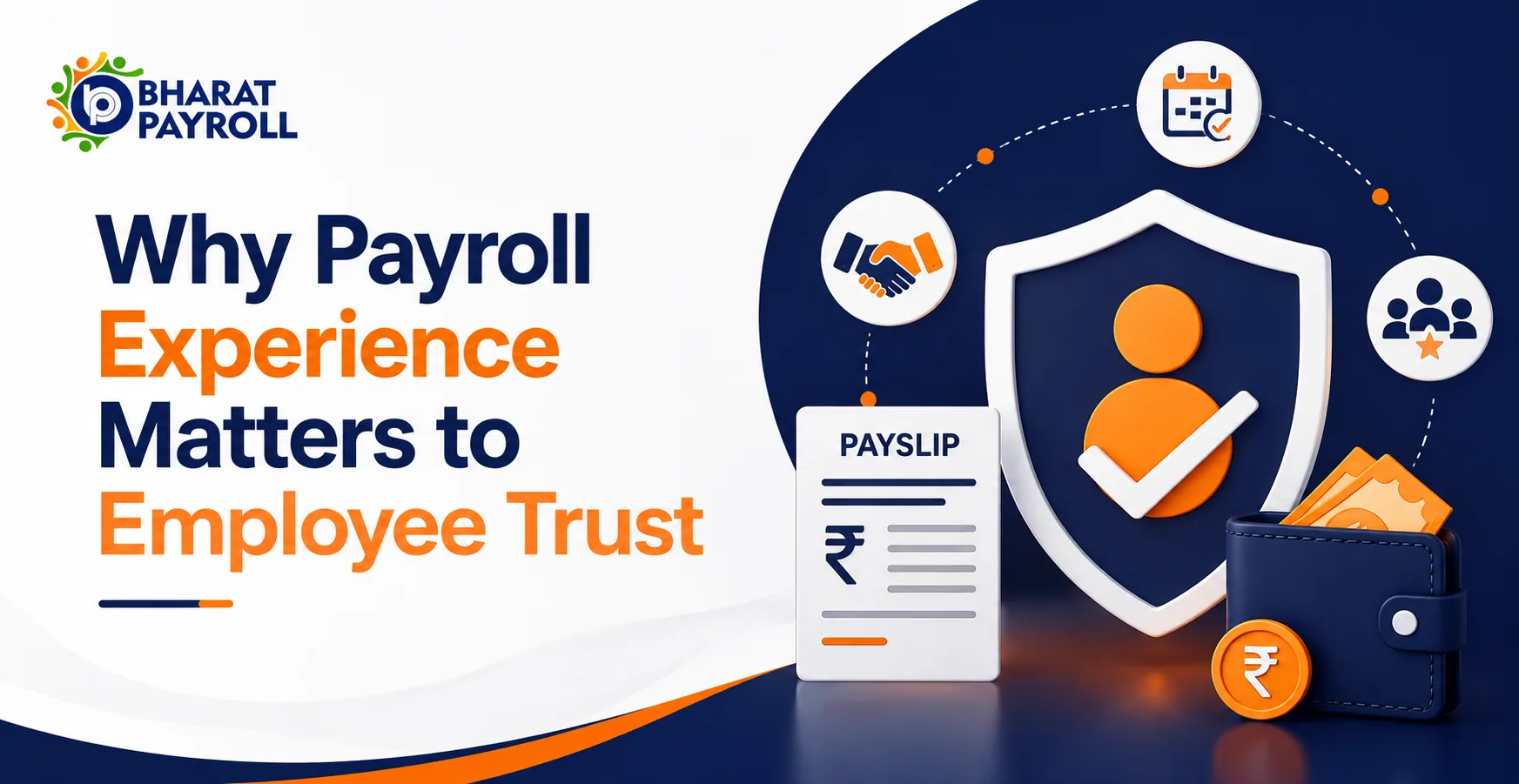
Payroll experience plays a pivotal role in employees’ self-esteem, confidence, and commitment to an organisation. When payroll is accurate, timely, transparent, and easy to understand, employees feel valued and respected, allowing them to focus fully on their work rather than worrying about salary-related issues. When salaries are delayed, deductions are unclear, payslips are confusing, or corrections take too long, trust drops quickly.
For business leaders, the consequences extend beyond employee satisfaction. Payroll errors can increase HR workload, trigger compliance concerns, create unnecessary employee queries, and negatively impact retention. In a competitive talent market, even small payroll issues can influence how employees perceive the organisation and whether they choose to stay long-term.
That is why modern HRMS platforms powered by artificial intelligence (AI) like Bharat Payroll matter. They help companies move from scattered payroll processing to a more structured, transparent, and employee-friendly payroll system.
What Is Payroll Experience?
Payroll experience refers to the complete employee journey around salary processing, payslips, deductions, reimbursements, tax declarations, statutory contributions, and payroll-related support.
It includes every touchpoint where an employee interacts with payroll information.
A good employee payroll experience includes:
- Accurate salary processing
- On-time salary credit
- Clear payslips
- Transparent deductions
- Easy access to salary records
- Simple tax declaration workflows
- Fast payroll query resolution
- Leave and attendance-linked salary accuracy
- Reimbursement visibility
- Compliance-related payroll clarity
For employees, payroll is personal. It affects rent, EMIs, savings, family expenses, tax planning, and basic financial confidence. Even a small payroll mistake can feel serious because it directly touches the employee’s personal life.
For employers, payroll experience is a trust signal. It shows whether the company can manage sensitive data, follow processes, and keep its commitments.
Why Payroll Experience Matters Now
Employees now expect workplace systems to be as clear and accessible as the apps they use every day. They can check bank balances instantly, download payment receipts, track orders, and get digital confirmations in seconds. Payroll cannot feel slow, unclear, or dependent on long email chains anymore.
Payroll processing is not as simple as transferring salaries. It involves multiple interconnected activities to consider, including attendance validation, leave, overtime; Indian companies have to deal with bonuses, incentives, reimbursements, tax declarations, PF, ESI, professional tax where applicable, TDS, and policy-based deductions.
When payroll data sits across spreadsheets, emails, attendance tools, and manual approval chains, errors become easier. Employees may not understand why their take-home salary changed. HR teams then spend time explaining deductions, checking reimbursements, correcting leave records, or responding to repeated payslip requests.
A better payroll experience reduces confusion before it becomes frustration.
It gives employees confidence that their salary is being calculated fairly. It also gives HR and finance teams a more reliable way to manage payroll without constant manual follow-ups.
The Business Problem: Payroll Mistakes Damage Trust Fast
Employees may ignore a delayed internal announcement. They may tolerate a slow approval once in a while. But they rarely ignore a salary mistake.
Payroll problems create immediate emotional impact because they affect personal financial commitments. If an employee sees a wrong deduction, missing reimbursement, unexplained tax change, or salary delay, the first question is not technical. It is personal: “Can I trust this company to handle my pay correctly?”
Common payroll experience problems include:
- Salary delays
- Incorrect leave or attendance mapping
- Wrong deductions
- Unclear payslip components
- Delayed reimbursement processing
- Manual tax declaration errors
- Poor response to payroll queries
- Lack of salary transparency
- Mismatch between HR policy and payroll calculation
- Repeated dependency on spreadsheets
For HR managers, these issues increase query volume. For finance teams, they create rework and audit pressure. For COOs, they show gaps in operational discipline. For CIOs, they expose data movement and system integration problems.
The cost of payroll errors is not only financial. It also shows up in employee dissatisfaction, lower confidence in internal systems, and unnecessary friction between employees and HR.
Payroll Experience and Employee Trust Are Directly Connected
Employee trust grows when people believe the organization is fair, consistent, and transparent.
Payroll affects all three.
Fairness comes from accurate calculations.
Consistency comes from on-time processing.
Transparency comes from clear salary communication.
A good payroll experience tells employees:
- Their salary is calculated correctly.
- Their deductions are explainable.
- Their reimbursements are tracked.
- Their tax details are handled properly.
- Their payroll documents are accessible.
- Their employer has a reliable process.
This is why payroll should not be seen as only a backend function. It is one of the most visible ways a company proves its reliability every month.
When employees trust payroll, they spend less time questioning the system and more time focusing on work. HR teams also spend less time firefighting and more time improving the employee experience.
Why Salary Transparency Matters
Salary transparency does not always mean making everyone’s salary public. In payroll operations, salary transparency means employees clearly understand how their salary is structured, calculated, deducted, revised, and paid.
For Indian companies, salary transparency should include:
- Clear salary structure
- Basic pay, allowances, and benefit visibility
- Tax deduction clarity
- PF and ESI visibility where applicable
- Professional tax visibility where applicable
- Leave impact on salary
- Reimbursement status
- Bonus or incentive breakup
- Payslip accessibility
- Year-to-date salary and tax details
When salary information is unclear, employees fill the gap with assumptions. Those assumptions can quickly turn into distrust.
For example, if an employee’s take-home pay changes and the payslip does not explain why, the employee may assume there is an error. But if the HRMS clearly shows an unpaid leave adjustment, tax declaration update, or reimbursement hold, the conversation becomes easier.
Salary transparency reduces unnecessary disputes. It gives employees the information they need before they raise a complaint.
Payroll Is Also a Communication Channel
Every payslip, salary revision, tax update, reimbursement note, or bonus entry communicates how organised the company is. When payroll communication is clear, employees understand what changed and why. When it is unclear, even correct payroll can create doubt. In fact, companies should treat payroll communication as part of the employee experience, not just an administrative update. Clear salary notes, deduction explanations, tax summaries, and policy-linked updates help employees feel informed instead of surprised.
How HRMS Improves Employee Payroll Experience
An HRMS improves payroll experience by connecting employee data, attendance, leave, salary structures, tax details, approvals, and payroll workflows in one system.
Without an HRMS, payroll teams often depend on spreadsheets, emails, manual attendance inputs, and disconnected approval trails. This increases the risk of errors and delays.
With an HRMS like Bharat Payroll, organisations can create a more structured payroll process by bringing key payroll inputs into one workflow.
An HRMS can help with:
- Employee data management
- Salary structure setup
- Attendance and leave integration
- Payroll calculation workflows
- Payslip generation
- Tax declaration collection
- Reimbursement tracking
- Approval workflows
- Payroll reports
- Employee self-service access
- Compliance-related payroll records
The result is not only faster payroll. The bigger value is consistency.
When employees can access payslips, tax records, salary details, and payroll documents without repeatedly contacting HR, the employee payroll experience improves. When HR teams can process payroll using structured data instead of manual follow-ups, accuracy improves.
A good HRMS makes payroll easier for both employees and HR teams.
What Leaders Should Measure in Payroll Experience
A better payroll experience should be measured, not assumed. HR and finance teams should track payroll accuracy rate, on-time salary processing, number of payroll queries, average query resolution time, payslip download/access rates, reimbursement delays, and recurring correction requests. These metrics show whether payroll is becoming more reliable for employees and easier for HR teams to manage. For leadership, they also turn payroll from a routine process into a visible trust and governance indicator.
A Practical Payroll Trust Framework for Indian Companies
Indian companies can improve payroll experience by looking at payroll through five trust layers.
1. Accuracy
Payroll should calculate salary, deductions, reimbursements, and statutory components correctly. Accuracy is the first layer of trust because employees judge payroll by what reaches their bank account.
2. Timeliness
Salary should be processed on schedule. Even if calculations are correct, delays can create anxiety and reduce employee confidence.
3. Transparency
Employees should understand how their salary is calculated. Payslips, deduction details, tax information, and reimbursement status should be easy to access.
4. Accessibility
Employees should not depend on long email chains for every payroll question. Self-service access to payslips, tax documents, and payroll history improves confidence.
5. Resolution
When payroll issues happen, employees should know where to raise them and how quickly they will be resolved. A clear query-resolution process protects trust during exceptions.
This framework helps HR and business leaders move payroll from “monthly processing” to “monthly trust-building.”
What B2B Buyers Should Look for in a Payroll HRMS
When evaluating payroll software or an HRMS, buyers should look beyond salary calculation.
A payroll HRMS should support employee trust, operational control, compliance readiness, and reporting visibility.
Important evaluation questions include:
- Can the system manage Indian payroll structures?
- Can it connect attendance, leave, and payroll?
- Can employees access payslips themselves?
- Can HR configure salary components clearly?
- Can payroll changes be reviewed before processing?
- Can the system support tax declaration workflows?
- Can payroll reports be generated for HR and finance?
- Can employees reduce routine dependency on HR?
- Can the system scale across branches or business units?
- Can it reduce spreadsheet-based payroll work?
Comparing HRMS platforms should go beyond feature lists. Businesses should evaluate how well the platform improves accuracy, transparency, employee access, payroll control, and HR efficiency.
The right payroll system should reduce confusion for employees and reduce manual dependency for HR.
Payroll Experience Use Cases by Buyer Role
Different stakeholders care about payroll experience for different reasons.
| Buyer Role | What They Care About | Payroll Experience Impact |
| HR Manager | Employee queries, payroll accuracy, payslip clarity | Reduces complaints and improves employee confidence |
| COO | Process discipline and workforce morale | Improves operational reliability and reduces recurring issues |
| CIO | System integration, data security, workflow control | Reduces disconnected tools and manual data movement |
| Finance Leader | Payroll reports, deductions, audit readiness | Improves financial visibility and documentation |
| Business Head | Team stability and employee satisfaction | Builds trust through timely and transparent salary handling |
Payroll experience is not only an HR concern. It affects operations, finance, IT, and leadership.
Bharat Payroll and the HRMS Advantage
Bharat Payroll helps Indian companies manage payroll as part of a structured HRMS workflow.
The goal is simple: Make payroll easier to process, easier to understand, and easier to trust.
For HR teams, Bharat Payroll can support cleaner employee records, structured salary data, payroll inputs, payslip generation, payroll-related reporting, and employee access. For employees, it can reduce confusion around salary details and lower dependency on HR for routine payroll questions.
For leadership teams, the value is operational visibility. A structured HRMS can help reduce manual work, improve consistency, and create better control over payroll workflows.
This matters especially for growing Indian companies where payroll complexity increases with more employees, multiple departments, varied salary structures, branch-level operations, attendance policies, and compliance responsibilities.
Payroll should not become harder as the company grows. It should become more structured.
| Manual Payroll vs HRMS-Led Payroll Experience | ||
| Area | Manual Payroll Process | HRMS-Led Payroll Process |
| Salary Inputs | Collected through spreadsheets and emails | Managed through structured employee data |
| Attendance Sync | Manual or delayed | Connected with attendance and leave workflows |
| Payslip Access | Shared manually by HR | Employees can access payslips directly |
| Query Handling | Repeated emails and follow-ups | More structured access and resolution |
| Error Risk | Higher due to manual entry | Lower with centralized data and checks |
| Reporting | Time-consuming and fragmented | Easier reports for HR and finance |
| Employee Trust | Depends heavily on HR response speed | Improves through clarity and self-service |
An HRMS does not remove the need for HR judgment. It removes avoidable confusion from the process.
Common Payroll Experience Mistakes Companies Make
Many payroll issues are not caused by lack of intent. They happen because the process is not structured well enough.
Common mistakes include:
- Using too many disconnected spreadsheets
- Not updating employee records on time
- Making payslips difficult to understand
- Delaying payroll query responses
- Not explaining deduction changes clearly
- Treating payroll as only a finance task
- Not connecting attendance, leave, and payroll data
- Not giving employees self-service access
- Not reviewing payroll exception reports
- Not updating payroll workflows as the company grows
These mistakes may look small individually. Together, they weaken employee trust.
How to Improve Payroll Experience Step by Step
Indian companies can improve payroll experience through a practical process.
Step 1: Audit Payroll Issues
Review common payroll complaints from the last few months. Identify whether issues come from attendance, leave, deductions, reimbursements, tax declarations, employee data, or communication gaps.
Step 2: Clean Employee Data
Payroll accuracy depends on employee data accuracy. Review employee records, salary structures, bank details, tax information, and statutory details where applicable.
Step 3: Improve Payslip Clarity
Make payslips easier to understand. Employees should know what was paid, what was deducted, and why their take-home salary changed.
Step 4: Connect Attendance and Leave
Payroll becomes more reliable when attendance and leave inputs flow through a controlled process instead of being manually collected at the last minute.
Step 5: Enable Employee Self-Service
Give employees access to payslips, salary history, tax declarations, and relevant payroll documents through the HRMS.
Step 6: Track Query Resolution
Payroll trust improves when issues are acknowledged, tracked, and resolved within a defined timeline.
Step 7: Review Payroll Reports
HR and finance teams should review payroll summaries, exceptions, reimbursements, and changes before final processing.
This process turns payroll improvement into a repeatable system.
Practical Checklist for Better Employee Payroll Experience
Use this checklist to evaluate your current payroll process.
- Is salary processed on time every month?
- Are payslips easy for employees to understand?
- Can employees access salary documents without HR follow-up?
- Are attendance and leave connected to payroll?
- Are reimbursements tracked clearly?
- Are tax declarations collected in a structured way?
- Are statutory payroll components handled carefully?
- Are payroll changes reviewed before salary processing?
- Are employee payroll queries tracked and resolved?
- Are payroll reports available for HR and finance teams?
- Is employee data updated regularly?
- Is payroll dependency on spreadsheets reducing?
- Is the system scalable for more employees and branches?
If several answers are “no,” the company may not just have a payroll process issue. It may have an employee trust issue.
Build Employee Trust Through Better Payroll
Accurate, transparent, and timely payroll helps create a more confident and engaged workforce.
FAQs
1. What is payroll experience?
Payroll experience is the complete employee journey around salary, payslips, deductions, reimbursements, tax declarations, and payroll-related support. A good payroll experience is accurate, timely, transparent, and easy for employees to access.
2. Why does payroll experience affect employee trust?
Payroll affects employee trust because salary is personal. When pay is accurate, on time, and clearly explained, employees feel respected. When errors or unclear deductions happen repeatedly, employees may lose confidence in the company’s internal systems.
3. What is salary transparency in payroll?
Salary transparency means employees can clearly understand their salary structure, deductions, reimbursements, tax details, and payslip components. It does not always mean public salary disclosure. In payroll operations, it means clarity and explainability.
4. How can HRMS improve employee payroll experience?
An HRMS improves employee payroll experience by connecting employee records, attendance, leave, salary structures, tax declarations, reimbursements, and payslips in one system. This reduces manual work and gives employees better access to payroll information.
5. Why is payroll important for Indian companies?
Payroll in India involves salary calculation, deductions, employee records, attendance, leave, reimbursements, tax declarations, and statutory components where applicable. A structured payroll process helps companies improve accuracy, transparency, and compliance readiness.
6. How should companies compare payroll HRMS platforms?
Companies should compare payroll HRMS platforms based on payroll accuracy, employee self-service, salary transparency, reporting, attendance and leave integration, compliance support, scalability, ease of use, and implementation support.
7. How does Bharat Payroll help improve payroll experience?
Bharat Payroll helps Indian companies manage payroll through an HRMS-led workflow that supports structured employee data, salary processing, payslip access, payroll reporting, and better payroll visibility for HR teams and employees.