
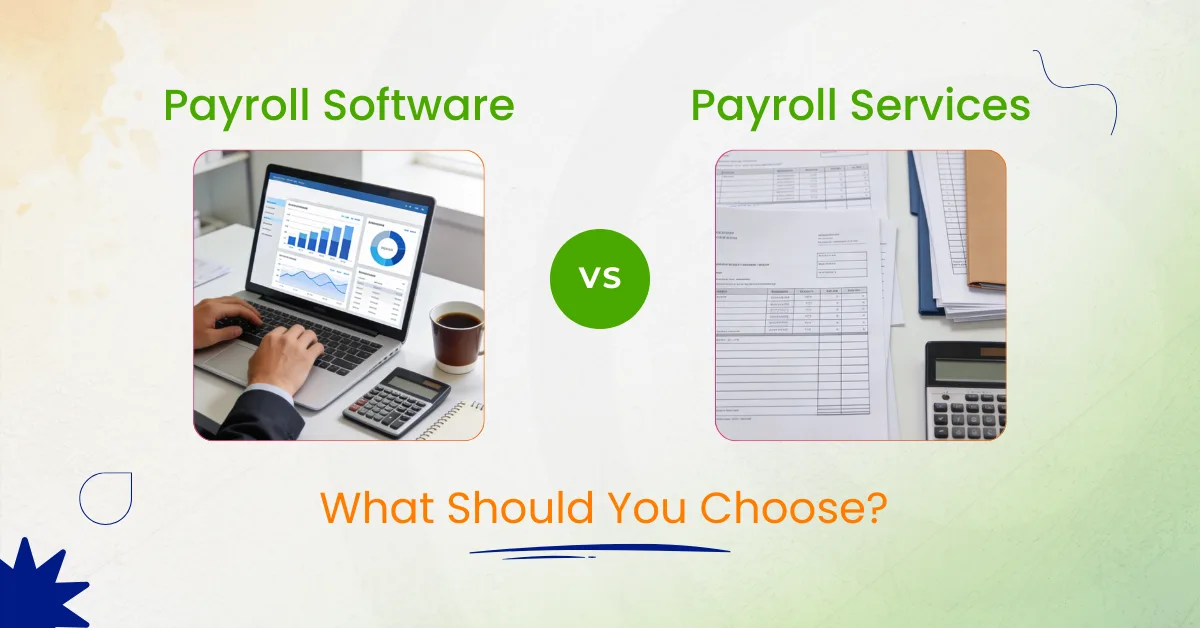
Payroll software allows businesses to manage payroll internally using automation tools, while payroll services involve outsourcing payroll processing, tax filings, and compliance to a third-party provider. The better option depends on business size, compliance complexity, internal expertise, and long-term cost structure.
Now let’s break this down in detail. In 2026, with increasing statutory complexity and digital compliance mandates in India, payroll decisions directly impact financial risk and operational efficiency. In India, payroll decisions are closely tied to PF, ESI, TDS, Professional Tax, and state-specific compliance obligations. Businesses must choose payroll solutions that handle statutory filings accurately and adapt to frequent regulatory changes. At Bharat Payroll, we help businesses choose payroll software or payroll services based on long-term scalability and cost efficiency. Now let’s go deeper.Why This Decision Matters More in 2026
- Over 62% of small businesses now use digital payroll software.
- Compliance penalties have increased across multiple jurisdictions.
- Remote workforce expansion has raised payroll complexity.
- Data security risks in payroll systems are increasing.
- Tax regulations are updated more frequently than before.
What Is Payroll Software?
Businesses that want complete control often prefer dedicated payroll software in India that automates salary processing and compliance updates. It automates:- Calculating employee wages and deductions accurately.
- Payroll taxes based on updated tax rules.
- Direct deposit into employees’ bank accounts.
- Generating pay stubs instantly.
- Managing payroll data securely.
- Compliance reporting is automatic.
Pros of Payroll Software
- Full control over payroll data access.
- Lower long-term payroll software costs.
- Easy integration with accounting systems.
- Employee self-service portals included.
- Transparent tax calculations every payroll cycle.
- Scalable for growing small businesses.
Cons of Payroll Software
- Requires internal payroll specialist oversight.
- Compliance responsibility remains internal.
- Set up and configuration time required.
- The internal team must monitor tax regulations.
- Errors are possible without proper payroll training.
What Are Payroll Services?
Payroll services involve outsourcing payroll to a payroll company. A payroll service provider manages the entire payroll process externally. They handle:- Processing payroll every payroll cycle.
- Managing payroll taxes and filings.
- Filing tax payments with authorities.
- Ensuring payroll compliance under labor laws.
- Managing employee benefits contributions.
- Reducing payroll compliance risks significantly.
Pros of Payroll Services
- Reduced payroll responsibilities internally.
- Compliance is handled by experienced payroll providers.
- Lower risk of payroll errors.
- No need for an in-house payroll specialist.
- Suitable for complex payroll needs.
- Supports multi-state tax regulations.
Cons of Payroll Services
- Monthly fees are higher over time.
- Limited control over payroll data.
- Dependency on third party company.
- Customization flexibility may be limited.
- Data security risks require evaluation.
Payroll Software vs Payroll Services: Pros and Cons Breakdown
| If You Value | Choose | Why |
|---|---|---|
| Full payroll data control | Payroll Software | Internal visibility and flexibility |
| Minimal internal workload | Payroll Services | A third party manages payroll tasks |
| Lower long-term costs | Payroll Software | Flat monthly fee structure |
| Zero compliance headaches | Payroll Services | Provider handles tax compliance |
| Integration with accounting systems | Payroll Software | Seamless system integration |
| Complex multi-location operations | Payroll Services | Experienced payroll providers |
Real Bharat Payroll Case Example
In early 2025, a 120-employee manufacturing company approached Bharat Payroll. They were using payroll services from a third-party company. Monthly fees were increasing. They also lacked real-time payroll data access. Their challenges:- Delayed payroll reports
- High service fees
- Limited customization
- Dependency on the external payroll company
- Reduced payroll costs by 28%
- Improved payroll accuracy
- Gained full payroll data visibility
- Faster tax compliance reporting
- Improved employee satisfaction
Payroll Software vs Payroll Services: Detailed Comparison
| Feature | Payroll Software | Payroll Services |
|---|---|---|
| Control | Manage payroll internally | Outsourcing payroll |
| Cost Model | Flat monthly fee | Per employee monthly fees |
| Compliance | Software updates tax rules | Provider handles tax compliance |
| Data Access | Full payroll data access | Limited backend access |
| Setup | Requires configuration | Quick onboarding |
| Best For | Stable small businesses | Growing complex organizations |
Key Payroll Compliance Requirements in India (2026)
Indian businesses must comply with multiple statutory regulations, including:
-
Provident Fund (PF) monthly filing and remittance
-
Employee State Insurance (ESI) contributions
-
TDS deductions and quarterly Form 24Q filing
-
Professional Tax (state-specific requirements)
-
Labour Welfare Fund compliance
-
Gratuity tracking and payout management
-
Bonus Act compliance
-
Salary structure alignment with CTC components
A payroll solution must automate these requirements accurately to avoid penalties and reporting errors.
2026 Payroll Trends in India (Official Data Signals)
India’s payroll landscape is influenced by statutory expansion and digital infrastructure growth. According to the Employees’ Provident Fund Organisation, over 1.6 crore net payroll additions were recorded in FY 2023–24, indicating formal workforce expansion. The National Payments Corporation of India reported that UPI transactions crossed 130+ billion annually, accelerating digital salary disbursement expectations. The Ministry of Statistics and Programme Implementation recorded 5.4% average CPI inflation, impacting salary budgeting and CTC revisions. The Income Tax Department continues to update tax structures under the new regime, increasing TDS recalculation frequency. Implication: Payroll systems in 2026 must be automated, compliant, and scalable.Common Payroll Mistakes Businesses Make (And How to Avoid Them)
Businesses often underestimate the complexity of understanding payroll and statutory compliance in India. Here are the most common mistakes:1. Ignoring Payroll Compliance Updates
Tax laws and labor laws change frequently. Missing updates can result in penalties and compliance issues. Payroll software with automated updates reduces this risk. Payroll services also monitor compliance, but you must confirm their accuracy.2. Underestimating Payroll Complexity
Small businesses often assume payroll is simple. But managing employee payments, benefits, tax calculations, and statutory filings quickly becomes complex. When payroll complexity increases, errors increase.3. Focusing Only on Monthly Fees
Many business owners choose payroll services based only on cost. They ignore long-term scalability and data access limitations. Payroll software may appear expensive initially, but it can offer cost savings over time.4. Overlooking Data Security Risks
Payroll data contains sensitive employee information. Weak systems can expose data security risks. Choose payroll system software that protects sensitive employee information with encryption and access controls.5. Delayed Payroll Processing
Manual processes often cause payroll errors and delayed employee payments. This directly impacts employee satisfaction. Professional providers handle complete payroll processing including salary computation, statutory filing, and tax payments.Long-Term Scalability: What Happens as Your Business Grows?
Choosing the right payroll solution is not just about today. It is about the next five years. Let’s evaluate growth scenarios.Scenario 1: Employee Count Doubles
If your team grows from 50 to 150 employees:- Payroll services’ monthly fees increase significantly.
- Payroll software costs often remain stable.
- Managing payroll internally becomes more efficient.
Scenario 2: Multi-Location Expansion
If you expand to multiple states:- Tax regulations become complex.
- Payroll compliance requirements increase.
- Outsourcing payroll may reduce risk.
Scenario 3: Integration with Business Systems
As your company grows, you may need:- Integration with accounting software.
- Sync with attendance and HR systems.
- Automated reporting for audits.
Scenario 4: Increased Audit and Compliance Monitoring
Growing companies face stricter scrutiny. A structured payroll management system helps with:- Accurate payroll reporting.
- Tax compliance documentation.
- Audit readiness preparation.
Growth Impact Summary
| Business Stage | Recommended Payroll Solution | Reason |
|---|---|---|
| Early Startup | Payroll Services | Low internal expertise |
| Growing SMB | Payroll Software | Cost efficiency and control |
| Multi-State Enterprise | Hybrid Solution | Balance of control and compliance |
| Rapid Expansion | Payroll Software | Scalable payroll system |
Payroll Software vs Payroll Services: 2026 Decision Matrix
| Decision Factor | Payroll Software | Payroll Services | Who Wins? |
|---|---|---|---|
| Cost Structure | Flat monthly fee | Per employee monthly fees | Software long-term |
| Control Level | Full internal control | Limited operational control | Software |
| Compliance Responsibility | Internal monitoring required | Provider ensures compliance | Services |
| Scalability | Scales efficiently with growth | Costs increase with headcount | Software |
| Data Security | Direct payroll data access | Data stored with a third party | Depends on the provider |
| Setup Effort | Requires configuration | Faster onboarding process | Services |
| Best Use Case | Stable growing businesses | Complex multi-location companies | Depends on structure |
Quick Interpretation
If control and cost savings matter most, payroll software is stronger. If reducing payroll responsibilities and compliance stress matters most, payroll services may be safer. This matrix helps business owners evaluate payroll software vs payroll services, and what should you choose in seconds.Decision Framework: How to Choose in 2026
Choose Payroll Software If:- You want full payroll data control.
- You have internal HR payroll software expertise.
- The payroll cycle is predictable monthly.
- You require integration with accounting software.
- You want cost savings long-term.
- Payroll complexity is manageable internally.
- Payroll responsibilities are overwhelming.
- Compliance management expertise is lacking.
- Payroll errors are increasing.
- Multi-location tax rules complicate processing.
- You prefer to focus on core business activities.
How Bharat Payroll Helps You Decide
At Bharat Payroll, we analyze:- Your payroll complexity
- Growth projections
- Compliance exposure
- Payroll software costs
- Risk tolerance
- Internal payroll capabilities
- Advanced payroll management software
- Secure payroll system software
- Complete online payroll service
- Employee self-service portals
- Automated tax calculations
- Accurate payroll for small businesses
Final Conclusion
Payroll software vs payroll services: what you choose depends on control, cost, compliance, and scalability. Both payroll software and payroll services offer advantages. The right payroll solution depends on your payroll needs and long-term growth strategy. At Bharat Payroll, we help businesses make confident payroll decisions backed by data, compliance expertise, and secure payroll systems. Let Bharat Payroll simplify your entire payroll process in 2026.Make the Smart Payroll Decision Today
Choosing between payroll software and payroll services is a strategic decision. Consider scalability, compliance, and long-term costs—not just monthly fees.