
Growth looks good from the outside.
A growing company opens a second office. Then it adds another legal entity. A new factory comes in. A services arm is created. A sales team is hired in another state. Sometimes, a group company acquires a smaller firm and keeps its payroll running separately for a few months.
At first, this feels manageable.
One HR person keeps a salary sheet for one entity. Another team handles the new branch. Finance asks for the total payroll cost before the month closes. Compliance teams chase PF, ESI, TDS, PT, and LWF reports from different places.
Then the cracks begin to show.
Employee codes are different. Salary structures are not aligned. One entity follows a different payroll cut-off. Professional Tax is calculated differently across states. The group CFO wants one payroll view, but HR has five files and three versions of the truth.
That is usually when companies realise they do not just need payroll software. They need multi entity payroll management.
What Is Multi-Entity Payroll?
Multi-entity payroll is the process of managing payroll for more than one legal entity, business unit, group company, subsidiary, branch, or location from a controlled payroll system.
For Indian companies, this can mean payroll across:
- Multiple companies under one group
- Different GST-registered business units
- Separate legal entities in different states
- Factories, offices, warehouses, and field teams
- Acquired companies still running on older salary structures
- Different employee categories such as permanent, contract, trainee, and consultant staff
In simple terms, multi-company payroll helps a business run payroll separately where required, but view it together where needed.
That balance matters.
Each entity may need its own statutory registration, salary rules, challans, employee records, cost centers, approval flows, payslip formats, and compliance reports. At the same time, leadership still needs one consolidated view of payroll cost, headcount, liabilities, deductions, and trends.
Why Growing Indian Companies Struggle With Group Company Payroll
A single-company payroll process is already detailed. Attendance, leave, salary revisions, reimbursements, arrears, bonuses, deductions, tax declarations, PF, ESI, PT, and TDS must all come together before salary day.
Now multiply that by three, five, or ten entities.
That is where group company payroll becomes difficult.
One entity may be in Maharashtra, where Professional Tax rules apply one way. Another may be in Tamil Nadu. A third may have employees in Telangana. Some employees may fall under ESI, while others do not. Some may move from one entity to another during the year. Some may receive reimbursements from one company while being employed by another.
These are not rare cases. They happen often in Indian businesses that are expanding quickly.
The real issue is not salary calculation alone. The real issue is control.
Who approved the salary change? Which entity bears the cost? Which PT slab applies? Which PF number is used? Is the employee active in the correct entity? Has the transfer been reflected in payroll? Are reports matching the finance books?
If these questions are answered manually every month, payroll becomes stressful.
Where Payroll Consolidation Becomes Important
Payroll consolidation means bringing payroll data from different entities into one reliable reporting view.
It does not mean mixing everything into one salary sheet. That would be risky.
Good payroll consolidation keeps entity-level payroll separate for compliance, but gives management a group-level view for decisions.
For example, finance may want to know:
- Total salary payout across all entities
- Employer PF, ESI, gratuity, and bonus liabilities
- Payroll cost by entity, branch, department, and location
- Headcount growth by business unit
- Reimbursement and variable pay trends
- Pending payroll approvals before salary release
- Compliance status across all entities
- Cost impact of new hires, exits, and transfers
Without consolidation, every monthly review becomes a manual exercise.
HR sends one file. Finance cleans it. Accounts cross-check deductions. Compliance asks for revised data. By the time the report is ready, the next payroll cycle has started.
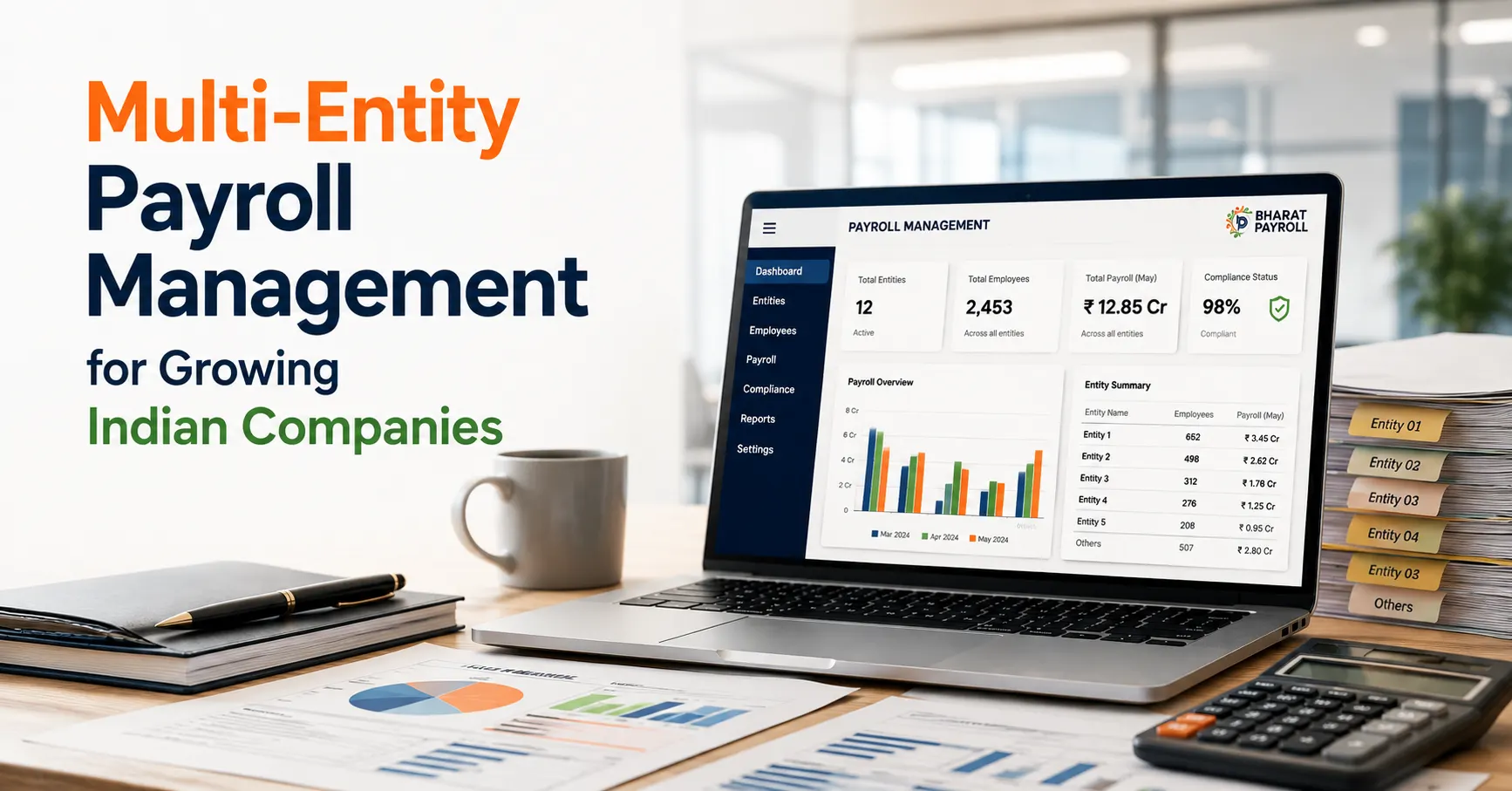
A multi-entity payroll system solves this by allowing each company to run its own payroll rules while feeding accurate data into a central dashboard.
The India-Specific Payroll Problem
Payroll in India is not just about paying employees on time. It is tied to statutory compliance, state rules, wage structures, documentation, and audit readiness.
For a growing company, these areas become more complex with every new entity.
PF may need establishment-level mapping. ESI depends on coverage and eligible wages. Professional Tax changes from state to state. Labour Welfare Fund applies only in certain states and follows its own contribution frequency. TDS depends on employee declarations, salary projections, tax regime selection, previous employment income, and investment proofs.
Now add the new Labour Codes into the picture.
The focus on wage definitions, timely payment, social security, and compliance discipline makes payroll structure more important than ever. Companies can no longer afford to treat payroll as a back-office calculation done in scattered spreadsheets.
For multi-entity businesses, the payroll system must answer one simple question every month:
“Is every employee paid correctly, under the correct entity, with the right deductions, approvals, and statutory reports?”
If the answer is not clear, the payroll process is not ready for scale.
Common Multi-Entity Payroll Challenges
Different Salary Structures Across Entities
One company may have Basic, HRA, Special Allowance, and Conveyance. Another may use CTC with flexible benefits. A newly acquired entity may still have an older format.
If salary components are not standardised carefully, payroll reports become hard to compare. It also affects PF, gratuity, bonus, taxable income, and cost reporting.
Entity Transfers During the Year
Employees may move from one group company to another. This creates questions around joining date, exit date, leave balance, tax calculation, previous payroll data, Form 16, gratuity continuity, and full and final settlement.
A casual transfer entry can create problems later if payroll and compliance records are not aligned.
State-Wise Compliance Differences
This is one of the biggest reasons Indian companies need a proper multi entity payroll.
Professional Tax, LWF, holiday rules, leave rules, minimum wages, and local compliance can vary depending on where the employee works. A single payroll rule cannot be applied blindly across all locations.
Manual Payroll Consolidation
When each entity runs payroll separately, group reporting usually happens through Excel. Someone collects all payroll sheets and creates a consolidated report.
That works for a while. Then it becomes slow, error-prone, and difficult to audit.
Different Approval Workflows
In one entity, salary revisions may need HR and finance approval. In another, the business head may approve incentives. In a manufacturing unit, overtime may come from shift supervisors.
Without workflow control, payroll teams end up chasing approvals until the last day.
Duplicate or Inconsistent Employee Records
When companies expand fast, employee data often gets duplicated. One employee may have different codes across systems. Bank details may be updated in one file but not another. PAN, UAN, ESIC, and Aadhaar data may be incomplete.
Small data gaps become payroll errors.
What a Good Multi-Company Payroll System Should Do
A good multi-company payroll system should not force every entity into the same structure. It should allow flexibility without losing control.
Here is what growing Indian companies should look for:
| Payroll Need | What the System Should Support |
| Separate entity payroll | Run payroll independently for each legal entity |
| Group-level reports | Consolidate payroll cost, headcount, deductions, and liabilities |
| Compliance mapping | Manage PF, ESI, PT, TDS, and LWF as per entity and location |
| Approval workflows | Route salary changes, arrears, reimbursements, and payouts properly |
| Employee transfers | Manage movement between entities with clean records |
| Audit trails | Track who changed what, when, and why |
| Role-based access | Allow HR, finance, managers, and admins to see only relevant data |
| Payroll analytics | Give leadership a real view of workforce cost and trends |
The best payroll system should feel practical, not complicated. HR should be able to process monthly payroll. Finance should be able to trust the numbers. Leadership should be able to see the bigger picture.
Why Separate Payroll and Consolidated Reporting Must Work Together
Some companies try to solve multi-entity payroll by creating one master payroll sheet for the whole group.
That is risky.
Each entity may have different statutory registrations, cost structures, salary rules, approval flows, and compliance obligations. Merging everything into one flat sheet can make audits difficult.
Other companies go in the opposite direction. They allow every entity to run payroll separately with no central visibility.
That also creates problems.
The right approach sits in the middle.
Payroll should be processed entity-wise, but reviewed group-wise.
This gives companies the best of both worlds. Each legal entity stays compliant. The group gets a clean consolidated view. HR does not lose control. Finance does not have to rebuild reports from scratch.
How Multi-Entity Payroll Helps Finance Teams
For finance teams, payroll is one of the largest recurring costs. In growing Indian companies, salary cost is not just a monthly payout. It affects cash flow, budgeting, profitability, cost allocation, and statutory liabilities.
A multi-entity payroll system helps finance teams see:
- Entity-wise salary expense
- Department-wise payroll cost
- Branch-wise manpower cost
- Employer contribution liabilities
- Bonus, incentive, and arrear payouts
- Full and final settlement impact
- Payroll variance from the previous month
- Cost movement after hiring or restructuring
This is where payroll becomes more than processing. It becomes a business control function.
When payroll data is clean, finance can close books faster, plan cash flow better, and answer leadership questions with confidence.
How It Helps HR Teams
HR teams are usually the first to feel payroll pressure.
Employees ask about salary slips. Managers ask about new joiner pay. Finance asks for reports. Compliance asks for filings. Leadership asks for headcount. Meanwhile, attendance, leave, overtime, reimbursements, and arrears keep changing until the cut-off.
In a multi-entity setup, this pressure multiplies.
A proper payroll system helps HR by giving one place to manage employee records, salary structures, attendance inputs, leave data, transfers, approvals, and payroll status.
It also reduces repeated questions like:
“Has this employee been moved to the new entity?”
“Which salary structure applies here?”
“Why is PT deducted differently?”
“Who approved this arrear?”
“Is the full and final settlement ready?”
When the system holds the answer, HR does not have to keep explaining the same thing every month.
Where Bharat Payroll Fits In
Bharat Payroll is built for Indian payroll realities, not generic salary processing.
For growing companies with multiple entities, branches, or group companies, Bharat Payroll helps bring payroll, HRMS, attendance, compliance, reports, and employee records into one connected system.
Businesses can manage payroll across entities while still keeping data structured for PF, ESI, TDS, PT, LWF, salary components, payslips, approvals, and reports. This is important for companies that are scaling across cities, states, factories, offices, and business units.
The real benefit is control.
HR teams can process payroll with fewer manual checks. Finance teams can review consolidated payroll costs. Employees can access payslips and salary information through self-service. Management gets better visibility into workforce cost across the group.
For Indian companies moving from single-entity operations to group structures, this kind of payroll control is no longer optional. It becomes part of responsible growth.
Signs Your Company Needs Multi-Entity Payroll
A company may not always know when it has outgrown its old payroll process. The warning signs are usually visible before the errors become serious.
You may need multi-entity payroll if:
- Payroll is managed separately for each group company
- Finance manually consolidates payroll every month
- Employees work across multiple states
- PT, LWF, or local compliance is handled outside the system
- Salary structures differ widely across entities
- Employee transfers are tracked manually
- Payroll approval depends on emails and Excel files
- Reports do not match between HR and finance
- Audit queries take too long to answer
- Management lacks a group-level payroll view
If three or more of these are true, payroll is already under strain.
What Companies Should Fix Before Moving to Multi-Entity Payroll
Software helps, but messy data can weaken any system.
Before shifting to a multi-entity payroll platform, companies should clean up a few basics.
Start with employee master data. Check PAN, UAN, ESIC number, bank details, joining date, location, department, designation, cost center, and entity mapping.
Then review salary structures. Identify which components should be standard and which can vary by entity or employee group.
Next, define payroll calendars. Every entity should have clear cut-offs for attendance, reimbursements, salary revisions, approvals, and payroll release.
Finally, define reporting needs. HR, finance, compliance, auditors, and leadership may all need different views. It is better to plan these reports before implementation rather than chase them later.
A clean setup makes payroll consolidation much easier.
Final Thoughts
Multi-entity growth is a good problem, but only if payroll is ready for it.
When Indian companies expand across entities, states, locations, and business units, payroll becomes more than a monthly salary run. It becomes a compliance, finance, HR, and governance function.
A strong multi entity payroll system helps companies keep entity-wise payroll accurate while giving leadership a consolidated view of payroll cost and compliance. It reduces manual work, improves control, supports audits, and helps HR and finance teams work from the same data.
For group companies, fast-growing startups, manufacturing units, services firms, and multi-location businesses, payroll should not depend on scattered files and last-minute checks.
Bharat Payroll helps Indian businesses manage group company payroll, multi-company payroll, and payroll consolidation with better structure, compliance visibility, and control.
Growth becomes easier when payroll can scale with it.
Manage Multi-Entity Payroll with Complete Control
Run payroll for multiple companies, automate statutory compliance, and get consolidated reports from a single platform.
FAQs
1. What is multi-entity payroll?
Multi-entity payroll is the process of managing payroll for multiple legal entities, branches, subsidiaries, or group companies from one controlled payroll system.
2. Why do Indian companies need multi-company payroll?
Indian companies need multi-company payroll to manage separate entities, state-wise compliance, salary structures, employee transfers, and consolidated payroll reporting.
3. What is payroll consolidation?
Payroll consolidation brings payroll data from different entities into one reporting view for finance, HR, compliance, and leadership decisions.
4. How does group company payroll help finance teams?
Group company payroll helps finance teams track salary cost, statutory liabilities, headcount, department-wise expenses, and entity-wise payroll trends from one place.
5. Can Bharat Payroll manage payroll for multiple entities?
Yes. Bharat Payroll helps Indian companies manage payroll across multiple entities, locations, departments, and compliance rules with centralized control and reports.
6. What compliances matter in multi-entity payroll in India?
PF, ESI, TDS, Professional Tax, Labour Welfare Fund, wage rules, leave rules, and state-specific payroll requirements matter in multi-entity payroll.