

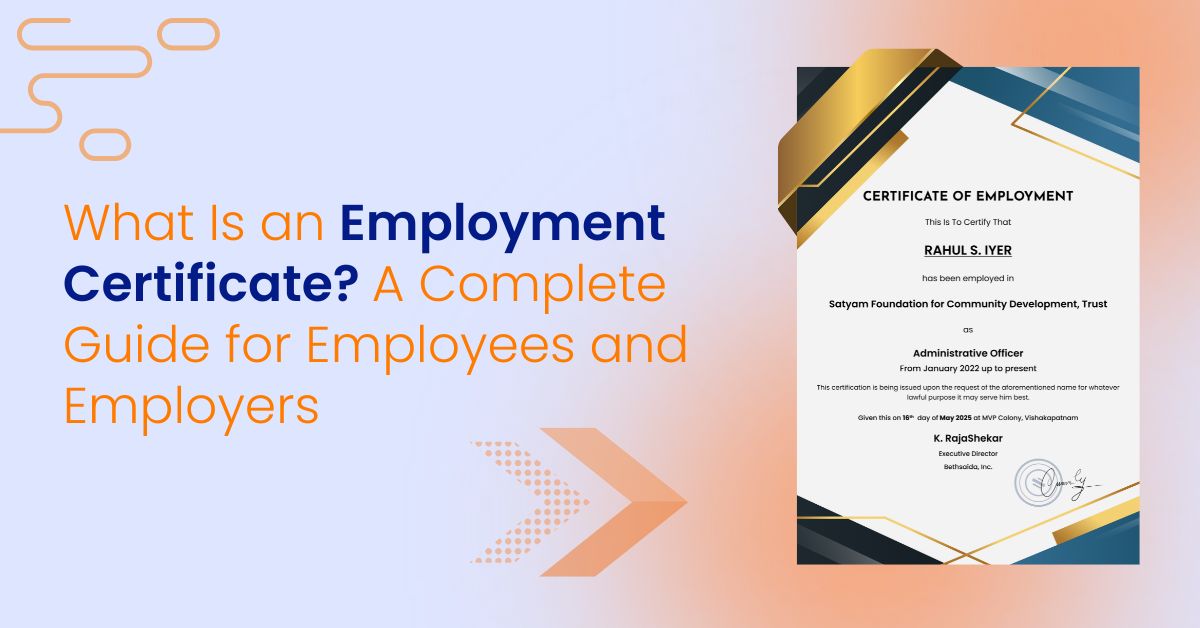
A certificate of employment is an official document that confirms a person’s job status, role, and employment history with an organization. It is commonly used for professional verification, financial approvals, and legal requirements.
Employees rely on employment certificates when applying for jobs, loans, visas, or rental housing. Employers use them to formally verify employment details and demonstrate compliance with labor and HR regulations.
With modern payroll and HR platforms like Bharat Payroll, organizations can generate accurate employment certificates directly from payroll and employee records, reducing manual errors and compliance risks.
This blog explains what an employment certificate is, why it matters for both employees and employers, the different types used, employer responsibilities for payroll and compliance, and best practices for requesting and issuing certificates correctly.
What Is a Certificate of Employment?
A certificate of employment is an official document issued by an employer to confirm basic employment details of an individual.
What it confirms
- The person is currently employed or was previously employed
- The job title or role held
- The employment duration
- The current employment status
Example:
If an employee applies for a home loan, the bank may ask for a certificate of employment to confirm that the applicant is actively employed and earning a regular income.
Why must it be accurate
- Information is verified against HR and payroll records
- Third parties rely on it for legal and financial decisions
- Any mismatch can cause rejections or delays
Example:
If the salary or employment status in the certificate does not match payroll records, a visa or loan application may be rejected.
How it is used
- Job applications and background verification
- Bank loans and credit approvals
- Visa and immigration processing
- Rental and housing verification
Example:
A landlord may request a certificate of employment to confirm stable employment before approving a rental agreement.
Why is it an official document
- Issued on company letterhead
- Signed by authorized HR or management
- Based on verifiable employment data
This is why a certificate of employment is not optional or informal. It must be issued correctly, using accurate records, to be accepted by authorities and institutions.
Why Employment Certificates Matter for Employees
For employees, an employment certificate is often required for major career and life decisions. Many institutions rely on verified employment proof before approval.
Employment certificates help employees:
- Provide employment history and job title during formal job applications
- Confirm current employment status and stable income for financial institutions
- Support visa applications with verified employment details for the immigration department
- Verify employment relationship for rental agreements and housing approvals
- Provide official document proof after leaving a previous employer
- Confirm salary details and monthly payments for loan eligibility
- Establish credibility with prospective employers during the final hiring stage
- Validate employment dates and the employee’s start date accurately
- Avoid delays caused by false information or missing employment records
- Maintain verified records aligned with employment laws and the labour code
Without a proper certificate of employment, employees may face delays, rejections, or repeated verification requests from government agencies, future employers, or financial institutions.
Why Employment Certificates Matter for Employers
For employers, issuing employment certificates is not just an administrative task. It reflects professionalism, legal compliance, and responsible human resource management.
Employment certificates help employers:
- Maintain transparent employment relationships with current employees and former employees
- Provide official document proof aligned with employment laws and the labour code
- Avoid employment verification disputes with government agencies and financial institutions
- Reduce legal risk when an employer refuses or delays certificate issuance
- Protect the employer’s reputation through accurate employment details and records
- Ensure consistency between payroll, employment contract, and employment status
- Demonstrate ethical HR practices to the labor court and labour court authorities
- Support employee rights by responding promptly to employees’ requests
- Standardize issuance usingthe approved employment certificate template
- Strengthen trust with prospective employers by requesting employment confirmation
Timely and accurate issuance of a certificate of employment protects the organization legally while also supporting employees during job changes, visa processes, and financial verifications.
Types of Employment Certificates and Their Uses
Different situations require different formats. Issuing the correct type ensures acceptance by third parties.
| Certificate Type | Issued To | Common Use |
|---|---|---|
| Certificate for Current Employees | Active employees | Loans, visas, rentals |
| Certificate for Former Employees | Resigned or terminated employees | Job verification, records |
| Certificate for Visa or Immigration | Active employees | Immigration and embassy submissions |
| Certificate for Loan or Credit | Active employees | Banks and financial institutions |
| Digital Employment Certificate | Current or former employees | HR system–generated verification |
Key Information Included in an Employment Certificate
An employment certificate must clearly present verified employment information. Any missing, incorrect, or inconsistent detail may result in rejection by banks, government bodies, or prospective employers.
Instead of viewing it as a simple list, the information can be understood in three logical groups:
1. Employee Identification Details
These details confirm who the certificate is issued for and must exactly match official records.
- Employee’s full legal name
- Job title and designation held
2. Employment Relationship Details
These details confirm the nature and duration of employment.
- Employee’s start date and end date, if applicable
- Current employment status (active or former employee)
- Salary information, only when specifically requested
3. Employer Verification Details
These details confirm who is issuing the document and its authenticity.
- Company name and registered address
- Authorized signatory name and designation
- Official company seal or stamp
Employees should always review the certificate carefully before using it. Employers must verify all HR and payroll records before issuance to ensure accuracy and compliance.
Employment Certificate – Employer Responsibilities
Generate accurately for payroll & compliance
Employers are legally and ethically responsible for issuing employment certificates correctly, securely, and on time.
Employer responsibilities include:
- Using official company letterhead to issue legally valid employment certificate documents
- Issuing employment certificates only through the HR department or an authorized person
- Matching employment details strictly with payroll records and employment contract data
- Issuing certificates within legally defined timelines under employment laws
- Ensuring secure delivery to employees or the requesting party, including third parties
- Correcting false information or factual errors promptly upon the employee’s request
Failure to comply may expose employers to labor disputes, labour court actions, and legal penalties under applicable labour code and employment laws.
How Employees Should Request an Employment Certificate
Submitting a clear and structured request helps employers process employment certificates faster and with fewer errors.
Step-by-step process:
1. Identify the right contact
Reach out to the HR department, human resources manager, office manager, or direct supervisor responsible for employment documentation.
2. Send a formal request
Write a professional request letter or email, including your full name, job title, employment dates, anda clear reason for requesting the certificate.
3. Specify required details
Clearly mention if salary information, current employment status, or third-party delivery is required for loans, visas, or rental agreements.
4. Provide contact details
Share your phone number, email address, and mailing address so HR can contact you for clarification if needed.
5. Follow internal procedures
Use official HR portals, employment management systems, or prescribed forms if your organization requires them.
6. Request in advance
Submit your request early, especially when deadlines exist for job applications, visa processing, or financial approvals.
Professional, complete requests reduce delays, prevent follow-ups, and ensure accurate issuance of the certificate of employment.
Employment Certificate vs Experience Letter
These documents serve different purposes and should not be confused.
| Document | Purpose | Common Use |
|---|---|---|
| Employment Certificate | Confirms factual employment details | Verification, compliance |
| Experience Letter | Describes role, skills, performance | Career growth, references |
Employees should request the document based on the actual requirement.
Legal Rights and Compliance Considerations
In many countries, employment laws require employers to issue an employment certificate when an employee formally requests it.
Common legal principles:
Mandatory issuance within a defined timeframe
Employers must issue the employment certificate within the timelines specified under the labor laws or labour code.
Employee’s right to request corrections
Employees are legally allowed to request corrections if employment details contain errors or false information.
Protection against refusal or unjustified delays
Employers cannot refuse or delay issuance without a valid legal justification under employment laws.
Applicability across all employment types
Legal obligations apply to probation, fixed-term contract, full-time, and contractual employment arrangements.
Compliance with data protection and privacy laws
Employment certificates must follow privacy laws when sharing salary information or personal details.
Employees may approach the labour court, the labour court authorities, or government bodies if employer obligations are not fulfilled.
Common Mistakes to Avoid
Mistakes from either side can lead to unnecessary delays, rejections, or legal complications.
1. Common employee mistakes:
Sending informal or incomplete requests
Informal emails or missing employment details often delay processing by HR professionals.
Not verifying certificate details carefully
Employees sometimes submit certificates without checking employment dates or job title accuracy.
Missing correction timelines
Delays in requesting corrections may limit legal remedies under labor laws.
2. Common employer mistakes:
Delaying issuance without justification
Unexplained delays may violate employee rights and trigger labor court complaints.
Providing incorrect or incomplete information
Mismatched payroll, salary details, or employment status can cause rejection by authorities.
Using unauthorized signatories or templates
Certificates must be signed by an authorized person using approved company templates.
Clear, professional communication between employees and employers prevents most of these issues.
Best Practices for Employees and Employers
| Role | Best Practice |
|---|---|
| Employees | Keep digital and printed copies |
| Employers | Maintain standardized templates |
| Both | Communicate clearly and professionally |
Conclusion: Why Employment Certificates Matter for Everyone
A certificate of employment is not just paperwork. It is a critical link between professional history, financial credibility, and legal compliance.
- For employees: It supports career growth, mobility, and financial access
- For employers: It demonstrates transparency, compliance, and responsible HR management
Clear processes, accurate records, and timely issuance protect both parties and build long-term trust.
Employment Certificate Made Simple with Bharat Payroll
Manage employment certificates accurately using Bharat Payroll with automated payroll, compliance workflows, and secure HR documentation.
Frequently Asked Questions (FAQs)
1. What is a certificate of employment?
A certificate of employment is an official document issued by an employer confirming an employee’s job title, employment dates, current employment status, and salary details if requested. It is commonly used for job verification, loans, visas, and legal purposes.
2. Who can request an employment certificate?
Any current or former employee can request a certificate of employment, regardless of contract type, employment duration, resignation reason, or termination status, as long as an employment relationship previously existed with the employer.
3. How should an employee request it?
Employees should submit a formal request through email, HR portal, or a written request letter, clearly stating their full name, job title, employment period, purpose of the certificate, and any specific details required by the requesting party.
4. How long does issuance take?
Most employers issue employment certificates within seven working days. Timelines may vary based on company policy, internal HR processes, document verification requirements, and local employment laws governing certificate issuance.
5. Can an employer refuse to issue it?
In many jurisdictions, employers cannot refuse to issue an employment certificate without valid legal reasons. Unjustified refusal or delay may violate labor laws and employee rights, potentially leading to complaints before labor authorities or courts.
6. What if the certificate has incorrect information?
If incorrect details are found, employees have the right to request corrections within a specified timeframe, often fourteen days. Employers are legally expected to correct factual errors related to employment dates, salary details, or job titles promptly.
7. Is it required for visa applications?
Yes, employment certificates are commonly required for visa and immigration applications. Immigration departments use them to verify employment status, income stability, employer details, and ongoing employment relationships during visa approval processes.
8. Can it be sent directly to third parties?
Yes, with the employee’s consent, employers can send employment certificates directly to third parties such as banks, landlords, government agencies, or prospective employers using official channels and verified contact details.
9. What laws govern employment certificates?
Employment certificates are governed by labor laws, labor codes, and employment regulations in each country. These laws define employer obligations, employee rights, issuance timelines, correction procedures, and data protection requirements related to employment documentation.