
Post payroll work starts when salary processing ends. That is the part many teams underestimate. Salary may be calculated, approved, and released, yet the payroll cycle is still not complete. Reports still need to move to finance. Statutory amounts still need to be deposited. Payslips still need to be issued. Queries still need answers. Records still need to stand up to audits. In India, where payroll connects directly with TDS, PF, ESI, professional tax, salary reports, and employee trust, post-payroll activities decide whether payroll closes well or leaves behind a trail of loose ends.
For employers, this is where payroll either proves its discipline or exposes its weak spots. If the work after salary release is rushed, the company usually sees the damage in delayed filings, confused employees, broken financial reconciliation, and a month-end cleanup that keeps repeating. If the structure is strong, payroll becomes easier to review, easier to explain, and easier to trust.
This guide explains the post-payroll meaning, the core post-payroll activities, and the full post-payroll process that employers should control after salary is processed.
What Is Post Payroll?
Post payroll refers to the activities that happen after the salary has been calculated and the payroll run has been completed. These activities include salary disbursement support, payslip release, statutory remittance, reporting, record keeping, query handling, reconciliation, and audit-ready documentation.
In other words, payroll does not end when net pay is ready. It ends when the company has completed the work that follows pay processing and can show that salary data, reports, deductions, and filings are all correct and complete.
That distinction matters. Many teams treat salary calculation as the main event and the rest as follow-up admin. That view creates problems. The post payroll process is where payroll data starts moving outward across finance, compliance, employee service, and reporting.
Bring Post Payroll Reports, Payslips, and Compliance Follow-Through Into One Flow
Use Bharat Payroll to manage payroll reports, payslips, salary visibility, and post payroll controls with better clarity.
Why Post Payroll Activities Matter More Than Teams Expect
Post payroll activities protect more than compliance. They protect payroll accuracy after the cycle closes. A weak post-payroll setup usually creates trouble in five places:
- employee confidence when payslips or answers are delayed
- finance accuracy when reports do not match accounting needs
- compliance control when remittance deadlines are missed
- management visibility when payroll reporting is incomplete
- audit readiness when records are scattered or hard to explain
This is why post-payroll work should not be treated as the tail end of payroll. It is part of payroll control itself.
Post Payroll Checklist for Employers
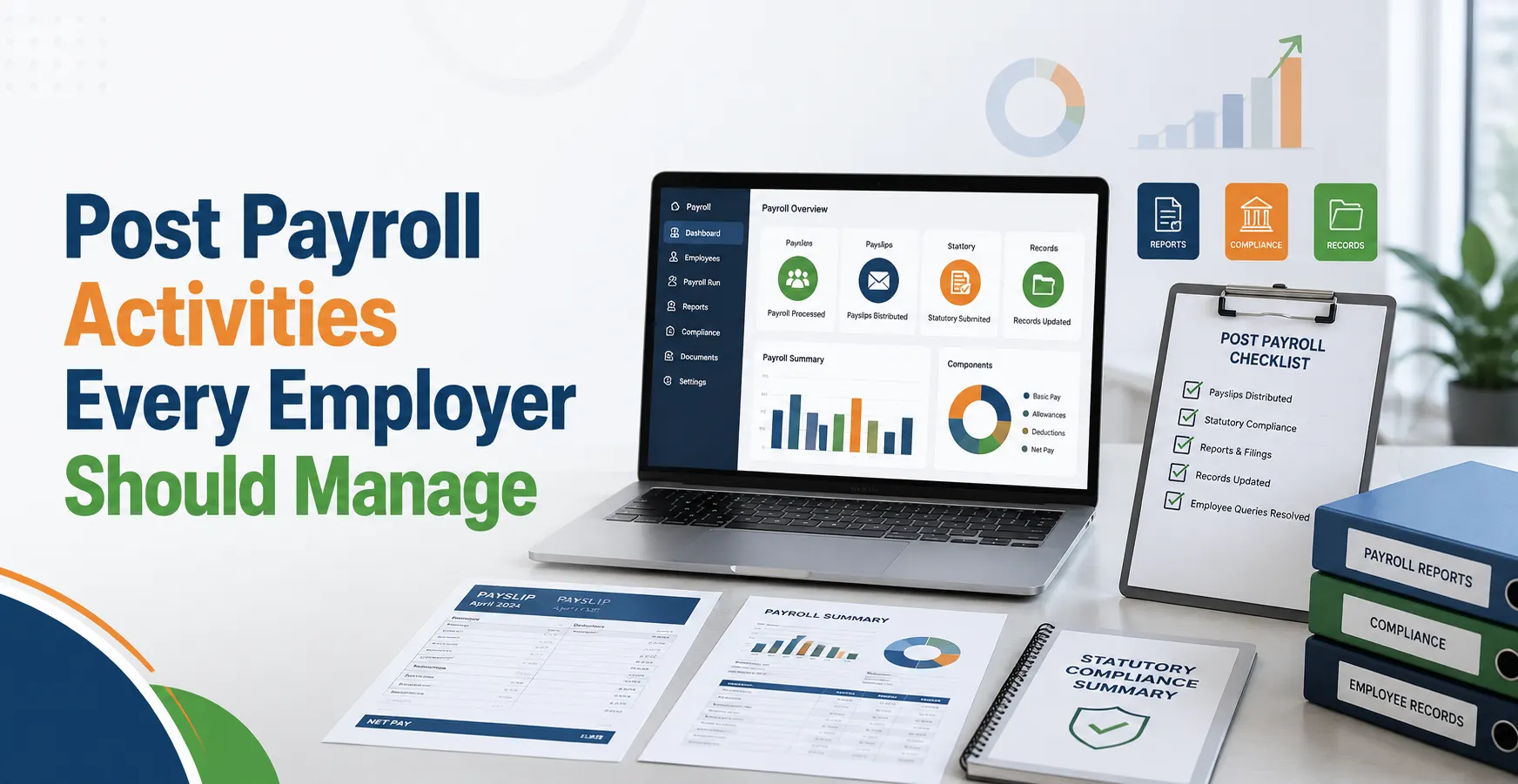
Before closing any payroll cycle, employers should confirm that:
- Payroll outputs have been validated
- Bank files and payment instructions are correct
- Joiners, leavers, and hold cases are reviewed
- Payslips are generated and released
- TDS, PF, ESI, PT, and other deductions are tracked for remittance
- Payroll reports are shared with finance and management
- Employee queries have a clear response path
- Payroll records are stored for audit and future reference
The Importance of Post Payroll Activities
The importance of post-payroll activities becomes clearer when employers look at what each task supports.
Salary data feeds finance. Deductions feed statutory filings. Payslips feed employee trust. Reports feed review and management decisions. Payroll records feed audits and future corrections.
If one of those parts is weak, the problem rarely stays small. A missed deduction filing turns into compliance pain. A weak bank file review turns into a payment delay. A poorly maintained payroll record turns into a dispute that nobody can close quickly.
That is why stronger post-payroll activities help employers with:
Payroll closure discipline
The payroll cycle is only complete when the last action tied to that cycle has been done properly.
Employee confidence
Employees trust payroll more when their pay, pay slips, deductions, and support requests all line up.
Finance and accounting clarity
Salary expense is one of the largest cost heads for most businesses. Poor post-payroll reporting weakens cost visibility very quickly.
Compliance control
TDS, PF, ESI, professional tax, labour welfare fund, and other statutory follow-through cannot sit in memory or spreadsheets alone.
What the Post Payroll Process Usually Includes
A good post-payroll process usually covers these stages in sequence:
1. Payroll output validation
The payroll run may be complete, though outputs still need review. Teams should validate salary summaries, deduction totals, bank advice, and exception cases before closing the cycle fully.
2. Employee payment support
Some companies handle bank transfer preparation internally. Others work with payroll partners or banking files. In both cases, payment support remains part of post-payroll work.
3. Payslip generation and release
Employees need timely salary slips with clear earnings, deductions, and net pay visibility.
4. Statutory remittance and filing
Amounts already deducted still need to be deposited and reported to the right authorities on time.
5. Finance and management reporting
Payroll reports move to finance, HR, and leadership for review, booking, and decision-making.
6. Query handling and record keeping
Employees ask questions after salary release, not before. At the same time, payroll records need to be stored in a way that supports later review.
Turn Post Payroll Steps Into a More Controlled Workflow
Use Bharat Payroll to handle salary outputs, payslips, reports, and post payroll follow-through with better visibility.
Report Generation and Validation
One of the most important post-payroll activities is report generation and validation.
Payroll does not only create one output. It usually creates multiple report needs across teams, such as:
- payroll summary reports
- salary register or pay register
- bank transfer files
- deduction and contribution reports
- cost-centre or department-wise summaries
- employee-wise salary details
- TDS or tax reports
- salary-on-hold or exclusion views
- variance and reconciliation reports
This is where many employers lose time. They process payroll, then start rebuilding the same information in different formats for HR, finance, and audit review.
Bharat Payroll’s public product pages already position reporting as a major strength. The platform highlights payroll summaries, tax filing support, deduction and contribution reports, salary info reports, customised reporting, compliance reports, and bank transfer code support.
For employers, that matters because cleaner reporting after payroll means:
- less manual report preparation
- faster finance handover
- better validation before payment
- stronger audit support later
Ensuring Employees Are Paid on Time
Salary timeliness is one of the clearest tests of payroll credibility.
The company may process payroll correctly and still create employee dissatisfaction if payment support after payroll is weak. A delayed bank file, a missed approval, or an incomplete account review can affect salary release even after payroll appears finished.
That is why post payroll work must include payment-readiness checks, such as:
Bank file accuracy
Net pay, employee account details, bank mapping, and exclusion cases need a last review.
Joiners and leavers
New employees should be included correctly. Employees on hold, exited employees, or unresolved cases should not slip through as payment mistakes.
Exception handling
Any hold, reversal, correction, or bank rejection should be tracked separately and resolved quickly.
Bharat Payroll’s public payroll product pages show support areas such as salary-on-hold status, bank transfer code, payroll reports, and payslip management, which are directly relevant to this stage of post-payroll control.
Employee Notifications and Payslip Release
A payroll cycle still feels incomplete to employees until they receive clear salary communication. This usually includes:
- Payslip release
- Salary credit confirmation, where relevant
- Access to salary breakdown
- Visibility into deductions and net pay
- Response support for mismatches
Bharat Payroll’s recent payslip-management content frames this well. It treats payslip handling as part of payroll control, not just a document issue, and ties it to accuracy, readability, access, timing, and record management.
That is the right way to see it. A good payslip release reduces employee confusion before it becomes payroll workload.
Handling the Queries
Post payroll is the stage where employee questions arrive. Some of the most common ones include:
- Why is my net salary different this month?
- Why was the tax deducted more than expected?
- Why is leave without pay affecting this salary?
- Why is my variable pay missing?
- Why is my salary on hold?
- Why does my payslip not match my expectations?
If query handling is weak, employees lose trust in payroll quickly. They may still receive a salary on time, though the experience feels unreliable.
A stronger post-payroll process gives teams:
Clear payslip support
If payslips are well structured, fewer questions become disputes.
Faster access to payroll records
Teams need employee-wise salary data, deductions, and prior cycle comparisons ready at hand.
Controlled escalation
Not every question should turn into a payroll rework. Good query handling separates explanation from correction.
Payroll Compliance and Last-Mile Activities
This is one of the most important parts of post-payroll.
During payroll, deductions may already have been computed. After payroll, the employer still needs to deposit and report them properly. In India, that usually includes TDS and social-security-related remittances such as PF and ESI, where applicable.
Current official guidance continues to show that, in general, TDS must be deposited by the 7th of the following month, with the March exception due by 30 April for non-government deductors.
PF and ESI deadlines are also deadline-sensitive and are commonly tracked monthly by payroll teams. For employers, this means post-payroll work must include:
- remittance tracking
- filing preparation
- due-date monitoring
- report support for statutory review
- proof and record storage
This is exactly where spreadsheet-led tracking starts showing strain. Dates differ, cycles repeat, and missed follow-up turns into avoidable penalty risk.
Payroll Accounting and Reconciliation
Once payroll is complete, salary data usually needs to move into the accounting side properly. This may include:
- Salary expense booking
- Cost-centre allocation
- Deduction liability review
- Reimbursement alignment
- Variance explanation between cycles
- Reconciliation with attendance and employee master records
Bharat Payroll’s reporting pages already point toward this wider use of payroll reports by covering salary details, deductions, tax liabilities, customised payroll reports, and organised monthly payroll records.
This matters because payroll is not a closed HR lane. It is also one of the largest monthly finance data streams in the business.
Analytics and Reporting
The post-payroll phase is where payroll data turns into management information. A good reporting layer after payroll helps employers see:
- salary trends
- department-wise payroll cost
- deduction patterns
- bonus and incentive shifts
- hold or exception trends
- employee count and salary movement
- payroll variance across cycles
That reporting is useful for more than audit review. It helps leadership read cost movement and helps HR teams spot patterns before they become problems.
Make Payroll Reports Easier to Review, Share, and Reconcile
From payroll summaries to deduction reports, Bharat Payroll helps employers work with cleaner post-payroll records.
Enhanced Reporting Capabilities
The difference between basic reporting and useful reporting is simple. Basic reporting tells the company what was paid. Useful reporting helps the company understand:
- Why the payroll changed
- Where costs are moving
- What deductions are rising
- Where attendance or leave is affecting pay
- Which employee groups need closer review
- Where the correction work keeps recurring
Bharat Payroll positions its reporting and analytics stack around exactly this kind of payroll visibility, including salary info reports, tax filings, deduction reports, customised payroll reports, and audit-friendly reporting.
Comparison Table: Core Post Payroll Activities
| Post payroll activity | What it covers | Why it matters |
| Report generation and validation | Payroll summaries, bank files, deduction reports, and salary details | Helps with finance, audit review, and payroll closure |
| Employee payment support | Bank advice, exclusions, hold cases, payment confirmation | Protects salary timeliness and trust |
| Payslip release and notifications | Salary slips, breakdown visibility, and employee communication | Reduces confusion and improves transparency |
| Compliance follow-through | TDS, PF, ESI, PT, filing support, due-date tracking | Protects the company from penalties and missed filing risk |
| Query handling | Salary questions, deduction review, exception resolution | Protects payroll credibility and employee experience |
| Accounting and reconciliation | Expense booking, cost review, variance checks | Connects payroll with finance control |
| Analytics and reporting | Payroll trends, deduction movement, and employee cost visibility | Supports management review and future decisions |
How Bharat Payroll Supports Post Payroll Activities
Bharat Payroll is commercially relevant here because post-payroll work depends on reporting, salary visibility, payroll control, and employee-facing clarity after the cycle closes.
Its public pages already highlight:
- payroll reports for summaries, deductions, contributions, and tax filings
- salary info reports for earnings, deductions, and benefits visibility
- payslip management for payroll-linked document control
- salary-on-hold tracking for exception visibility
- compliance and payroll reporting support for organised review after payroll
That gives employers a clearer structure around post-payroll activities, instead of forcing teams to rebuild payroll outputs across files and mail chains after every cycle.
Conclusion
Post payroll is where payroll either closes properly or keeps leaking work into the next cycle.
Salary may already be processed, though the real quality of payroll still depends on what happens after that point. Reports need validation. Finance needs usable outputs. Employees need payslips and answers. Compliance needs follow-through. Records need to stand up to review later.
That is why post-payroll activities should be treated as an active control stage, not as leftover admin work. Employers who take this stage seriously usually gain cleaner records, stronger employee trust, better reporting, and fewer repetitive payroll problems every month.
Keep Post Payroll Work Accurate After Salary Is Released
Use Bharat Payroll to manage reports, payslips, deductions, and post payroll review without repeated cleanup.
Frequently Asked Questions
1. What does post payroll mean?
Post payroll meaning refers to the activities completed after payroll processing, such as salary disbursement support, payslip release, statutory remittance, reporting, record keeping, and employee query handling.
2. What are post-payroll activities?
Post payroll activities usually include report generation, bank file validation, employee notifications, payslip release, statutory filings, payroll accounting, reconciliation, analytics, and payroll record maintenance.
3. Why is the post-payroll process important?
The post-payroll process matters because payroll does not end with salary calculation. Employers still need to complete compliance follow-through, payment support, finance reporting, and employee communication properly.
4. What happens in post-payroll compliance?
Post payroll compliance usually includes remitting deducted amounts such as TDS, PF, and ESI where applicable, preparing reports, and tracking filing or payment deadlines.
5. How does Bharat Payroll help with post-payroll activities?
Bharat Payroll supports post-payroll work through payroll reports, salary info reports, payslip management, compliance-linked reporting, and salary-on-hold visibility for stronger payroll control after salary processing.