
Salary conversations in India are changing, but not always in a formal way. Employees are not waiting for policy updates. They are checking salary ranges online, comparing offers with friends, looking at LinkedIn posts, and asking sharper questions during interviews.
For years, many Indian companies handled pay discussions quietly. The candidate shared the current CTC. The recruiter asked for the expected CTC. The final offer was shaped around negotiation, budget, urgency, and sometimes gut feeling. Existing employees usually found out later that a new hire in the same role had joined at a higher salary.
That model is gradually becoming unviable now.
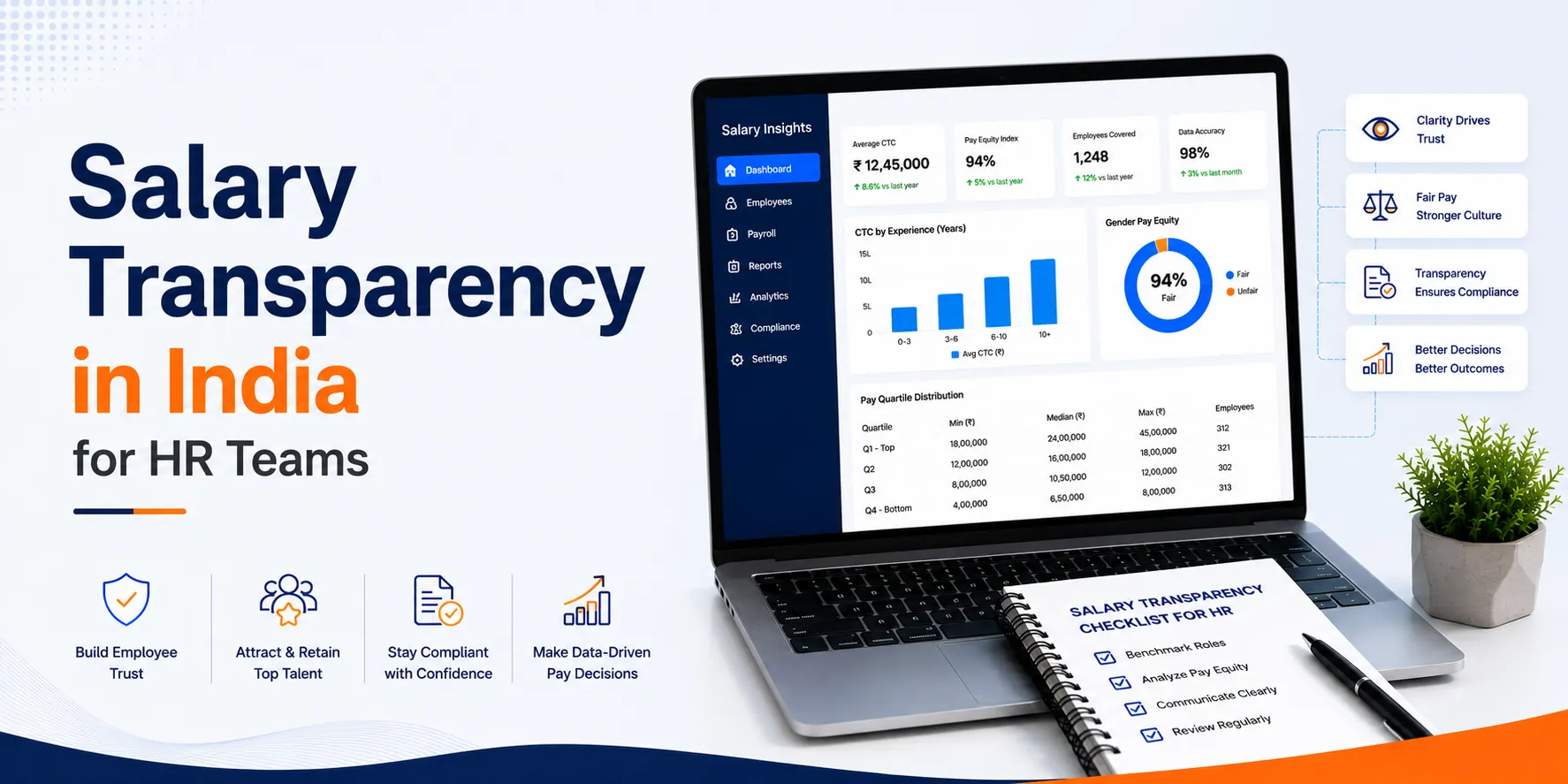
Salary transparency does not mean every company has to publish every employee’s pay. It means the company should be able to explain how salaries are decided, what a salary range includes, why pay may differ between two people, and how employees can grow into the next level.
For HR teams, the real work starts much before anything is disclosed. It starts with clean salary data, clear job levels, proper CTC breakups, manager training, and reliable cloud payroll software that keeps compensation records accurate.
Salary Transparency Is Not Just a Salary Range
In many global conversations, pay transparency is mostly about showing salary ranges in job ads. In India, the issue is more layered.
A candidate may see “₹10 LPA” and still ask, “How much will I get in hand?” An employee may know their CTC but not understand how much is fixed, how much is variable, what is deducted, and what is counted as a benefit.
That is why salary transparency in India has to cover more than the final number.
It should explain:
- CTC
- Fixed salary
- Variable pay
- Bonus
- Incentives
- PF contribution
- Gratuity
- Insurance
- Professional tax
- TDS
- In-hand salary
The problem is not that companies use CTC. The problem is that CTC is often explained badly. A package can look attractive on paper and still disappoint the employee when the first salary is credited.
HR teams that want to improve salary transparency should first make compensation easier to understand.
Why HR Teams Cannot Ignore This Shift
The pressure is coming from many directions.
Candidates are asking for salary ranges earlier in the hiring process. Employees are becoming more aware of market benchmarks. Younger workers are less willing to accept vague answers like “as per company standards.” Global companies are also bringing more structured pay practices into Indian teams, especially in GCCs and multinational offices.
There is also a trust angle. When employees do not understand how pay is decided, they assume the worst. They may feel negotiation matters more than performance. They may believe external hires are valued more than internal employees. They may think salary decisions are personal, not structured.
Sometimes they are right.
That is why salary transparency can be uncomfortable. It reveals the weak points in an existing compensation system. If designations are unclear, salary bands are missing, payroll data is scattered, or managers are not trained, transparency can create more questions than answers.
But avoiding the topic does not solve it. It only delays the reaction.
Start With Payroll Data, Not Policy Language
A salary transparency policy sounds good on paper. But if the data behind it is messy, HR will struggle.
This is where many companies get stuck. Salary information sits in one spreadsheet. Increment history is in another. Offer letters are saved in email folders. Payroll is handled separately. Attendance and leave data may not match salary deductions. Job titles are inconsistent across departments.
Before HR promises transparency, it needs to know whether the company can answer basic salary questions quickly and correctly.
For example:
- Can HR see the current CTC and previous CTC of every employee?
- Can it check when the last increment was given?
- Can it compare people in the same role and grade?
- Can it separate fixed pay from variable pay?
- Can it identify salary differences by location, tenure, or department?
- Can it explain why one employee is above the midpoint and another is below it?
If the answer is no, the first step is not communication. It is a cleanup.
Cloud payroll software helps here because it brings salary records, payslips, deductions, revisions, and payroll history into one place. When connected with a cloud HR system, it becomes easier to link salary data with joining date, designation, attendance, leave, promotion, and employee status.
That connection matters. Salary transparency depends on records, not memory.
CTC Needs Plain English
Many salary disputes begin with one simple issue: the employee did not fully understand the offer.
A candidate accepts ₹12 LPA. Later, they realize a part of it is variable. Another part includes employer PF. Gratuity is included. Insurance is counted. The actual monthly in-hand salary feels much lower than expected.
From the company’s side, the offer may be technically correct. From the employee’s side, it feels unclear.
That gap damages trust.
HR teams should make every offer and salary revision simple enough for an employee to understand without calling a payroll person three times. The breakup should clearly show what is guaranteed, what is performance-linked, what is deducted, and what will roughly reach the bank account each month.
This is one area where online payroll tools can reduce confusion. Standard salary structures, clear payslips, downloadable documents, and employee self-service access make the process more transparent.
But the language still matters. “Your annual CTC is ₹12 LPA” is not enough. HR should explain what that number actually means.
Salary Bands Should Come Before Salary Disclosure
A company cannot become transparent about pay if it has never defined its pay structure.
Many businesses in India grow quickly without building formal job levels. One person is called an executive, another senior executive, and another specialist, but the responsibilities are not clearly separated. Some employees are paid based on market urgency. Some are paid based on negotiation. Some are still sitting on old salary structures because they joined years ago.
This creates problems when salary ranges become visible.
A proper salary band answers a few important questions. What is the minimum and maximum pay for this role? What skills justify the higher end? What performance level is expected? What is the difference between junior, mid-level, and senior? Does location affect the range? Does certification, domain knowledge, or team ownership change the band?
Without this clarity, employees will compare only the number.
And once that happens, HR has very little room to explain.
Pay Gaps Need to Be Found Before Employees Find Them
Every company has some pay differences. Not all differences are unfair. A person with stronger experience, niche skills, high performance, or larger responsibility may earn more than another person in the same department.
The question is whether the difference can be explained.
A pay audit helps HR separate explainable differences from risky ones. It can show where people in similar roles are paid very differently without a clear reason. It can also show whether legacy hiring decisions, gender gaps, location assumptions, or aggressive negotiations have created uneven pay.
This is especially important before publishing salary ranges in job posts.
Imagine an existing employee earning ₹7.5 LPA seeing a new job posting for the same title with a range of ₹9 LPA to ₹12 LPA. That employee will not think about market correction or hiring difficulty. They will ask, “Why am I not in that range?”
HR needs an answer before that question arrives.
Payroll SaaS systems can make pay audits easier because they store compensation history in a more usable format. Instead of manually checking multiple sheets, HR can review salary data across departments, locations, grades, and employee groups.
The Current CTC Question Will Need Rethinking
In India, “What is your current CTC?” is almost automatic in recruitment. It helps recruiters screen candidates quickly. It also helps companies control offer budgets.
But it has a weakness. It can carry old pay gaps into new jobs.
If someone was underpaid in their previous company, a hike on current CTC may still leave them underpaid. If someone negotiated strongly earlier, they may continue to stay ahead. Over time, two people doing similar work can end up with very different salaries simply because their past salaries were different.
A more mature hiring process starts with the role, not the candidate’s last salary.
Before interviews begin, HR should know the budgeted range, job level, must-have skills, market value, and internal equity position. Candidate expectations still matter, but they should not be the only anchor.
This shift will not happen overnight in India. But HR teams that prepare early will have cleaner and fairer hiring discussions.
Managers Will Need Better Answers
Most employees do not ask HR first. They ask their manager.
“Why was my hike low?”
“What do I need to do for the next level?”
“Why is the new person earning more?”
“Is my salary below market?”
“Will my role be reviewed this year?”
If managers are not prepared, they either avoid the question or give a careless answer. Both are damaging.
Salary transparency needs manager enablement. Managers should understand the company’s salary bands, increment logic, promotion criteria, performance linkages, and escalation process. They do not need access to everyone’s salary. They do need enough context to explain decisions responsibly.
A good manager’s conversation can calm concerns. A poor one can push an employee toward resignation.
Do Not Announce Transparency Before Preparing Employees
Some companies make the mistake of treating salary transparency as an external branding move. They add salary ranges to job descriptions but do not prepare existing employees.
Adding salary ranges without preparing the present employees can backfire.
Employees will compare. They will check ranges. They will ask why new roles are priced differently. They will question whether they are below the band. If HR has not prepared internal communication, the company may end up reacting on a case-by-case basis.
A better approach is gradual.
First, clean the data. Then define bands. Then review gaps. Then align leadership and managers. Then improve offer letters and salary revision formats. After that, decide what can be shared externally and internally.
Transparency works better when people understand the system behind the number.
Where Cloud Payroll Software Fits In
Cloud payroll software will not fix pay fairness by itself. But it gives HR the foundation to manage salary transparency properly.
It keeps compensation records more organized. It reduces manual calculation errors. It helps generate payslips and salary documents. It tracks revisions. It supports statutory deductions. It gives HR better access to payroll history.
When paired with a digital HR platform, the value increases. HR can connect payroll with employee records, attendance, leave, performance, and promotion data. That makes salary decisions easier to review and explain.
For growing Indian companies, this matters because payroll is no longer just a monthly processing task. It is becoming a source of compensation intelligence.
The companies that still depend only on spreadsheets may find it difficult to answer pay questions with confidence.
What HR Should Fix First
HR teams do not need to solve everything at once. A practical starting point is to fix the areas employees notice most.
Start with clear CTC breakups. Make offer letters and revision letters easier to understand. Standardize salary structures. Review whether employees in similar roles are mapped to the right grade. Check for unexplained pay gaps. Train managers before they face difficult questions.
Then review the technology. If salary, attendance, leave, and payroll data are sitting in disconnected files, it may be time to move toward cloud payroll software or a broader cloud HR system.
The goal is not just automation. The goal is to make compensation decisions easier to defend.
Final Thoughts
Salary transparency in India will not look exactly like it does in other countries. Indian compensation has its own complexity: CTC, take-home salary, statutory deductions, variable pay, allowances, bonuses, and fast-changing market salaries.
That is why HR teams need to prepare carefully.
A company does not become transparent by publishing a salary range. It becomes transparent when it can explain the range, defend the structure, correct unfair gaps, and help employees understand how pay growth works.
For HR leaders, this is the right time to clean payroll data, build salary bands, simplify CTC communication, train managers, and invest in reliable online payroll tools.
The future of salary transparency in India will belong to companies that can answer one question clearly:
“Why is this employee paid this amount?”
If HR can answer that with data, fairness, and confidence, the company is ready for the next stage of pay transparency.
Build a Strong Foundation for Salary Transparency
Clear compensation communication starts with accurate payroll records and structured salary data. Bharat Payroll helps HR teams manage payroll, salary revisions, payslips, and compliance with confidence.
FAQs
1. What is salary transparency in India?
Salary transparency in India means giving employees and candidates clear information about salary ranges, CTC breakup, fixed pay, variable pay, deductions, benefits, and pay growth criteria.
2. Is salary transparency mandatory in India?
India does not currently require every private employer to publish salary ranges in all job postings. However, HR teams should still maintain fair pay records, clear salary structures, and proper wage documentation.
3. Why is CTC clarity important for Indian employees?
CTC can include fixed salary, variable pay, employer PF, gratuity, insurance, bonuses, and other benefits. Without a clear breakup, employees may misunderstand their actual in-hand salary.
4. What should HR teams do before sharing salary ranges?
HR teams should clean payroll data, define salary bands, review pay gaps, simplify CTC communication, train managers, and decide what salary details can be shared internally or externally.
5. How does cloud payroll software support salary transparency?
Cloud payroll software helps HR maintain salary records, payslips, deductions, salary revisions, and payroll history in one place. This makes compensation easier to explain, review, and audit.
6. Why should companies review pay gaps early?
Pay gap reviews help HR identify unexplained differences across roles, grades, gender, location, tenure, and performance. This helps companies fix issues before employees question salary differences.
7. How can Bharat Payroll help with salary transparency?
Bharat Payroll helps HR teams manage CTC breakups, payroll records, salary revisions, payslips, deductions, and compliance data with better accuracy. This supports clearer and more confident salary communication.