
HR should consider many things for running an accurate hospital payroll.
Nurses can swap shifts. Apart from OP consultations and surgeries, doctors take rounds. Lab technicians stay late for an emergency case, and a consultant visits twice a week. Reception, billing, pharmacy, security, housekeeping, and ward staff all follow different duty patterns. Some of them work on public holidays as well.
All of this looks seamless inside a hospital. But for payroll, every small change matters.
Unlike a basic salary tool made for fixed office hours, payroll software for hospitals needs customised features or workflows. Hospitals and clinics need a payroll that understands shifts, duty rosters, attendance corrections, overtime, night duty, leave, statutory deductions, and department-wise reports.
In healthcare, salary errors do not stay small. They affect staff trust, HR workload, finance reports, and the mood of teams already working under pressure.
Hospital Payroll Does Not Follow Office Timings
Most businesses run on a predictable schedule. Healthcare does not.
A hospital may have doctors, nurses, pharmacists, lab staff, radiology teams, billing executives, front desk staff, ward assistants, ambulance drivers, security, and housekeeping employees working in different shifts. Some are permanent employees. Some may be consultants. Some work fixed hours. Some rotate between day and night duties.
This makes healthcare payroll different from regular payroll.
A single payroll cycle may include basic salary, LOP, overtime, night shift allowance, holiday pay, arrears, reimbursements, consultant payouts, statutory deductions, and full and final settlements.
When these inputs come from registers, Excel sheets, WhatsApp messages, and biometric exports, payroll teams spend more time checking than processing.
The real issue is not only calculation. It is whether HR has the right information before salary day.
Attendance Is Where Most Payroll Errors Begin
In hospitals, attendance is not just present or absent.
A nurse may start duty at 8 PM and finish the next morning. A technician may work after assigned hours due to a delayed procedure. A doctor may be on call. A support staff member may exchange duty with someone else. A front desk employee may work extra hours during a rush.
If hospital attendance is not connected to shift rules, payroll becomes messy.
For example, a night shift punch may look like a late entry or wrong-day attendance if the system does not read the roster properly. A missed punch may become LOP. Approved overtime may not reach payroll. A holiday duty may be missed.
These are the exact situations that create employee complaints after salary credit.
A better system should help HR see attendance, roster, leave, overtime, and approvals together, not as separate files.
Small Clinics Also Outgrow Manual HR Quickly
A clinic may feel too small for HRMS in the beginning.
But the problem starts when the clinic adds more doctors, support staff, reception teams, branches, or extended working hours. Suddenly, the owner or admin team is checking attendance, leave, salary changes, consultant payments, documents, and payslips manually.
A clinic HRMS helps small and mid-sized clinics bring employee records, attendance, leave, payroll, and reports into one place.
This is useful because clinic teams are usually lean. The same person may handle billing, appointments, staff coordination, and payroll inputs. If the process depends on memory or manual notes, mistakes are bound to happen.
A proper HRMS does not make the clinic more complicated. It removes repeated follow-ups.
What Should Payroll Software for Hospitals Handle?
Hospitals should not choose payroll software only by looking at the dashboard. The software must be tested against real healthcare situations.
It should handle shift-wise attendance, rotating rosters, missed punches, overtime approvals, night duty rules, leave without pay, department-wise salary reports, statutory deductions, payslip generation, and employee self-service.
It should also allow role-based access. A department head may approve attendance but should not see salary details. Finance may need payroll cost reports but not edit employee records. Employees should be able to view payslips and leave details without asking HR every month.
Here is a quick view of what matters:
Hospital Payroll Need | What the Software Should Support |
Shift teams | Day, night, rotating, weekly off, and emergency duty mapping |
Attendance | Biometric, mobile, missed punch, late mark, and approval tracking |
Payroll | Salary, LOP, overtime, arrears, allowances, and deductions |
Compliance | PF, ESI, TDS, PT, and statutory payroll reports |
Employees | Payslips, leave balance, attendance view, and self-service access |
Finance | Department-wise payroll cost, variance, and salary reports |
This kind of checklist helps hospitals avoid buying software that looks good during a demo but fails during the actual payroll cycle.
Why Shift Rules Should Be Built Into Payroll
Manual shift calculation is one of the biggest reasons hospital payroll gets delayed.
Every hospital has its own rules. Night duty may carry an allowance. Overtime may need manager approval. Public holiday duty may be paid differently. Some employees may get compensatory off instead of extra pay. Some roles may not be eligible for certain allowances.
If HR has to check all of this manually, errors will keep coming back.
Good payroll software should allow hospitals to define these rules once and apply them properly every month.
When the roster, attendance, and payroll are connected, the system can identify who worked which shift, whether overtime is approved, whether LOP applies, and whether an allowance should be added.
That saves time. More importantly, it reduces arguments after salary release.
Healthcare Payroll Needs Compliance Discipline
Hospitals and clinics cannot treat compliance as a year-end activity.
Payroll has recurring statutory responsibilities such as PF, ESI, TDS, Professional Tax, and other applicable deductions or reports. Employee records should be accurate. Salary structures should be clear. Joining and exit details should be updated on time. Full and final settlements should not be handled casually.
In healthcare, there may also be different employee categories. A hospital may have permanent employees, trainees, consultants, contractual staff, and outsourced support teams. Payroll teams need clarity on who is on the company payroll, who is paid as a consultant, and who is managed through a vendor.
If this distinction is not clear, reports become unreliable.
Payroll software helps by keeping employee data, payroll calculations, statutory details, and reports in one system.
A Better Payroll Process Starts Before Salary Day
Hospitals often try to fix payroll during the last few days of the month. That is too late.
The better approach is to check payroll inputs throughout the month.
Rosters should be ready in advance. Attendance should be reviewed every week. Missed punches should be corrected before cut-off. Leave approvals should not stay pending. Overtime should have a clear approval trail. Salary revisions and arrears should be locked before payroll processing.
This does not need a complicated process. It only needs discipline.
When HR waits until the end of the month, every issue becomes urgent. When checks happen regularly, payroll becomes calmer.
Where Bharat Payroll Fits In
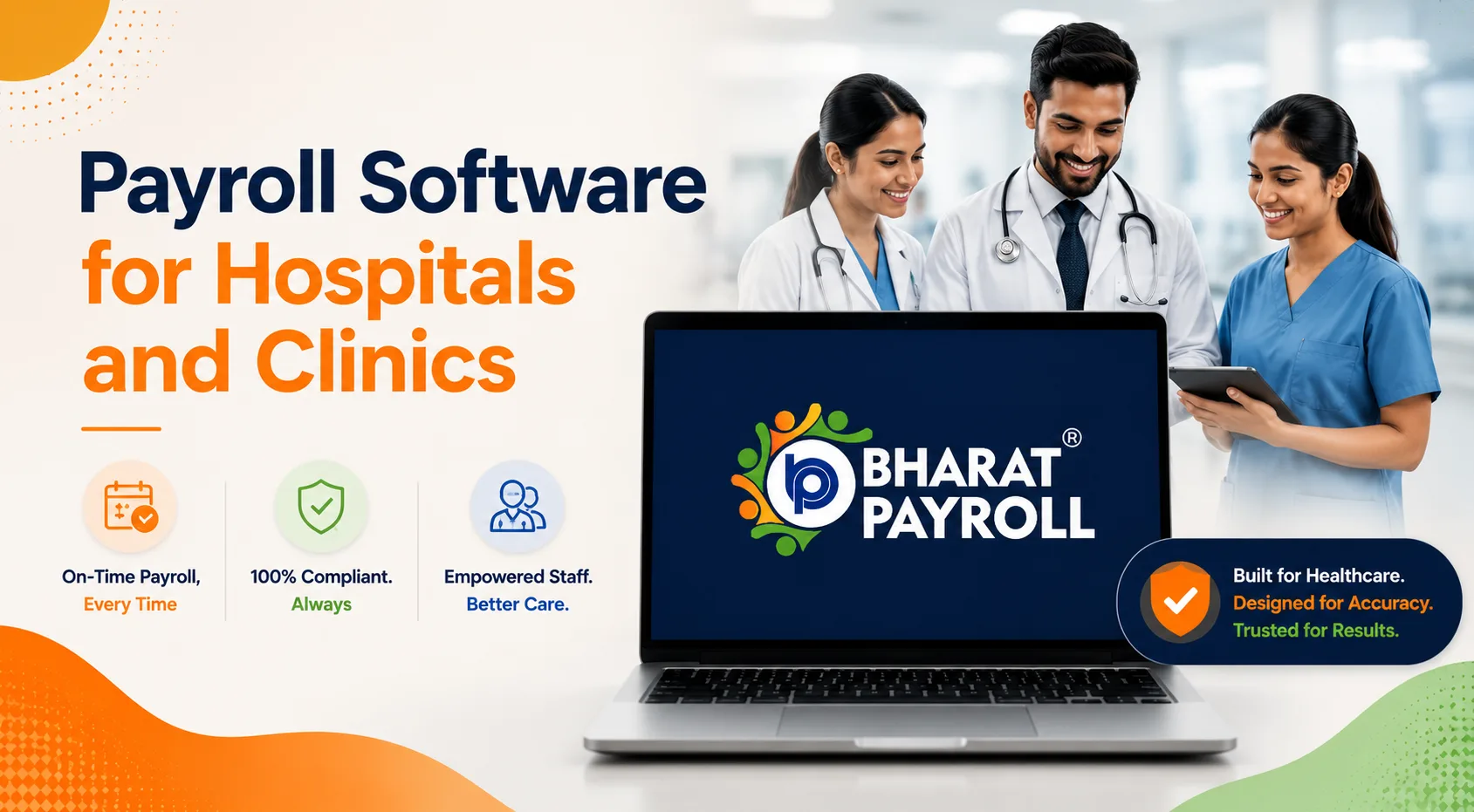
Bharat Payroll helps Indian businesses manage payroll, attendance, compliance, employee records, reports, and HRMS workflows from one platform.
For hospitals and clinics, this is important because payroll accuracy depends on attendance and shift data. Bharat Payroll helps connect employee records, leave, attendance, salary processing, deductions, payslips, and reports with better control.
A hospital can manage shift-based payroll with fewer manual checks. A clinic can reduce dependence on spreadsheets. Finance teams can review payroll cost with more clarity. Employees can access payslips and basic payroll details without repeated follow-ups.
The benefit is not just faster payroll.
The bigger benefit is fewer errors, better visibility, and a payroll process that matches how healthcare teams actually work.
When Manual Payroll Becomes a Problem
Manual payroll may work when a clinic has five or ten employees. It becomes risky when the team grows, shifts change often, or the business opens another branch.
The signs are easy to notice.
Attendance is checked from registers. Overtime is calculated manually. Managers approve shifts over messages. Employees keep asking why salary changed. Payslips are delayed. Finance cannot get department-wise reports quickly. HR spends the last week of every month chasing corrections.
At that stage, the issue is not effort. The issue is the system.
Healthcare teams need payroll that is structured enough to handle daily changes without turning every month into a correction cycle.
Final Thoughts
Hospitals and clinics depend on people who work across shifts, departments, emergency hours, weekends, and holidays. Their payroll process should respect that complexity.
The right payroll software for hospitals helps connect hospital attendance, shift rosters, leave, overtime, statutory deductions, payroll reports, and employee self-service in one place.
For healthcare payroll teams, this means fewer manual checks and fewer salary errors. For finance, it means clearer reports. For employees, it means better trust in salary processing.
Bharat Payroll helps hospitals, clinics, and healthcare businesses manage payroll and HRMS workflows with better control, so teams spend less time fixing payroll issues and more time running smoother operations.
Simplify Payroll for Hospitals and Clinics
Manage shift-based payroll, attendance, leave, compliance, and employee records from one centralized HRMS platform built for healthcare teams.
FAQs
1. What is payroll software for hospitals?
Payroll software for hospitals helps manage staff salaries, shifts, attendance, leave, overtime, compliance, payslips, and reports.
2. Why is healthcare payroll difficult?
Healthcare payroll is difficult because hospitals manage rotating shifts, night duty, overtime, consultants, support teams, and statutory deductions.
3. What is hospital attendance?
Hospital attendance tracks staff presence, shift timing, missed punches, overtime, leave, and roster-based working hours.
4. How does a clinic HRMS help?
A clinic HRMS helps manage employee records, attendance, leave, payroll, documents, payslips, and HR reports in one system.
5. How can Bharat Payroll help healthcare teams?
Bharat Payroll helps hospitals and clinics manage attendance, payroll, compliance, employee records, payslips, and reports with better control.