
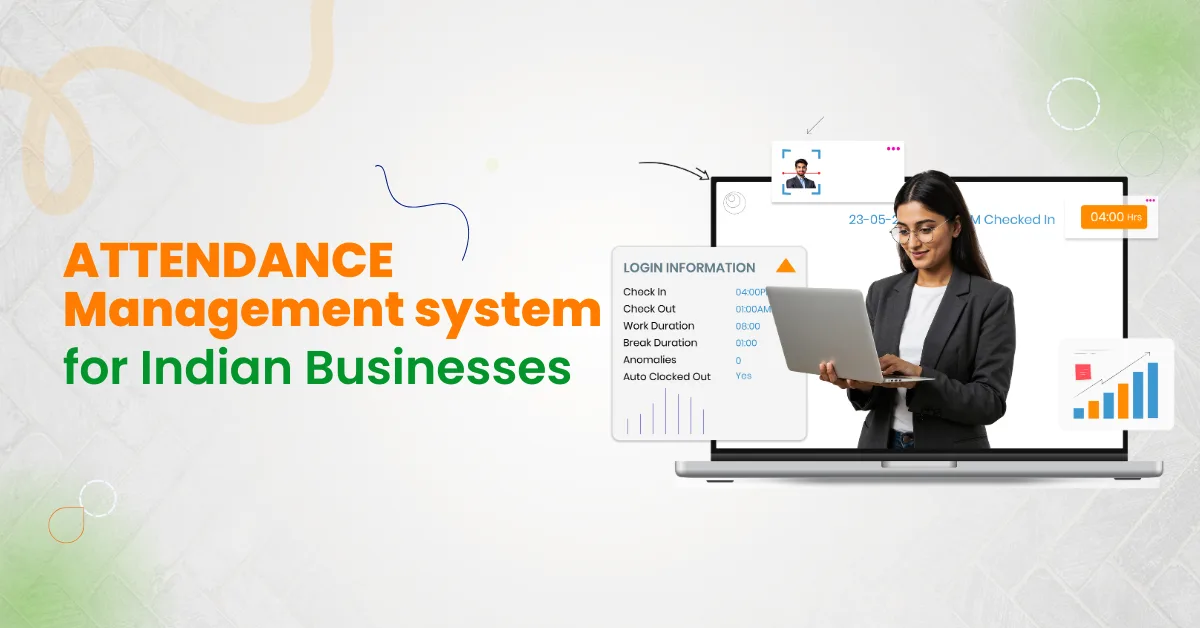
An attendance management system helps businesses track attendance accurately across office teams, field staff, shift workers, hybrid employees, and remote teams. In India, Payroll and HRMS Integration makes attendance records much more useful because employee data, shift timing, leave, approvals, working hours, and payroll outputs stay connected instead of being checked manually from separate files.
For many businesses, attendance only becomes urgent when payroll is already at risk. A missed punch, an unapproved half-day, a wrong overtime record, or a location mismatch can quickly turn into salary corrections, employee complaints, and more month-end effort than the team expected. A stronger attendance system reduces that chain reaction.
That is why attendance management matters far beyond marking presence. It supports payroll readiness, workforce planning, absence control, policy enforcement, employee trust, and audit-ready records. When attendance is handled well, payroll runs with fewer corrections and better visibility.
What Is an Attendance Management System?
An attendance management system is a digital setup used to record when employees start work, end work, take breaks, work overtime, miss shifts, or request leave adjustments. It replaces manual registers, scattered spreadsheets, and loosely managed timesheets with a clearer record of employee presence.
A modern attendance management software setup may support:
- daily check-in and check-out records
- break tracking
- shift timing
- leave-linked attendance changes
- overtime and late arrival review
- employee attendance tracker views
- approval workflows
- reporting for payroll and HR review
In simple terms, it answers a practical question every business faces: who works, when they work, how long they work, and how that should affect salary.
Attendance Management System Benefits for Businesses
Attendance affects payroll, scheduling, discipline, compliance, and employee trust at the same time. If attendance records are weak, payroll becomes weaker too.
The main benefits of a strong attendance management system include:
- fewer manual attendance errors
- cleaner payroll preparation
- better shift and availability planning
- stronger visibility into lateness, absence, and overtime
- easier review of attendance history
- lower risk of proxy attendance and false entries
- quicker response to exceptions before payday
- better employee payroll management through more accurate hour tracking
Indian employers feel this more sharply as work patterns diversify. A field employee may need location-based attendance. A factory worker may work by shift. A hybrid employee may split time between the office and home. An office team may work from browser or mobile check-ins. One attendance method rarely works for all of them.
Problems With Traditional Attendance Methods
Traditional attendance methods look simple until the team grows. Paper registers, manual Excel files, and unchecked timesheets tend to create the same problems again and again.
- Delay: HR or managers often discover errors only when payroll is already being prepared.
- Inconsistency: One department may record attendance differently from another.
- False marking: Buddy punching, proxy marking, and unverified attendance updates are more likely when the system is weak.
- Rework: Payroll teams spend time correcting attendance-linked salary inputs rather than reviewing actual payroll exceptions.
That is why businesses are moving to attendance tracking software, time attendance software, and automated attendance system models that pull check-ins, leave, approvals, and work patterns into one record.
How the Attendance Management System is Better than Manual Tracking
|
Area |
Manual Attendance Tracking |
Attendance Management System |
|
Check-in records |
Paper or spreadsheet-based |
Recorded digitally in real time |
|
Error correction |
Slower and manual |
Easier through rules and approvals |
|
Shift tracking |
Harder to standardise |
Easier to apply by team or role |
|
Remote staff visibility |
Weak |
Better with mobile and location-linked methods |
|
Payroll support |
Needs extra checking |
Closer to payroll inputs |
|
History and reporting |
Scattered |
Easier to filter and retrieve |
|
Buddy punching risk |
Higher |
Lower with biometric or controlled methods |
|
Growth readiness |
Admin effort rises quickly |
More stable as teams scale |
For most organisations, the main gain is not the device or app. It is cleaner attendance data flowing into a more dependable process.
How to Choose the Right Attendance Management System
Choosing the right attendance management system depends less on the app screen and more on how your business actually works.
Ask these questions first:
- Do you have office, shift, hybrid, field, or remote employees?
- Does payroll depend on attendance-linked hours or overtime?
- Do managers need approval workflows for missed punches and corrections?
- Do you need location controls, such as IP or geofencing, for attendance?
- Will employees need mobile access?
- Do you need biometric or face-based attendance for control?
- How often does HR currently correct attendance before payroll?
The right system should reduce repeated attendance handling, not add another layer of admin.
Common Attendance Tracking Methods Used Today
A strong attendance management system should support more than one way to mark presence. Businesses rarely operate with one employee type anymore.
Web and Mobile Check-In
This works well for office, hybrid, and distributed teams. Employees can mark attendance through browser or app access. Bharat Payroll’s attendance solution states that employees can log hours using mobile devices or desktops while capturing location and IP details.
Biometric Attendance Software
A biometric attendance software setup uses fingerprint or face-based verification to reduce false entries. Bharat Payroll’s face-recognition page positions it as a real-time attendance option designed to reduce manual handling and improve employee monitoring.
Geofencing Attendance
Geofencing attendance is useful for field teams, site-based operations, and employees who should mark their presence only from approved work locations. This is especially relevant for businesses with sales teams, service teams, and location-sensitive attendance rules.
Kiosk and Shared Device Marking
This works for factories, retail outlets, warehouses, and shift-heavy environments where teams mark attendance from a shared point at entry or exit.
Manual Regularisation Within Controlled Rules
Even the best time and attendance system needs a correction path for missed punches, network issues, or approved attendance changes. The difference is that those corrections should flow through approvals, not informal messages.
Capture Attendance in Real Time
A real-time attendance software setup gives managers and HR teams a current picture rather than a delayed reconstruction. This matters when teams need to review late arrivals, absence patterns, missed punches, or shift coverage before the payroll cycle closes.
Real-time capture supports:
- same-day visibility
- faster attendance approvals
- quicker abnormality review
- stronger payroll preparation
- easier manager action on exceptions
Bharat Payroll’s attendance rules approvals page positions automated approval flows as part of accurate payroll processing and improved tracking.
Payroll and HRMS Integration in Attendance Management
Payroll and HRMS Integration turns attendance from an isolated record into payroll-ready data.
Without integration, the process often looks like this: attendance is recorded in one tool, leave sits in another, employee work details sit elsewhere, and payroll is prepared from a stitched file after multiple checks. That slows the cycle and raises the chance of error.
With HRMS attendance linked to payroll, the flow becomes tighter:
- employee details stay in one working record
- attendance and leave feed salary inputs more clearly
- shift rules and approvals remain easier to trace
- overtime and absence impact can be reviewed before payroll lock
- employee payroll management becomes less manual
Bharat Payroll’s broader HRMS structure supports this connected model through employee records, attendance approvals, leave balance, reporting, and consolidated views shown in the uploaded manuals.
Keep Attendance Records Ready Before Payroll Starts
Track attendance, approvals, and payroll-linked work hours from one connected system with Bharat Payroll.
Key Features to Look for in Attendance Management Software
Not every attendance software product gives businesses the control they actually need. For Indian employers, the best-fit system is usually the one that reduces monthly correction work rather than just offering one more way to mark attendance.
Look for:
- multiple attendance marking methods
- attendance and leave linkage
- shift and overtime support
- approval workflows for correction and regularisation
- employee attendance software access on mobile and desktop
- abnormality alerts
- reporting filters by employee, department, date, or location
- attendance and payroll management system support
- role-based access and record visibility
- support for biometric, face, mobile, and location-based attendance where required
Current 2026 buying-guide content in India is also emphasising payroll integration, real-time visibility, leave linkage, and exception handling as must-have features.
Attendance Management for Remote, Hybrid, and Field Teams
This is where many businesses struggle. A single office-based method does not work for all employee groups.
A modern online attendance management system should support:
- remote employees working from approved locations
- hybrid employees moving between home and office
- field teams needing location-linked check-ins
- shift teams needing entry and exit discipline
- managers reviewing attendance patterns without waiting for HR consolidation
For Indian companies with employees in Hyderabad, Bengaluru, Chennai, Pune, Mumbai, Gurugram, or multiple branch locations, this flexibility becomes critical. Attendance should still remain controlled even when the workplace changes.
Attendance Methods by Business Type
Different businesses need different attendance methods. The strongest employee attendance management system is usually the one that matches work reality instead of forcing one rule across every team.
Office Teams
Web and desktop attendance often work well for stable office-based schedules.
Shift-Based Operations
Factories, warehouses, retail, and healthcare setups usually need shift-linked attendance with stronger entry and exit discipline.
Field Teams
Sales and service teams often need mobile attendance with location-linked proof and approval control.
Hybrid Teams
Hybrid teams usually need a mix of office, remote, and manager-reviewed attendance methods.
Multi-Location Businesses
Multi-branch businesses benefit from centralised reporting, location visibility, and cleaner attendance views across departments or cities.
This is one of the main reasons attendance software selection should follow business structure, not just feature count.
Reports and Analytics in an Attendance Monitoring System
A good attendance monitoring system should not stop at raw records. It should help businesses read patterns.
Useful attendance reports may include:
- daily presence view
- late arrival report
- missed punch report
- overtime report
- leave-linked absence report
- shift variance report
- attendance data for payroll
- department-wise attendance summary
This reporting layer matters because attendance data is only useful when someone can review it quickly and act on it before salary release.
Common Attendance Management Mistakes Businesses Should Avoid
The same issues show up across businesses again and again.
- One is treating attendance review as a payroll-stage task instead of a daily process.
- Allowing too many manual corrections without structure.
- Using one method for all employee groups, even when work patterns differ.
- Ignoring attendance abnormalities until payday.
- Keeping attendance and payroll too far apart.
These mistakes usually lead to delayed salary correction, leave disputes, and more review work each month.
Why Bharat Payroll Helps Businesses Manage Attendance Better
Bharat Payroll is useful here because it connects attendance with the records around it. Its attendance solution highlights secure check-ins, mobile and desktop logging, location and IP capture, and employee self-service. Its related pages also position face recognition and approval workflows as attendance tools that support accurate payroll processing.
That gives employers a cleaner working setup across:
- attendance capture
- leave-linked adjustments
- approval review
- payroll preparation
- employee access
- reporting and audit support
For growing businesses, this reduces the amount of repeated month-end effort.
Track Attendance with Less Manual Work Every Month
Use Bharat Payroll to manage attendance, attendance-linked payroll checks, and employee records from one connected setup.
Best Practices for Attendance Management
A stronger attendance process usually follows a few habits consistently.
- Define clear attendance rules before rollout
- Use appropriate marking methods for each employee group
- Review abnormality alerts regularly
- Keep leave and attendance connected
- Approve corrections through workflow, not informal chats
- Check the attendance-linked payroll impact before salary lock
- Store attendance history properly for review and audit support
These practices make the employee attendance tracker more useful and reduce payroll friction later.
Final Thoughts
A strong attendance management system helps businesses do more than mark check-ins. It gives them a cleaner view of work hours, presence, overtime, leave impact, and payroll-linked time records.
For Indian employers, the value grows when attendance is tied closely to payroll and HR records. That is where Payroll and HRMS Integration matters most. It turns attendance from a daily log into part of a working business record.
Bharat Payroll supports that approach by keeping attendance, employee data, approvals, and payroll-linked review closer together. That helps teams work with better accuracy, better control, and fewer avoidable corrections at month-end.
Run Attendance and Payroll from One Centralised Platform
Use Bharat Payroll to track attendance, manage approvals, and keep payroll-linked hours ready for review.
Frequently Asked Questions
1. What is an attendance management system?
An attendance management system is a digital system used to record employee check-ins, check-outs, breaks, shifts, overtime, and attendance status.
2. Why is an attendance management system important for businesses?
It helps businesses track attendance accurately, reduce payroll errors, improve shift visibility, and keep attendance records easier to review.
3. What is the difference between manual attendance and attendance management software?
Manual attendance relies on registers or spreadsheets. Attendance management software stores attendance digitally, supports approvals, and makes records easier to track and review.
4. Can an attendance management system support remote teams?
Yes. A modern online attendance management system can support remote and hybrid teams through mobile, web, and location-based check-ins.
5. What is biometric attendance software?
Biometric attendance software uses methods such as fingerprint or face recognition to verify attendance and reduce false entries.
6. What is geofencing attendance?
Geofencing attendance uses location boundaries so employees can mark attendance only from approved work areas.
7. How does Payroll and HRMS Integration improve attendance management?
Payroll and HRMS Integration improves attendance management by keeping employee records, leave, attendance, approvals, and payroll-linked hours closer together, which reduces manual checking.
8. Can attendance systems help reduce payroll mistakes?
Yes. When attendance is tracked well and reviewed in time, payroll gets cleaner work-hour data and fewer attendance-related corrections.
9. What reports should a time and attendance system provide?
A useful time and attendance system should provide late arrival reports, overtime reports, missed punch reports, presence summaries, and attendance data for payroll review.
10. Is an attendance management system useful for small businesses, too?
Yes. Smaller businesses benefit as much as larger ones because attendance errors affect salary accuracy quickly, even with a modest employee count.