
A department requests five additional employees. The workload has increased, deadlines are slipping, and the existing team regularly works beyond scheduled hours.
Recruitment may seem like the obvious solution. But the real problem could be unfilled vacancies, poor shift allocation, frequent absences, uneven workloads, or a temporary rise in demand.
This is where payroll data workforce planning becomes valuable. Payroll records show more than what employees were paid. They reveal how workforce costs are changing, where capacity pressure is building, and whether the business can support its proposed hiring plans.
Payroll Records Reveal What Headcount Reports Miss
A headcount report answers one question: how many employees does the organisation have?
Payroll data answers several others.
How much does the workforce actually cost? Which departments depend heavily on overtime? Where are temporary staffing expenses increasing? How will planned salary revisions affect next year’s budget?
These questions matter because two departments with the same headcount can have completely different workforce costs.
One department may employ senior specialists, pay regular incentives, and operate extended shifts. Another may consist primarily of junior employees working standard hours. Looking only at employee numbers would make both teams appear similar.
Payroll records expose the difference.
They contain information such as:
- Basic and gross salaries
- Cost to Company
- Employer contributions
- Overtime payments
- Bonuses and incentives
- Allowances
- Leave-related deductions
- Joining and exit dates
- Department and location costs
- Salary revisions
- Payroll variance
This information becomes even more useful when connected with attendance, recruitment, productivity, and financial data.
The CIPD workforce planning guidance explains that workforce planning involves analysing information to understand future demand for people and skills, then converting that understanding into action. It also stresses that workforce metrics must be interpreted within the wider organisational context.
The Hiring Request That Payroll Data Can Challenge
Consider a customer support team that has recorded high overtime for four consecutive months.
The manager requests three new employees. Before approving the request, HR and finance review the payroll, attendance, vacancy, and shift records.
They discover that:
- Two experienced employees left and were never replaced.
- Overtime is concentrated on Mondays and Fridays.
- New recruits are still completing product training.
- Absence rates are unusually high during the evening shift.
- Customer demand rises sharply for only three months each year.
The original request was for three permanent employees. The data suggests several possible responses.
The organisation could replace the two employees who left, adjust shift coverage, use temporary staff during peak months, or cross-train employees from another support function.
Payroll data does not automatically select the correct option. It makes the available options visible.
Without that information, the company may approve unnecessary permanent headcount or reject a request that reflects a genuine capacity shortage.
High Overtime Is a Signal, Not Just an Expense
Overtime commonly appears in payroll reviews only after expenditure exceeds the monthly budget.
By then, the operational problem may have existed for several months.
Consistently high overtime can point to:
- Insufficient staffing
- Delayed replacement hiring
- Poor scheduling
- Seasonal demand
- Frequent absenteeism
- Skills concentrated among too few employees
- Inefficient processes
- Uneven workload distribution
The more useful question is not simply, “How much overtime did the company pay?”
It is, “Why was the overtime necessary?”
Imagine a production unit spending ₹14 lakh annually on overtime. A permanent employee performing similar work may cost ₹8 lakh a year after salary, benefits, and employer contributions.
At first glance, recruitment appears to be the better financial decision.
However, payroll and attendance patterns may show that most overtime occurs during an eight-week peak period. In that case, permanent recruitment could create unused capacity during the rest of the year. Temporary staffing, revised shift schedules, or cross-functional deployment may be more appropriate.
This is the difference between payroll reporting and payroll intelligence.
Labour Cost Analysis Needs Operational Context
A high payroll cost does not automatically indicate poor efficiency.
A technology team may have a high average salary because it employs difficult-to-replace specialists. A sales department may receive substantial incentives after exceeding revenue targets. A new branch may carry higher staffing costs while it builds its customer base.
The opposite is also true.
A department with low payroll expenditure may be understaffed, missing deadlines, losing customers, or placing unsustainable pressure on employees.
For meaningful labour cost analysis, organisations should compare payroll figures with business outcomes.
| Payroll measure | Business measure to review alongside it |
| Department payroll cost | Revenue, output, service volume or project value |
| Overtime expenditure | Workload, vacancies, absence and scheduling |
| Incentive payments | Sales performance or target achievement |
| Location-wise payroll | Branch revenue, capacity and operating demand |
| Headcount growth | Business growth and workload expansion |
| Temporary staffing cost | Seasonal demand and vacancy duration |
| Salary increases | Retention risk, market rates and role criticality |
The comparison helps management distinguish between a necessary workforce investment and an avoidable cost.
What Payroll Data Can Show Before Headcount Is Approved
The Full Cost of a New Employee
Hiring plans often begin with salary estimates. Salary, however, is only one part of the employment cost.
A realistic headcount budget may need to include:
- Employer statutory contributions
- Insurance and employee benefits
- Performance incentives
- Joining bonuses
- Recruitment fees
- Equipment and software
- Training and onboarding
- Shift or location allowances
- Expected salary revisions
Joining dates also change the forecast.
Ten employees joining in January create a different annual cost from ten employees recruited gradually between April and September.
Historical payroll records provide real salary and CTC benchmarks for comparable roles. Finance can use these figures to create a more dependable hiring forecast instead of relying on a broad estimate supplied during budget planning.
The Cost of Leaving a Vacancy Open
Not filling a role may reduce salary expenditure, but it can create other costs.
Existing employees may work overtime. Temporary workers may be hired. Projects may be delayed. Managers may spend more time covering operational work, and customer response times may decline.
Payroll data can reveal some of these indirect effects through overtime, temporary staffing payments, incentive changes, and workload-related allowances.
A vacancy should therefore be assessed against the cost of leaving it open, not only the salary saved.
Whether the Problem Is Headcount or Allocation
Some teams request more employees even though their total headcount appears adequate.
The difficulty may come from how employees are distributed.
One shift may be overloaded while another has spare capacity. One branch may use substantial overtime while a nearby branch operates below its staffing capacity. A particular skill may be concentrated among only two employees, creating a bottleneck whenever either person is absent.
Connected time and attendance data can help organisations compare scheduled hours, actual attendance, overtime, absences, and location-based availability before increasing headcount. Bharat Payroll’s attendance system includes clock-in and clock-out tracking, attendance rules, approvals, biometric integration, and payroll-connected attendance records.
Payroll Patterns Make Staffing Forecasts More Reliable
Workforce demand rarely changes without leaving signals.
A retailer may see overtime and incentive payments rise before every festive season. A logistics company may depend on temporary workers during particular months. A professional services firm may add employees shortly before major client projects begin.
Historical payroll data allows organisations to identify these recurring patterns.
The business can then decide:
- When recruitment should begin
- Whether positions should be permanent or temporary
- Which locations will need additional capacity
- Which skills will be required
- How much payroll expenditure should be reserved
- Whether internal transfers can meet demand
- What a delay in recruitment may cost
This is especially useful when hiring lead times are long. If previous records show that staffing demand rises every October, recruitment does not need to begin after the pressure appears. It can start months earlier.
Forecasting becomes proactive rather than reactive.
Leave Data Also Belongs in Workforce Planning
An employee may remain part of the official headcount while being unavailable for work.
That is why headcount alone can overstate operational capacity.
Planned leave, extended absences, recurring absenteeism, and overlapping leave requests can all affect how much work a team can handle. They can also increase overtime or temporary staffing costs.
A connected leave management system can give HR teams visibility into leave balances, approval patterns, employee absences, overlapping requests, and leave-related payroll adjustments. Bharat Payroll’s system connects leave tracking with payroll and provides centralised reporting on absence patterns.
This information is particularly useful when planning for:
- Peak business periods
- Festival and holiday seasons
- Maternity or extended leave
- Shift-based operations
- Project deadlines
- Location-specific staffing requirements
A team of 40 employees may not have the capacity of 40 employees during a month when several people are on planned or extended leave.
The Numbers HR and Finance Should Review Together
Workforce planning often becomes difficult because HR and finance work from different reports.
HR may focus on vacancies, skills, workload, retention, and employee availability. Finance may focus on budgets, cash flow, cost control, and profitability.
Payroll creates a common reference point.
A focused monthly review can cover:
- Where did payroll exceed or fall below the budget?
- Which departments recorded unusual overtime?
- Did headcount change according to plan?
- Which vacancies are creating additional costs?
- Are new employees joining on schedule?
- Which locations show increasing absence or temporary labour costs?
- What is the financial effect of approved salary changes?
- Are labour costs increasing faster than business activity?
The CIPD people analytics factsheet describes people analytics as the use of employee-related data to solve business problems and support evidence-based decisions. It also notes that relevant data can come from HR, IT, finance, and other organisational systems.
The goal is therefore not to make payroll the sole source of truth. It is to connect payroll with the wider information required for a sound workforce decision.
Three Decisions Payroll Intelligence Can Improve
Hire More Employees or Continue Overtime?
If overtime has become a permanent part of operations, recruitment may cost less over the year and reduce pressure on the existing team.
If overtime appears only during a short seasonal peak, temporary staffing or scheduling changes may provide better value.
The decision should compare total costs, duration of demand, skill requirements, and operational risk.
Add Headcount or Redeploy Existing Employees?
One branch may request additional employees while another has underused capacity.
Location-wise payroll, attendance, workload, and vacancy data can reveal whether internal transfers or shared teams can meet demand before external recruitment begins.
Increase Staffing or Fix the Process?
Not every capacity problem is a headcount problem.
Employees may be spending too much time on manual approvals, repeated data entry, avoidable rework, or tasks that could be automated.
If payroll costs and headcount remain stable while output falls, the organisation may need to review processes rather than recruit more people.
Where Payroll Data Can Mislead
Payroll records are useful, but they are not automatically objective or complete.
A high-cost employee may hold specialised knowledge that protects a major client relationship. A department may show little overtime because employees complete unpaid work outside scheduled hours. A low-cost location may experience high attrition and repeated recruitment expenses.
Poor data quality can also create the wrong conclusion.
Common issues include:
- Employees assigned to incorrect departments
- Inconsistent job titles
- Outdated salary structures
- Missing joining or exit dates
- Incorrect cost-centre allocation
- Temporary staff excluded from reports
- Allowances classified differently across locations
- HR and finance using different reporting periods
Before using payroll data for strategic workforce planning, organisations should validate employee, salary, department, attendance, leave, and location records.
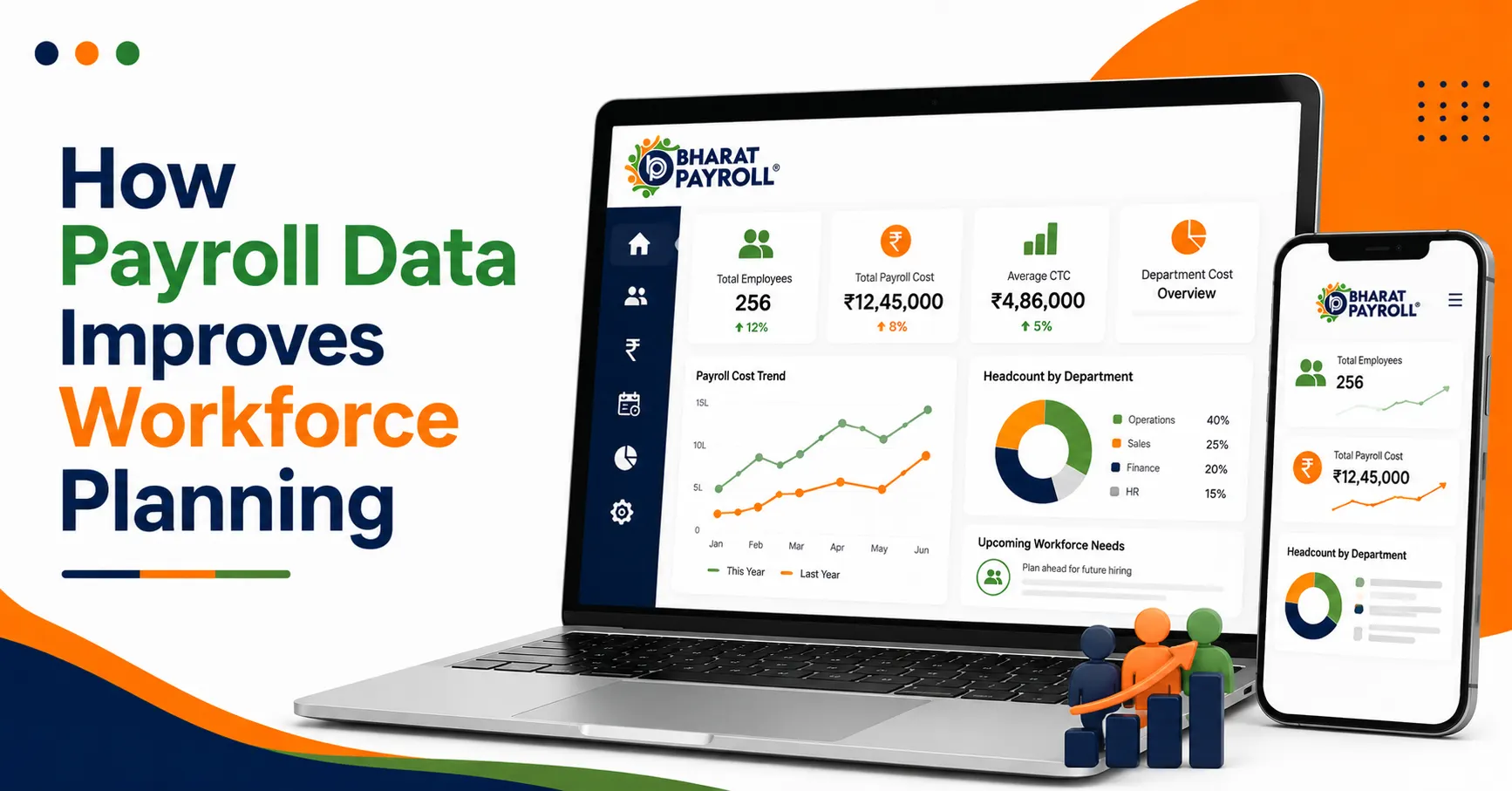
Bharat Payroll’s payroll reporting and analytics capabilities include salary information, CTC, variance, statutory, audit, missing-information, leave, and other payroll reports. Its reporting tools also support customisable fields, filters, date ranges, and real-time payroll analytics for cost and forecasting reviews.
A Practical Monthly Workforce Review
The review can begin with one simple question:
What changed in payroll this month, and why?
Start with payroll variance. Identify departments, locations, or cost centres where actual expenditure differed from the approved budget.
Then examine the reason.
Did new employees join earlier than planned? Was recruitment delayed, causing overtime? Did incentives increase after a strong sales month? Did an extended absence require temporary cover? Was a salary revision applied retrospectively?
The next discussion should focus on action.
The organisation may need to:
- Approve replacement hiring
- Adjust shift schedules
- Move employees between teams
- Use temporary staff
- Accelerate training
- Revise the workforce budget
- Review compensation
- Investigate an unexpected payroll change
The review is complete only when the numbers lead to a decision.
How Bharat Payroll Supports Better Workforce Decisions
Bharat Payroll connects payroll information with employee, attendance, leave, CTC, statutory, and organisational records.
HR and finance teams can use these records to examine:
- Department-wise salary costs
- Employee CTC
- Payroll variance
- Joining and exit information
- Attendance and overtime
- Leave and absence patterns
- Employer contributions
- Salary revisions
- Location-wise workforce costs
- Missing employee information
Its dynamic reporting tools allow users to select relevant employee, payroll, leave, and organisational fields for a particular analysis. This means a report can be shaped around the decision being considered rather than forcing every team to work from the same fixed template.
For example, an organisation reviewing branch expansion could compare location, department, designation, CTC, attendance, overtime, and joining dates.
A company preparing its annual workforce budget could review current headcount, salary revisions, employer contributions, vacancies, and expected recruitment costs.
The result is not simply another payroll report. It is a more consistent basis for headcount planning, staffing forecasting, labour cost analysis, and financial decision-making.
Better Workforce Planning Begins with Better Questions
Payroll data cannot replace managerial experience. It can make that experience more precise.
- Why is overtime rising in one team but not another?
- Why does one branch have a higher labour cost per employee?
- Why are temporary staffing expenses continuing after the peak season?
- Why is payroll increasing when headcount remains unchanged?
- Does the organisation need more employees, different skills, or better scheduling?
These questions move workforce planning away from assumptions. They help leaders understand where people are needed, what those people will cost, and which workforce response is most likely to support the business.
Turn Payroll Data into Smarter Workforce Decisions
Connect payroll, attendance, and HR data to plan hiring, control costs, and improve workforce efficiency.
Frequently Asked Questions
1. How does payroll data support workforce planning?
Payroll data shows employee costs, overtime, incentives, salary revisions, attendance-related payments, employer contributions, and workforce movement. These insights support headcount, budgeting, staffing, and compensation decisions.
2. Which payroll reports are useful for headcount planning?
Useful reports include employee CTC, department-wise payroll, payroll variance, overtime, attendance, leave, joining, exit, salary revision, and location-wise workforce reports.
3. Can payroll data identify understaffing?
Repeated overtime, delayed replacement hiring, rising temporary labour costs, and recurring workload-related payments may indicate understaffing. Attendance, demand, and productivity data should be reviewed to confirm the cause.
4. What is payroll intelligence?
Payroll intelligence is the use of payroll information to understand workforce costs, staffing pressure, compensation trends, budget variance, and the financial effect of employee-related decisions.
5. How often should workforce payroll data be reviewed?
Operational payroll and workforce measures should generally be reviewed monthly. A more detailed review can take place quarterly, during annual budgeting, or before expansion and major recruitment decisions.
6. What is the difference between payroll analytics and HR analytics?
Payroll analytics focuses primarily on salary, deductions, employer costs, overtime, incentives, and payroll variance. HR analytics covers a wider range of employee information, including recruitment, retention, skills, performance, attendance, and engagement.