
A payroll run may appear successful even when serious problems are building beneath the surface. Employees may receive their salaries on time, yet the system could still be applying an outdated deduction rule, missing an approval record or storing sensitive information without adequate protection.
These hidden payroll compliance risks are becoming harder to ignore in 2026. Employers must manage statutory deductions, digital filings, employee records, tax reports, access controls and audit documentation with greater accuracy. A legacy payroll system built around spreadsheets, manual checks or outdated software may no longer provide the control these responsibilities require.
Processing salaries is only one part of payroll. The greater challenge is maintaining accurate records, meeting statutory obligations and demonstrating that every payroll run can withstand scrutiny.
When Does an Old Payroll System Become a Compliance Risk?
Age alone does not make payroll software unsuitable. A system becomes risky when it can no longer keep pace with the employer’s legal and operational responsibilities.
Consider a company that calculates salaries through an older desktop application. Attendance records arrive by email, deductions are checked in spreadsheets and final payroll changes are approved through chat messages. The salary calculation may be correct, but the company could struggle to prove who changed a record, who approved it and which version was used.
That gap between processing payroll and proving payroll accuracy is where compliance exposure begins.
Common warning signs include:
- Statutory changes must be entered manually.
- Payroll data moves between disconnected files.
- Corrections overwrite the original record.
- Approval histories are difficult to retrieve.
- Reports require extensive spreadsheet work.
- Former employees still have system access.
- Backups depend on individual users.
- Errors are discovered after salaries are released.
A modern payroll software system can centralise calculations, TDS processing, reporting and payroll records instead of leaving essential controls spread across separate tools.
Outdated Rules Can Produce Incorrect Payroll
Payroll regulations do not remain fixed. Contribution requirements, filing formats, tax provisions, wage rules and reporting procedures may change. An older system can continue applying logic programmed years ago unless someone updates it manually.
This can lead to several problems:
- Employee deductions may be calculated using outdated rules.
- Contributions may be assigned to the wrong wage component.
- Reports may not match the latest filing format.
- Statutory deadlines may be missed because the system provides no alert.
- Payroll teams may unknowingly use an old template.
Employers can review current filing facilities and procedural information through the official EPFO employer services. EPFO provides online services for establishment registration, monthly return filing, payments, documents and employer guidance. Current contribution information is also available through the official ESIC contribution page.
Software does not remove the employer’s legal responsibility. It should, however, make it easier to apply current rules, maintain accurate records and identify exceptions before payroll closes.
Manual Payroll Creates Errors That Are Hard to Trace
Manual payroll is often seen as inexpensive because it relies on tools the business already uses. That view overlooks the time spent reconciling files, checking formulas, correcting mistakes and responding to employee queries.
A spreadsheet cell can be changed without explanation. A formula can be copied incorrectly. A revised attendance sheet may arrive after payroll has been processed. One team member may use an updated tax sheet while another continues working from an older version.
These are not unusual technical failures. They are ordinary process weaknesses that become compliance gaps when no reliable control identifies them.
The risk increases when payroll depends on one employee who understands the formulas, passwords and filing sequence. If that person is absent or leaves the company, payroll continuity may be affected.
Moving towards automated payroll processing can reduce repeated data entry and bring calculations, records and approvals into a more controlled workflow.
Why Legacy Payroll Systems Increase Audit Risk
An auditor may ask for more than a salary register. The business may need to provide deduction details, payment records, employee changes, approval histories, previous-period reports and explanations for unusual adjustments.
A reliable audit trail should answer four basic questions:
- What changed?
- Who made the change?
- When was it changed?
- Who reviewed or approved it?
A legacy system may show only the final value. If an employee’s salary was revised from ₹60,000 to ₹65,000, the current record may display ₹65,000 without preserving the earlier figure, change date, reason or approver.
That missing context can turn a routine audit request into several days of searching through emails, spreadsheets and paper records.
Bharat Payroll’s payroll reports include payroll summaries, tax and deduction reports, employee-level information, historical payroll data and customisable reporting by period or department. Keeping these records in an accessible format can improve audit preparation and reduce dependence on reconstructed evidence.
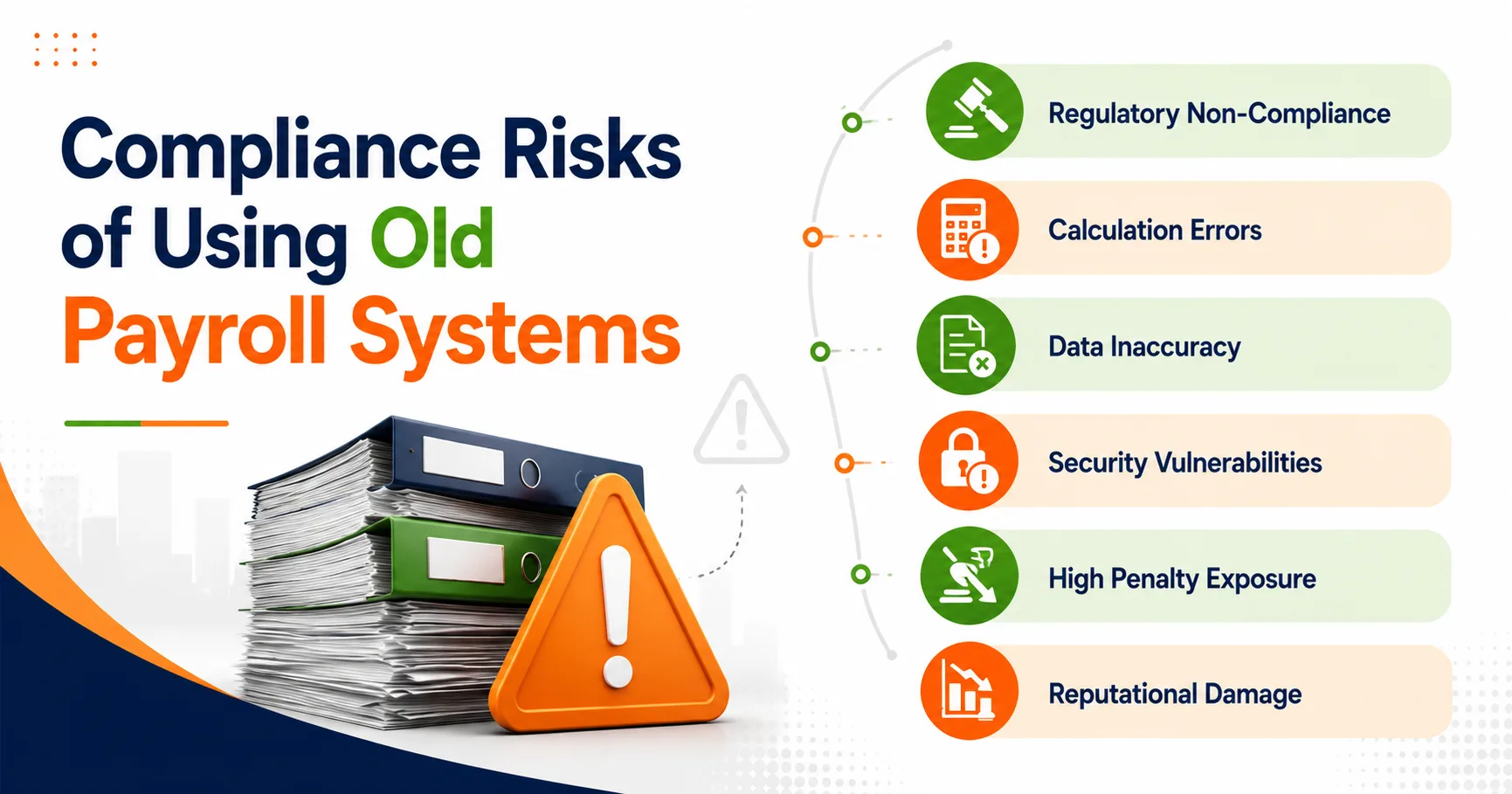
Main Compliance Risks of Outdated Payroll Software
| Weakness in an Old System | Possible Outcome |
| Outdated statutory configuration | Incorrect deductions or contributions |
| Manual data movement | Duplicate, omitted or altered records |
| Missing change history | Poor audit traceability |
| Weak user permissions | Unauthorised access to salary information |
| Limited reporting | Delayed filings and difficult reconciliation |
| Inconsistent backups | Permanent loss of payroll records |
| Disconnected attendance and leave data | Incorrect payable days or salary calculations |
| Dependence on one payroll administrator | Delays and operational disruption |
Not every weakness immediately leads to a penalty. Together, however, they make mistakes more likely and make those mistakes harder to detect, explain and correct.
Payroll Security Is Part of Compliance
Payroll records contain bank details, tax information, addresses, salary structures, identity data and other confidential employee information. An old payroll system may store this information locally, use shared login credentials or give more people access than their roles require.
Common payroll security risks include:
- Shared passwords between payroll users
- No multi-factor authentication
- Unencrypted payroll files
- Unrestricted administrator access
- Former employees retaining login access
- Payroll reports sent through unsecured channels
- No record of downloads or data changes
- Infrequent or untested backups
A payroll breach can create financial, legal, operational and reputational consequences. Even without an external attack, excessive internal access can expose confidential salary information.
Role-based permissions, controlled records, secure backups and activity tracking should therefore form part of every payroll system review.
What Can Compliance Penalties Cost a Business?
A direct fine may be only one part of the cost. A payroll failure can also lead to interest charges, professional fees, employee complaints, delayed financial closing, additional audit work and management time spent investigating the issue.
A business with non-compliant payroll may face problems arising from:
- Late or inaccurate statutory submissions
- Incorrect employee deductions
- Missing supporting records
- Unreconciled payroll liabilities
- Inadequate protection of employee information
- Delayed correction of payroll mistakes
- Incorrect tax or contribution reports
The larger cost is often operational disruption. HR, finance, legal and management teams may all become involved in resolving an issue that began with one incorrect field or missed update.
Is It Time to Upgrade the Payroll System?
Businesses do not need to wait for an audit notice or a major salary error. A structured review can reveal whether the present system still meets operational and compliance needs.
The review should examine the following areas.
Regulatory readiness: Can the system accommodate changing statutory rules and reporting requirements without extensive manual work?
Data control: Does it maintain one reliable employee and payroll record, or do teams work across several files?
Traceability: Can reviewers see previous values, changes, approvals and processing histories?
Security: Are access rights based on job roles, and can permissions be removed quickly?
Reporting: Can payroll, deductions, taxes and historical records be produced without rebuilding them in spreadsheets?
Scalability: Can the system support more employees, locations, entities and salary structures without creating parallel processes?
If the answer to several of these questions is no, upgrading payroll systems should be treated as a risk-control project rather than a routine software purchase.
Organisations considering a transition can also review how cloud-based payroll systems in India support remote access, automated processing, payroll security and centralised records.
How to Replace an Old Payroll System Safely
A rushed migration can transfer existing errors into a new system. The business should clean and validate its payroll information before implementation.
A practical transition should include:
- Reviewing employee master data and salary structures
- Identifying duplicate, inactive and incomplete records
- Documenting existing payroll and approval workflows
- Mapping statutory deductions and company policies
- Testing calculations against previous payroll periods
- Validating opening balances and year-to-date values
- Restricting access according to user responsibilities
- Running parallel payroll before the final switch
- Training HR, finance and payroll users
- Preserving historical records for future audits
The objective is not merely to install new software. It is to establish a payroll process that is easier to operate, review and defend.
Reduce Payroll Compliance Risks with Bharat Payroll
An old payroll system may continue producing salary figures, but that does not mean it provides the controls a growing business needs. Repeated manual work, weak audit trails, outdated rules, scattered records and limited security can gradually increase compliance exposure.
Bharat Payroll brings payroll calculations, TDS processing, compliance reporting, employee records, historical data and controlled access into a cloud-based system. This helps HR and finance teams spend less time reconstructing information and more time reviewing payroll before it is finalised.
Upgrade Your Payroll Before Risks Turn Into Penalties
Ensure compliance, accuracy, and security with a modern payroll system built for 2026.
Frequently Asked Questions
1. What are payroll compliance risks?
Payroll compliance risks arise when salary calculations, deductions, filings, records or data-handling practices do not meet applicable employment, tax or statutory requirements.
2. Why is a legacy payroll system risky?
A legacy system may depend on outdated rules, manual updates, limited reports, weak permissions or incomplete change histories. These limitations increase the likelihood of errors and make audits more difficult.
3. Can manual payroll be compliant?
Manual payroll can be compliant, but it requires strong controls, regular regulatory updates, careful reviews, secure records and complete documentation. The workload and risk generally increase as the organisation grows.
4. How does outdated payroll software affect audits?
Outdated software may not preserve historical changes, approvals, user activity or detailed reports. The organisation may then need to reconstruct evidence from spreadsheets, emails and paper records.
5. How can Bharat Payroll help reduce payroll compliance risks?
Bharat Payroll helps businesses improve payroll accuracy through automated calculations, organised payroll records, statutory reporting, controlled access and audit-ready payroll information. These features reduce dependence on fragmented spreadsheets and repeated manual checks.
Does Bharat Payroll support growing organisations?
Yes. Bharat Payroll is designed to help growing organisations manage payroll records, reporting, deductions and employee information in a more centralised and scalable system.
What should a business check before upgrading payroll software?
The business should assess statutory functionality, reporting, security, integrations, audit trails, data migration, access controls, scalability, implementation support and user training.
Does payroll automation remove compliance responsibility?
No. The employer remains responsible for payroll compliance. Automation supports that responsibility by reducing repetitive work, applying configured rules consistently, improving documentation and highlighting exceptions.