
The HRM planning process helps businesses identify workforce needs, forecast employee demand, assess existing talent, and plan recruitment, training, and staffing costs. By combining HR records with payroll data, attendance trends, and business forecasts, organizations can make better decisions about headcount, employee availability, workforce allocation, and future workforce budgets.
Consider a department requesting five additional employees because workloads are increasing. Hiring may appear necessary, but payroll and attendance records could reveal unfilled vacancies, excessive overtime, poor shift allocation, or temporary seasonal demand.
A structured HR planning process helps determine whether the organization needs more employees, different skills, improved scheduling, or better workforce utilization.
What Is the HRM Planning Process?
The human resource management (HRM) planning process is the systematic approach organizations use to evaluate their current workforce, forecast future employee requirements, identify staffing gaps, and develop strategies to meet business objectives.
Also known as the human resource planning process or manpower planning, it helps ensure that the organization has employees with the right skills, in the right roles, at the right time.
HR planning typically involves:
- Evaluating organizational objectives
- Assessing existing employees and skills
- Forecasting workforce demand
- Estimating future employee availability
- Identifying staffing and skills gaps
- Planning recruitment, training, and redeployment
- Estimating workforce costs
- Monitoring and adjusting workforce plans
An integrated HRMS software solution can support this process by organizing employee records, attendance, leave, and payroll information for workforce analysis.
Why Is Human Resource Planning Important?
Human resource planning helps organizations prepare for workforce requirements rather than responding only when staffing problems arise.
Without planning, businesses may experience unnecessary hiring expenses, employee shortages, uneven workloads, high overtime costs, or delayed recruitment.
A structured HR planning process helps businesses:
- Improve headcount planning: Identify how many employees are needed across teams and locations.
- Control workforce costs: Estimate salaries, employer contributions, overtime, and recruitment expenses.
- Address skills gaps: Identify where training or recruitment is necessary.
- Improve workforce allocation: Deploy employees according to workload and business demand.
- Support business expansion: Prepare staffing plans before opening new locations or departments.
- Reduce operational disruption: Anticipate vacancies, absences, and employee turnover.
Payroll information makes these decisions more realistic by connecting staffing requirements with actual employment costs.
What Are the Steps in the HRM Planning Process?
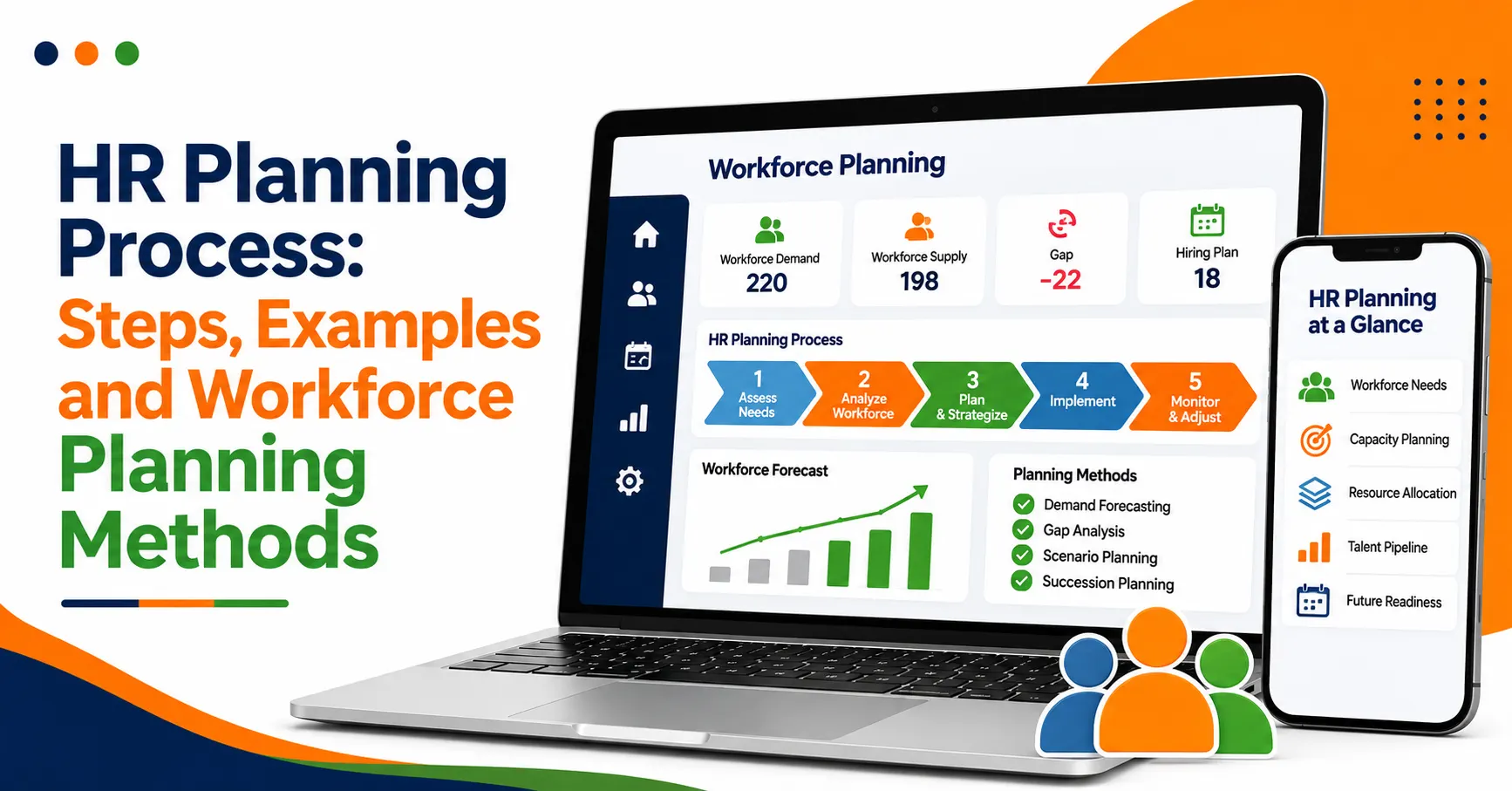
The HRM planning process generally follows seven steps, from understanding business objectives to monitoring workforce results.
Step 1: Analyze Organizational Objectives
HR planning should begin with the organization’s business strategy.
A business planning to open three new branches will have different staffing requirements from one focused on reducing costs or improving existing operations.
HR teams should review:
- Business expansion plans
- Revenue and production targets
- New projects and departments
- Workforce productivity goals
- Expected employee turnover
- Available hiring budgets
Example: A retail company planning five new stores must estimate store managers, sales employees, administrative staff, and associated salary costs before recruitment begins.
Step 2: Assess the Current Workforce
The next step is evaluating existing employee capacity, skills, availability, and costs.
Headcount alone does not provide a complete picture.
Two departments with 30 employees each can have different salary structures, skill levels, overtime requirements, and workloads.
HR teams should review:
- Current headcount
- Employee skills and experience
- Department-wise staffing
- Employee CTC and salary costs
- Overtime patterns
- Attendance and leave
- Employee joining and exit records
- Workforce distribution across locations
Payroll reporting and analytics helps organizations examine salary information, CTC, payroll variance, and employee-related costs alongside operational records.
This assessment establishes the workforce baseline for future planning.
Step 3: Forecast Future HR Demand
HR demand forecasting estimates the number and types of employees an organization will require during a future period.
Forecasting should consider anticipated workloads, business growth, employee productivity, technology changes, and seasonal demand.
For example, a customer support department may expect a 25% increase in service requests during the next financial year.
Before estimating additional headcount, HR should determine whether the workload can be managed through existing employees, improved processes, revised shifts, or recruitment.
Historical payroll, overtime, and attendance trends can provide useful indicators of staffing pressure.
However, payroll data should be evaluated alongside actual demand and operational performance.
Step 4: Forecast HR Supply
HR supply forecasting estimates how many employees will be available to meet future organizational requirements.
It considers both existing employees and potential external recruitment.
Important factors include:
- Expected resignations
- Retirement
- Internal transfers
- Promotions
- Employees completing training
- Recruitment timelines
- Planned leave
- Contract staffing availability
A department may currently have 40 employees but expect three resignations and two internal transfers.
Its projected available headcount would therefore be 35, before considering new hires or other workforce changes.
Connected leave management software helps HR evaluate planned leave and absence patterns when estimating workforce availability.
Step 5: Identify Workforce Gaps
Workforce gap analysis compares future employee requirements with projected workforce availability.
The gap may involve employee numbers, skills, experience, location, or availability.
A basic headcount calculation is:
Workforce Gap = Required Employees − Projected Available Employees
Consider the following example:
| Workforce Measure | Employees |
| Current headcount | 100 |
| Expected exits | 8 |
| Confirmed internal additions | 3 |
| Projected available headcount | 95 |
| Future workforce requirement | 115 |
| Staffing gap | 20 |
The organization needs a plan to address a projected gap of 20 employees.
However, hiring 20 employees is not automatically the best solution. Training, internal transfers, automation, or revised workforce schedules may address part of the requirement.
Step 6: Develop and Implement the HR Action Plan
After identifying gaps, HR teams should develop specific workforce actions.
Possible strategies include:
- Recruiting employees
- Training existing teams
- Promoting internal talent
- Transferring employees between locations
- Adjusting shift schedules
- Using temporary staffing
- Improving retention
- Automating repetitive processes
Each action should include an owner, implementation timeline, required resources, and estimated cost.
For recruitment-related plans, hiring and onboarding software can help coordinate employee onboarding records and associated HR workflows.
Step 7: Monitor and Review Workforce Plans
HR planning should be reviewed regularly because business requirements and employee availability change.
Key performance indicators include:
- Actual versus planned headcount
- Employee turnover
- Overtime expenditure
- Recruitment costs
- Vacancy duration
- Salary budget variance
- Absenteeism
- Workforce cost per department
Monthly operational reviews and quarterly workforce planning discussions can help HR and finance teams identify changes early.
What Are the Main Workforce Planning Methods?
Organizations can use qualitative and quantitative workforce planning methods depending on their workforce size, industry, and available data.
| Method | How It Works | Best Used For |
| Trend analysis | Uses historical workforce patterns | Predicting headcount growth |
| Ratio analysis | Compares staffing with business output | Estimating employees per workload unit |
| Workload analysis | Calculates staffing from required work hours | Shift-based and operational teams |
| Managerial judgment | Uses managers’ knowledge of future needs | New projects or changing operations |
| Scenario planning | Models alternative business conditions | Expansion and uncertain demand |
| Skills inventory | Assesses available employee capabilities | Training and succession planning |
| Payroll cost analysis | Reviews employee costs and payroll patterns | Headcount budgeting and cost forecasting |
Trend Analysis
Trend analysis uses historical employee counts, turnover rates, business growth, and payroll costs to estimate future workforce requirements.
For example, if staffing demand increases consistently before the festive season, HR can begin recruitment earlier.
Ratio and Workload Analysis
Ratio analysis connects staffing requirements with measurable business output, such as customers served, production units, or support tickets.
Workload analysis estimates the hours required to complete expected work.
For example, if a department requires 1,600 productive work hours monthly and each employee contributes 160 productive hours, the estimated requirement is 10 full-time-equivalent employees.
This is a simplified calculation. Leave, training, breaks, utilization, and actual productivity must also be considered.
Scenario Planning
Scenario planning prepares different staffing forecasts for possible business conditions.
A company may estimate workforce requirements under three scenarios:
- Low demand
- Expected demand
- High demand
This helps avoid committing to permanent recruitment when future demand is uncertain.
Payroll-Based Workforce Analysis
Payroll analysis uses actual employee compensation, overtime, allowances, salary revisions, employer contributions, and departmental costs to evaluate the financial impact of workforce decisions.
It is particularly useful for headcount budgeting and deciding whether to recruit, redeploy, or adjust schedules.
How Can Payroll Data Improve Workforce Planning and Headcount Forecasting?
Payroll data provides financial context that traditional headcount reports often miss.
A headcount report shows how many employees belong to a department. Payroll information shows how much those employees cost and how staffing expenses change over time.
Important payroll outputs for company workforce planning include:
| Payroll Data | Planning Application |
| Employee CTC | Estimates hiring and workforce budgets |
| Department-wise salary costs | Compares staffing expenditure |
| Overtime payments | Identifies potential capacity pressure |
| Salary revisions | Forecasts compensation increases |
| Employer contributions | Estimates total employment costs |
| Joining and exit records | Supports workforce supply forecasts |
| Payroll variance | Identifies budget differences |
| Location-wise payroll | Supports branch-level staffing decisions |
| Incentives and allowances | Explains variable workforce costs |
Use Overtime Data to Evaluate Hiring Needs
High overtime does not always mean additional employees are required.
It may result from delayed recruitment, poor scheduling, absenteeism, seasonal demand, or uneven workload distribution.
Consider a production unit spending ₹14 lakh annually on overtime.
If a comparable permanent employee costs ₹8 lakh annually, including applicable employment costs, hiring may initially appear economical.
However, if most overtime occurs during an eight-week peak season, temporary staffing or revised shifts may be more suitable.
Connected time and attendance management data helps HR compare scheduled hours, actual attendance, overtime, and employee availability before approving headcount increases.
Estimate the Full Cost of New Employees
Recruitment budgets should include more than monthly salaries.
Potential costs include employer contributions, insurance, benefits, recruitment fees, equipment, onboarding, training, allowances, and expected salary increases.
For example, hiring 10 employees at an annual CTC of ₹6 lakh each represents ₹60 lakh in annualized CTC.
The actual first-year budget will depend on joining dates, CTC composition, additional recruitment expenses, and other costs not included in CTC.
Historical payroll data provides a useful basis for creating realistic employee cost forecasts.
Identify Payroll Variances Before Approving Headcount
Payroll expenditure can increase without corresponding headcount growth.
Possible causes include:
- Salary revisions
- Increased overtime
- Incentive payments
- Shift allowances
- Retrospective payroll adjustments
- Temporary staffing expenses
HR and finance should investigate these changes before concluding that workforce costs are increasing because of recruitment.
HR Planning Process Example: A Growing Customer Support Team
Consider a company with 50 customer support employees.
The department requests five additional employees because customer demand has increased and overtime costs are rising.
Before approving the request, HR reviews employee records, payroll reports, attendance information, and operational demand.
The analysis identifies:
- Two employees who resigned and were not replaced
- High overtime concentrated on specific days
- Three new recruits still undergoing training
- Frequent absences during evening shifts
- Higher customer demand during a three-month peak period
Instead of immediately hiring five permanent employees, the business considers replacing the two vacancies, adjusting shifts, completing training, and using temporary staffing during peak demand.
This example demonstrates the value of combining payroll data, workforce forecasting, and HR planning methods.
Payroll analysis reveals staffing costs and pressure points. Operational data helps determine the most appropriate workforce response.
Common Challenges in the Human Resource Planning Process
Even well-planned workforce strategies can produce inaccurate results when employee information is incomplete or inconsistent.
Common challenges include:
- Outdated employee records
- Incorrect department allocations
- Missing joining or exit dates
- Inconsistent job titles
- Unrecorded temporary workers
- Inaccurate attendance information
- Separate HR and finance spreadsheets
- Unreliable demand forecasts
- Unexpected employee turnover
These problems can distort workforce supply forecasts and staffing budgets.
Before making hiring decisions, organizations should validate payroll, employee, attendance, leave, and organizational information.
Bharat Payroll’s dynamic reporting tools allow teams to select relevant reporting fields and examine workforce information according to their analysis requirements.
How Bharat Payroll Supports the HR Planning Process
Bharat Payroll helps organizations connect employee, payroll, attendance, leave, and reporting information to support workforce-related decisions.
Its capabilities allow HR and finance teams to review:
- Employee CTC and salary information
- Department-wise payroll costs
- Payroll variance
- Attendance and overtime
- Leave and absence patterns
- Employee joining and exit details
- Salary revisions
- Employer contributions
- Location-wise workforce costs
- Missing employee information
Through HR data and reporting, businesses can examine connected workforce records and prepare reports relevant to staffing costs, headcount reviews, and workforce budgets.
These records can help organizations make more informed decisions about recruitment, employee allocation, compensation, and workforce expenditure.
However, forecasting future skill requirements, demand, and workforce capacity still requires business planning and management judgment alongside system-generated information.
Final Thoughts
The HRM planning process helps businesses align employee capacity, skills, and workforce costs with organizational objectives.
Effective planning requires a clear understanding of current staffing, future employee demand, available talent, workforce gaps, and the financial impact of staffing decisions.
Payroll data strengthens this process by providing measurable information about employee costs, overtime, compensation trends, and workforce changes.
When HR, payroll, attendance, and business information are reviewed together, organizations can make better decisions about recruitment, employee allocation, and workforce budgets.
Plan Your Workforce With Better HR and Payroll Data
Explore Bharat Payroll’s HRMS and payroll solutions to connect employee records, attendance, payroll, and reporting for more informed workforce decisions.
Frequently Asked Questions
1. What is the HRM planning process?
The HRM planning process is a systematic method of evaluating existing human resources, forecasting future employee requirements, identifying workforce gaps, and developing staffing strategies aligned with business objectives.
2. What are the seven steps in human resource planning?
The seven steps are analyzing organizational objectives, assessing the current workforce, forecasting HR demand, forecasting HR supply, identifying workforce gaps, implementing HR action plans, and monitoring workforce results.
3. What are the main methods of workforce planning?
Common workforce planning methods include trend analysis, ratio analysis, workload analysis, managerial judgment, scenario planning, skills inventory, and payroll-based cost analysis.
4. How can payroll data be leveraged for more accurate workforce planning and headcount forecasting?
Payroll data helps organizations analyze employee costs, overtime, salary revisions, employer contributions, department-wise expenses, and workforce changes. Combining these records with attendance, recruitment, workload, and business forecasts improves the basis for headcount planning.
5. What payroll outputs are useful for company workforce planning?
Useful payroll outputs include employee CTC, salary reports, overtime payments, payroll variance, department-wise costs, employer contributions, incentives, salary revisions, and location-wise workforce expenditure.
6. What is the difference between HR planning and workforce planning?
HR planning focuses on ensuring the organization has the employees and skills needed to meet business objectives. Workforce planning is often used interchangeably but may place greater emphasis on workforce demand, capacity, deployment, and future staffing scenarios.
7. How does HR planning help reduce workforce costs?
HR planning helps organizations identify unnecessary overtime, staffing imbalances, skills gaps, delayed recruitment, and avoidable workforce expenses. It supports better decisions about hiring, training, redeployment, and workforce budgets.
8. How often should organizations review their workforce plans?
Operational workforce measures can be reviewed monthly, while broader staffing plans may be reviewed quarterly or annually. Organizations should also reassess their plans when expansion, restructuring, major recruitment, or significant business changes occur.