
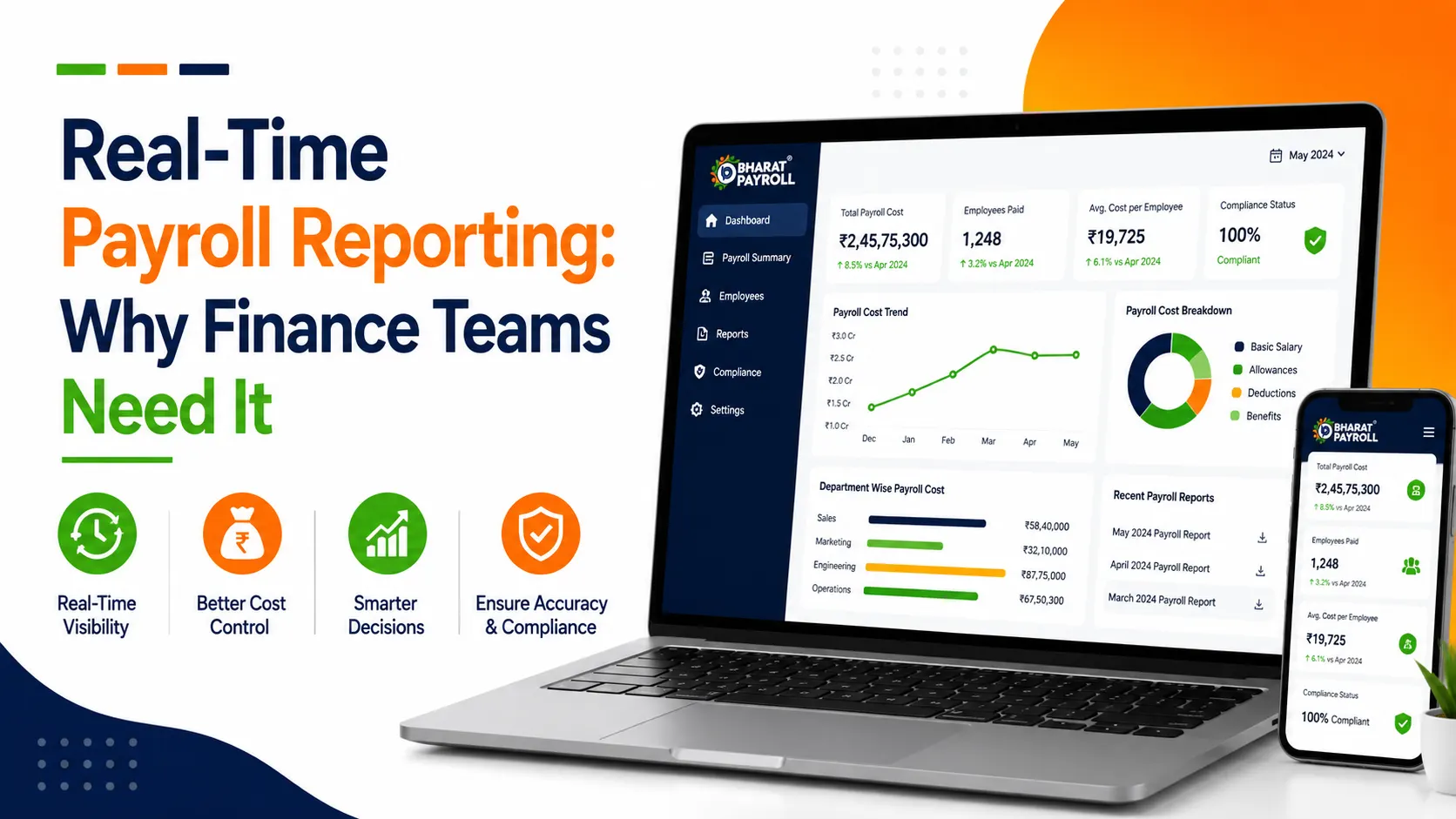
Real time payroll reporting gives finance teams current visibility into salary costs, deductions, liabilities, and payroll changes.
It replaces delayed spreadsheet updates with live payroll data that can be reviewed before the pay cycle closes.
That means stronger finance reporting, earlier variance checks, and fewer month-end surprises.
Explore Bharat Payroll Reporting & Analytics to bring salary, variance, TDS, gratuity, audit, and statutory reports into one connected view.
What Is Real-Time Payroll Reporting?
Real-time payroll reporting is the continuous availability of updated payroll information throughout the pay cycle. It brings approved employee changes, attendance, leave, deductions, reimbursements, incentives, and statutory values into reports that finance can review without waiting for final payroll.
It does not mean employees are paid continuously. It means the information used to calculate payroll remains visible and reviewable as the month progresses.
Why Do Finance Teams Need Real-Time Payroll Reporting?
Finance teams need real-time reporting because the final payroll figure is shaped by many changes during the month. New hires, exits, overtime, arrears, incentives, loss of pay, salary revisions, and reimbursements can all move the expected cost.
Early visibility helps finance teams:
- Compare projected payroll costs against approved budgets before final processing.
- Identify unusual salary movements while corrections can still be made.
- Estimate the cash required for salaries and related statutory liabilities.
- Review department, location, project, or entity costs without rebuilding spreadsheets.
- Question incomplete approvals before they become payment or reconciliation problems.
Real-time visibility changes payroll from a month-end result into an active financial control.
What Should Payroll Dashboards Show Finance Teams?
Payroll dashboards should show the current payroll position, the reason it changed, and the items requiring action. A total salary figure alone is not enough because finance must understand which people, components, departments, or events created the movement.
A useful payroll analytics dashboard should include:
- Current gross pay, deductions, net pay, and employer contribution estimates.
- Budget-to-actual comparisons across departments, locations, entities, and cost centres.
- Headcount changes, joining costs, exit settlements, and salary revision effects.
- Overtime, incentives, arrears, reimbursements, and other variable payroll components.
- Missing information, pending approvals, held salaries, and unusual calculation exceptions.
- TDS, gratuity, audit, variance, salary, and statutory reporting views.
Bharat Payroll’s reporting module provides salary information, variance, TDS, gratuity, audit, CTC, held salary, missing information, and statutory reports.
How Is Real-Time Reporting Different from Monthly Payroll Reports?
Real-time reporting helps teams act during payroll preparation, while a traditional month-end report mainly explains what has already happened. Both are useful, but they serve different purposes.
The following comparison shows where real-time visibility changes the finance workflow:
| Reporting Area | Traditional Month-End Report | Real-Time Payroll Reporting |
| Data availability | Available after payroll is finalised | Updated as approved inputs enter payroll |
| Variance review | Investigated after the final result | Investigated before payroll approval |
| Cash forecasting | Based mainly on prior periods | Based on current employee and payroll inputs |
| Compliance review | Concentrated near filing deadlines | Monitored throughout payroll preparation |
| Management reporting | Requires manual consolidation | Available through filtered payroll dashboards |
| Corrective action | Often deferred to the next cycle | Completed before salary and reports are locked |
Monthly reports remain important for accounting closure and audit records. Real-time reporting adds the earlier layer needed for prevention, forecasting, and control.
How Does Live Payroll Data Improve Cash-Flow Planning?
Live payroll data gives finance a more reliable view of the amount likely to leave the business on payday. It also exposes the difference between fixed payroll and variable costs such as overtime, incentives, arrears, reimbursements, and final settlements.
Finance can use that view to:
- Update short-term cash requirements as approved payroll inputs change.
- Separate recurring salary costs from one-time or exceptional payments.
- Compare payroll forecasts with budgets and previous payment cycles.
- Anticipate statutory deductions and employer-side contribution requirements.
- Escalate unexpected department-level increases before funds are released.
The forecast becomes more dependable as attendance closes, variable pay is approved, and employee changes are validated.
Why Is Finance and Payroll Integration Essential?
Finance and payroll integration keeps employee records, attendance inputs, payroll calculations, approvals, and accounting outputs connected. Without integration, HR may maintain one employee total, payroll may work from another file, and finance may receive a third version near payday.
Connected data helps teams trace a cost from its source to its financial impact. For growing organisations, this is especially important when payroll spans multiple entities, locations, bank accounts, or cost centres.
Bharat Payroll’s guide to multi-entity payroll management explains why consolidated visibility and entity-level controls must work together.
Integration also reduces repeated data entry. Approved information can move through a clearer sequence from employee records and attendance to payroll review, payment preparation, accounting, and reporting.
See the Reporting Workflow Before Payroll Closes
Request a Bharat Payroll demo to review how finance, HR, attendance, payroll, and compliance data can work within one connected process.
Can Continuous Payroll Processing Reduce Month-End Pressure?
Yes. Continuous payroll processing distributes review work across the month instead of leaving every check for the final payroll window. Teams validate changes closer to the event, when the right manager and supporting records are easier to reach.
For example, payroll teams can review:
- New employee records immediately after onboarding approval is completed.
- Salary revisions when effective dates and authorisations are confirmed.
- Attendance, overtime, and leave exceptions during weekly review cycles.
- Variable pay and reimbursements before the final payroll cut-off.
- Exit details when resignation and settlement inputs become available.
This approach still requires a formal cut-off, final validation, authorised approval, and payroll lock. It simply ensures the closing team faces fewer unresolved inputs.
Companies evaluating this capability can use the payroll software demo checklist to test reporting, approval, integration, and exception-handling features before buying.
How Does Compliance Reporting Strengthen Payroll Control?
Compliance reporting strengthens payroll control by making statutory values, payroll records, pending checks, and audit evidence easier to review. Finance should be able to connect every reported liability with the employee data, salary component, approval, and payroll period that produced it.
India’s Ministry of Labour and Employment states in its Compliance Handbook for Employers that prescribed attendance, wage, overtime, fines, and deduction registers must remain updated and may be maintained electronically. Its handbook also lists register updates, wage slips, and applicable EPF and ESIC deposits among recurring employer actions.
The Income Tax Department’s current TDS guidance says payroll and ERP systems need updates for the new section numbering, terminology, and reporting requirements under the Income Tax Act, 2025. It also directs employers to reset salary TDS computation from 1 April 2026 for Tax Year 2026–27.
Real-time compliance reporting can help teams notice missing tax data, contribution differences, unapproved revisions, or reconciliation gaps before reports are filed.
For audit preparation, the digital payroll record-keeping checklist explains how salary records, approvals, registers, payslips, and statutory evidence should remain organised and traceable.
What Should CFO Payroll Reporting Include?
CFO payroll reporting should summarise cost, cash, variance, compliance exposure, and workforce movement without burying decision-makers in employee-level detail. The report should show what changed, why it changed, whether the movement was expected, and what action is required.
A practical CFO view should cover:
- Total payroll cost, net pay, deductions, and employer-side obligations.
- Budget variance by department, entity, location, project, or cost centre.
- Headcount movement and the financial effect of joins, exits, and transfers.
- Fixed compensation compared with incentives, overtime, arrears, and reimbursements.
- Forecast payroll funding and major changes since the previous review.
- Exceptions, pending approvals, held salaries, and compliance reconciliation items.
This creates workforce intelligence that finance can use during budgeting, hiring reviews, restructuring, expansion, and cost-control discussions.
Which Payroll Variances Need Immediate Attention?
Finance should investigate a variance when it is unexpected, material to the relevant team, or unsupported by an approved business event. Not every increase is an error, but every unexplained increase deserves review before payroll is locked.
Common warning signs include:
- Payroll rises without a matching increase in approved headcount or compensation.
- Overtime grows sharply within one department, branch, or employee group.
- Net pay changes even though the employee’s fixed salary remains unchanged.
- Deductions fall despite stable eligibility and comparable gross salary values.
- One-time payments appear without attached approval or a clear effective date.
- Entity totals do not reconcile with consolidated payroll and finance reports.
Thresholds should reflect the organisation’s size and risk level. A small percentage change may still matter when it affects senior payroll, statutory deductions, or many employees.
How Can Finance Teams Implement Real-Time Payroll Reporting?
Finance teams should begin with the decisions they need to make, not with a large collection of charts. A focused implementation is easier to trust, govern, and expand.
A practical rollout includes:
- Define the payroll costs, variances, liabilities, and exceptions finance must monitor.
- Standardise employee, attendance, salary, deduction, and variable-pay input formats.
- Assign clear owners and approval stages for every payroll-impacting change.
- Connect HR, attendance, payroll, banking, and accounting data where appropriate.
- Configure role-based dashboards for finance, HR, payroll, and business leaders.
- Test totals, filters, exports, audit trails, and exception alerts before rollout.
- Retain final validation and authorised approval before salary files are released.
The first dashboard should answer a few high-value questions accurately. Additional views can be added after users trust the underlying data.
Final Verdict
Real time payroll reporting gives finance teams the time and context needed to act before payroll becomes final. With connected payroll dashboards, live cost views, compliance reporting, variance analysis, and finance and payroll integration, teams can forecast funding more accurately and investigate exceptions earlier. Bharat Payroll brings salary, TDS, gratuity, variance, audit, CTC, held-salary, missing information, and statutory reports into a connected reporting environment, helping finance move from spreadsheet reconstruction to timely payroll control.
Pick the Attendance System Your Payroll Can Rely On
Identify the right attendance setup for accurate salaries, smoother shifts, and fewer monthly errors with Bharat Payroll.
Frequently Asked Questions
1. What Is Real Time Payroll Reporting?
Real time payroll reporting provides updated visibility into payroll costs, employee changes, deductions, liabilities, and exceptions throughout the pay cycle instead of only after payroll is finalised.
2. Why Do Finance Teams Need Payroll Dashboards?
Payroll dashboards help finance teams compare payroll with budgets, monitor cash requirements, identify unusual movements, and review exceptions before salary and compliance reports are approved.
3. Does Real-Time Reporting Mean Employees Are Paid Continuously?
No. It means payroll inputs and projected results are updated throughout the month. Salary payment can still follow the organisation’s normal pay date and approval process.
4. What Should a Payroll Analytics Dashboard Include?
It should include gross pay, net pay, deductions, employer costs, budget variance, headcount movement, variable pay, statutory liabilities, pending approvals, and payroll exceptions.
5. How Does Real Time Payroll Reporting Support Compliance?
It helps teams review statutory values, missing information, approval records, and reconciliation differences earlier. Final filings and legal checks should still follow applicable requirements and authorised review.
6. What Is the Purpose of CFO Payroll Reporting?
CFO payroll reporting connects payroll with cash flow, budgets, workforce costs, statutory obligations, and business performance so leaders can understand both the total cost and its drivers.
7. Can Smaller Companies Benefit from Live Payroll Data?
Yes. Smaller companies can use live visibility to reduce spreadsheet dependency, anticipate salary funding, control variable payments, and prevent errors before they affect employees.
8. How Does Bharat Payroll Support Payroll Reporting for Finance Teams?
Bharat Payroll provides reporting and analytics for salary information, payroll variance, TDS, gratuity, CTC, audits, held salaries, missing employee information, and statutory records. These reports help finance, HR, and payroll teams review costs, investigate exceptions, and maintain clearer payroll records within one connected system.
9. How Often Should Finance Review Payroll Reports?
Finance should review key exceptions throughout the payroll cycle, complete a focused pre-approval review before payroll closure, and perform a final reconciliation after payment.