
“Can you send my payslip?” “How many leaves do I have left?” “Why is my salary different this month?” “Was my attendance corrected?” “Has my reimbursement been approved?”
Many HR teams face these questions regularly. In fact, they not only slow down the HR work but also impact the employees’ productivity. If your HR team is also dealing with those routine queries more often than not, it is a sign that your HR processes need an immediate fix.
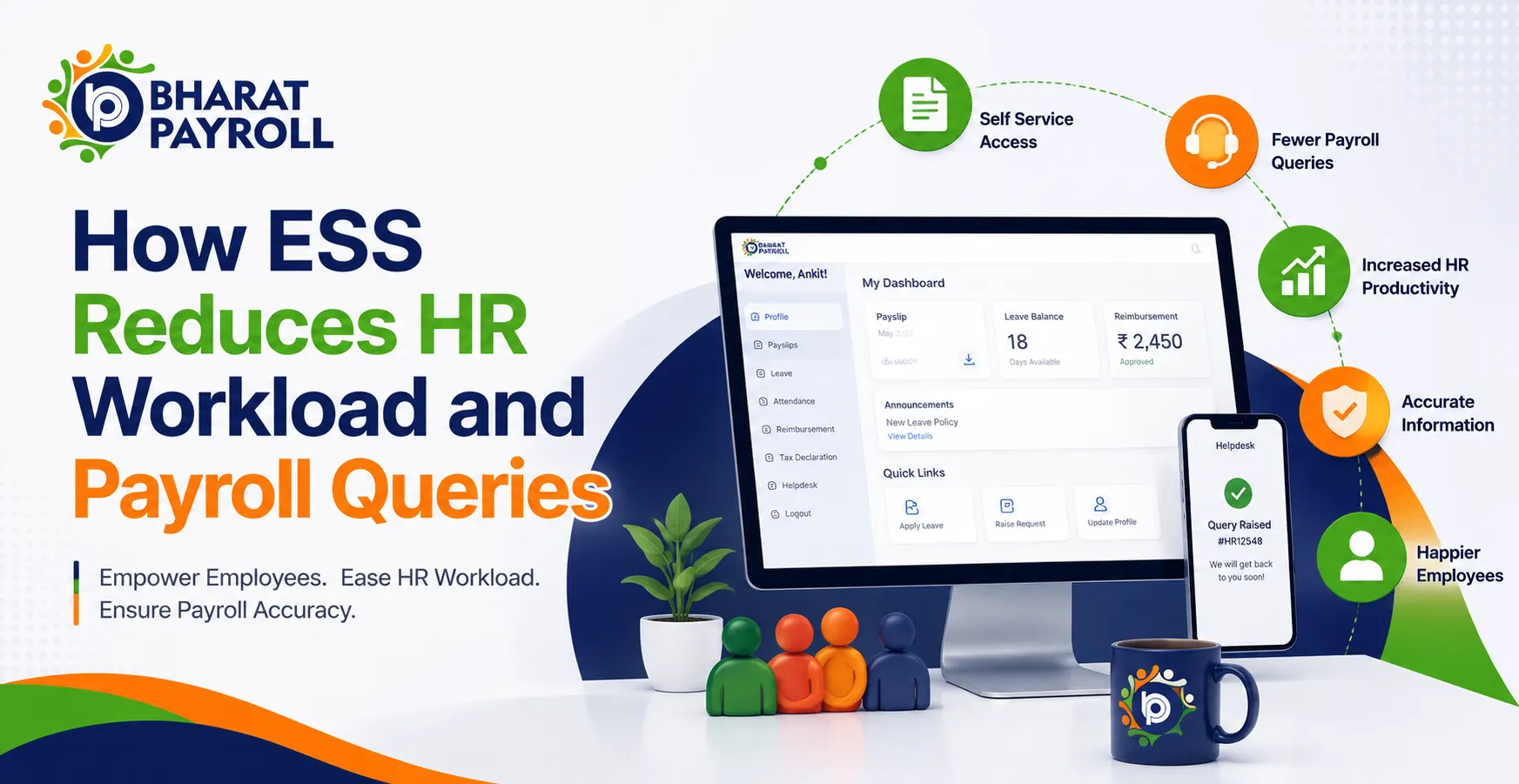
Rather than burdening your HR department with repetitive manual processes, streamline interactions by giving employees direct access to routine HR and payroll information through a secure Employee Self Service (ESS) portal.
Through ESS, employees can view payslips, apply for leave, check attendance, update basic details, submit requests, and track approvals without waiting for HR every time.
What Is Employee Self-Service (ESS) in HRMS?
Employee self-service, or ESS, is a feature inside an HRMS that allows employees to manage routine HR tasks on their own.
In a manual process, employees depend on HR for payslips, leave balance, attendance records, tax forms, reimbursement status, policy documents, profile updates, and approval status. That may work for a very small team. Once the company grows, HR slowly becomes a helpdesk for repeated questions.
An employee self-service system changes that. It gives employees one place to access common HR and payroll information, while HR keeps control over approvals, records, and workflows.
A useful ESS portal supports payslip downloads, leave requests, attendance views, employee documents, tax declarations, reimbursement tracking, profile updates, HR alerts, payroll requests, and approval status. For employees, it saves time. For HR, it removes hundreds of avoidable follow-ups every month.
Why Employee Self-Service Matters More Than Ever
The digital era is gradually shifting towards AI. And in this age of AI, your employees are habituated to getting instant information. They check bank transactions, download invoices, track deliveries, and raise support tickets from their phones. So when workplace information is still hidden in email chains or dependent on manual HR replies, the gap feels obvious.
This is where hr digital transformation becomes practical: fewer manual requests, cleaner approvals, and faster access for employees.
For Indian companies with office teams, sales teams, factory teams, branch employees, hybrid staff, and field workers, the pressure is higher. HR cannot manually answer every attendance, leave, payroll, and document request at scale.
An employee self-service portal protects HR time. It lets employees solve simple requests on their own and allows HR teams to focus on work that needs judgment, planning, and people interaction.
The Business Problem: HR Is Losing Time to Repeated Queries
Most HR teams are overloaded because small requests keep piling up.
One employee needs a payslip. Another wants a leave balance update. Someone from sales wants attendance corrected. A new joinee needs an onboarding document. A manager wants to know why an approval is pending. After payroll, questions increase again.
Across 100, 500, or 2,000 employees, these requests become a serious HR administrative burden.
Example: A 500-employee company receiving just two routine HR requests per employee each month creates 1,000 monthly interactions. If each request takes five minutes to check and close, HR loses more than 80 hours every month to repeat queries.
The issue is not only time. When HR is busy answering routine queries, hiring slows down, engagement activities lose attention, compliance checks become rushed, and workforce planning gets delayed.
That is why hr automation tools should be judged by the manual work they remove, not only by the features they list.
How ESS Reduces HR Workload
ESS reduces HR workload by moving routine employee requests into structured digital workflows.
Employees can download payslips without asking HR. They can check leave balances before applying. They can view attendance records before payroll closes. They can submit tax declarations and track claims from one place. HR alerts can go through a notification center instead of separate calls, emails, and chat messages.
This reduces back-and-forth communication and gives HR better records for requests, approvals, attendance changes, reimbursements, and employee updates.
How ESS Reduces Payroll Queries
Payroll queries usually increase when employees cannot see why something changed.
A salary may look different because of attendance, unpaid leave, tax declaration changes, reimbursement timing, overtime, arrears, or bank detail updates. If employees cannot see the related information, they naturally ask HR.
A strong HRMS ESS reduces payroll queries by giving employees access to payroll-linked information before they raise a question.
Employees can view payslips, attendance records, leave details, claim status, tax declarations, and salary-related documents. When the source of a payroll change is visible, many basic questions disappear. That is the real value of payroll self-service.
Employee Portal Benefits for Indian Companies
Clarity, speed, and reduced dependency are the direct employee benefits of a modern HRMS portal. Above all, transparency is one of the most valuable benefits of ESS as it clears any doubt in an employee’s mind with accurate information.
| Benefit | What Employees Get | What HR Gets |
| Faster access | Payslips, leave, attendance, and documents without waiting | Fewer basic requests |
| Better transparency | Clearer view of payroll-linked records | Fewer repeated explanations |
| Cleaner approvals | Visible request status | Better workflow tracking |
| Lower payroll confusion | Access to salary-related inputs | Fewer payroll queries |
| Better records | Forms, requests, and documents in one place | Cleaner audit and reporting support |
| Better experience | More control and less dependency | More time for strategic work |
A good HR self-service portal helps companies move from “ask HR for everything” to “check the system first.”
Bharat Payroll and HRMS ESS
Bharat Payroll helps Indian companies manage HRMS, payroll, attendance, leave, employee records, notifications, and employee self-service from one platform.
For companies dealing with repeated HR and payroll queries, Bharat Payroll’s HRMS ESS can support daily employee access through mobile app access for Android and iOS, login with email or mobile, two-factor authentication, notification center, WhatsApp, SMS, and email alerts where enabled, payslip generation, tax forms and declarations, attendance tracking, smart leave management, shift management, expense management, payroll automation, TDS calculation, statutory compliance support, documents and letters, onboarding, workforce reports, and exit workflows.
The point is not to add one more tool for HR to manage. The point is to reduce dependency, improve response time, and keep payroll inputs cleaner.
Manager Self-Service Matters Too
ESS is not only for employees. Managers also need self-service access.
Manager self-service helps department heads approve leave, review attendance, track team availability, approve claims, monitor pending requests, and view basic workforce reports.
This matters for COOs and business leaders because HR should not become the middle layer for every team-level approval. When managers can act directly inside the workflow, requests move faster, and HR gets better tracking.
Manual HR Support vs Employee Self-Service Portal
| Area | Manual HR Support | Employee Self-Service Portal |
| Payslips | HR shares them manually | Employees download them directly |
| Leave Balance | Employees ask HR | Employees check anytime |
| Attendance | HR checks records manually | Employees view attendance history |
| Payroll Queries | Repeated calls and emails | Employees review payroll-linked details |
| Documents | HR resends forms and letters | Employees access stored documents |
| Approvals | Follow-ups happen over chat or email | Requests move through the workflow |
| HR Time | Spent on repeated admin work | Focus shifts to higher-value work |
Manual support may work for a small team. As the company grows, it becomes slow, inconsistent, and difficult to track.
Use Cases by Buyer Role
| Buyer Role | Main Concern | How ESS Helps |
| CEO / Director | Productivity and process maturity | Reduces dependency and improves employee experience |
| COO | Operational discipline | Standardizes requests and approvals |
| HR GM / HR Manager | Query overload | Reduces repeated questions and improves response quality |
| CIO | Access control and data flow | Supports structured digital HR workflows |
| VP / AVP | Team visibility | Helps managers track leave, attendance, and approvals |
| Sales Teams | Mobile access | Supports employees working from the field |
ESS for Field, Sales, Hybrid, and Shift Teams
A sales employee may need attendance access while travelling. A field employee may need HR alerts on mobile. A shift employee may need schedule visibility before payroll closes.
For distributed teams, useful ESS capabilities include mobile access, attendance tracking, shift visibility, alerts, approval routing, and payroll-linked data visibility. If the workforce is spread across locations, ESS should travel with the employee.
Employee Self-Service Impact: Before vs After Implementation
| Metric | Before ESS | After ESS |
| Payslip Requests | High | Near Zero |
| Leave Queries | High | Self-Service |
| Payroll Clarifications | Frequent | Reduced |
| Approval Delays | Common | Faster |
| HR Admin Time | High | Lower |
Key Takeaway: Employee self-service shifts routine interactions from HR-managed processes to employee-driven workflows.
ESS ROI Framework for Decision-Makers
For CEOs, COOs, directors, HR heads, and AVPs, ESS should be measured as an operating improvement.
A practical ESS ROI framework is:
Reduced HR administrative time + lower payroll query volume + faster approvals + fewer manual errors + higher employee productivity = ESS business ROI.
The value shows up as lower operational friction, better process standardization, cleaner payroll inputs, faster response time, and stronger compliance readiness.
Business Benefits
- Lower operational costs
- Improved workforce productivity
- Faster employee response times
- Better process standardization
- Stronger compliance readiness
Top 10 HR Queries You Can Eliminate Immediately by ESS
| Employee Query | ESS Solution |
| Send my payslip | Self-download |
| What’s my leave balance? | Real-time visibility |
| Correct my attendance | Workflow request |
| Is my reimbursement approved? | Status tracking |
| Where is my Form 16? | Download center |
| What’s my shift schedule? | Employee portal access |
| Has my manager approved it? | Workflow visibility |
| Can I update my profile? | Self-service update |
| Where are company policies? | Document repository |
| What caused my salary change? | Payroll-linked visibility |
What Companies Should Look for in an Employee Self-Service System
Indian companies should look for mobile access, secure login, two-factor authentication, role-based access, payslip access, leave tracking, attendance visibility, document access, tax declaration support, claim tracking, alerts, approval workflows, manager visibility, payroll integration, profile updates, and reporting.
When comparing Bharat Payroll with any other HRMS alternative, ask which platform reduces HR dependency, payroll queries, and manual follow-ups in your actual work environment.
Common ESS Mistakes to Avoid
Many companies introduce ESS but continue using the old process in parallel.
Common mistakes include poor employee data, weak training, complicated approvals, no mobile access for field teams, missing payroll integration, outdated documents, no adoption tracking, and no pre-payroll review process.
ESS works only when it becomes the default place for routine HR actions.
A Practical ESS Implementation Framework
Start by listing the top employee queries HR receives every month. Most companies will find the same patterns: payslips, leave, attendance, reimbursements, documents, payroll questions, and approvals.
Next, move those answers and workflows into the employee self-service portal. Connect ESS with payroll and attendance so employees can see the information behind salary and leave-related changes.
Then train employees and managers through short videos, onboarding sessions, and reminder alerts.
After that, set response rules. Some requests can be self-service. Some need HR approval, manager approval, finance review, or payroll review.
Finally, track adoption. Check which queries reduce, where employees still need support, and which workflows need improvement.
What HR Should Measure After ESS Rollout
| KPI | Measurement Goal |
| Payroll queries | Reduction |
| Payslip requests | Reduction |
| Leave queries | Reduction |
| HR ticket volume | Reduction |
| Approval turnaround time | Improvement |
| Portal adoption rate | Increase |
| Employee satisfaction | Increase |
| HR productivity | Increase |
These KPIs show whether the employee self-service system is actually reducing HR workload or only adding another login.
Facing the Following Questions Frequently? Then Its Time to Go for ESS
Do employees ask HR for payslips every month?
Are payroll queries repeated after every salary cycle?
Do leave balance questions take HR time?
Are attendance corrections handled manually?
Do employees depend on HR for documents?
Are approvals scattered across email, chat, and calls?
Do field employees struggle with HR access?
Are reimbursements difficult to track?
Are tax declarations collected manually?
Can managers track pending approvals?
Can leadership see HR workload trends?
If several answers are “YES”, then it’s time to consider an Employee Self-Service (ESS) that reduces the HR workload and optimises employee experience.
Conclusion
ESS reduces HR workload when it gives employees direct access to the information they repeatedly ask HR to provide. The biggest value for the companies is not only fewer HR queries. It is cleaner payroll inputs, faster approvals, better employee confidence, and more time for HR to focus on people and business priorities.
Reduce HR Workload with Employee Self-Service
Give employees instant access to payslips, leave, attendance, and payroll information.
FAQs
1. What does employee self-service mean in HRMS?
Employee self-service in HRMS means employees can access routine HR information on their own, including payslips, leave requests, attendance records, tax forms, documents, reimbursements, and profile updates.
2. How does ESS reduce HR workload?
ESS reduces HR workload by allowing employees to complete routine tasks without contacting HR manually. It reduces repeated questions around payslips, leave balance, attendance, payroll queries, document access, and approval status.
3. How does ESS reduce payroll queries?
ESS reduces payroll queries by giving employees access to payslips, attendance records, leave details, tax declarations, claim status, and salary-related documents. When payroll-linked inputs are visible, employees ask fewer basic salary questions.
4. What are the main employee portal benefits?
The main employee portal benefits include faster access to HR information, fewer manual follow-ups, better salary and leave visibility, improved approval tracking, reduced HR workload, and a better employee experience.
5. Why is ESS important for Indian companies?
ESS is important for Indian companies because HR teams often manage payroll, attendance, leave, claims, documents, compliance, and employee support together. A self-service portal reduces routine dependency and helps HR manage growing teams more efficiently.
6. Is ESS useful for field or sales teams?
Yes. Mobile ESS helps field and sales employees check information, receive alerts, manage attendance, and raise requests without being in the office.