
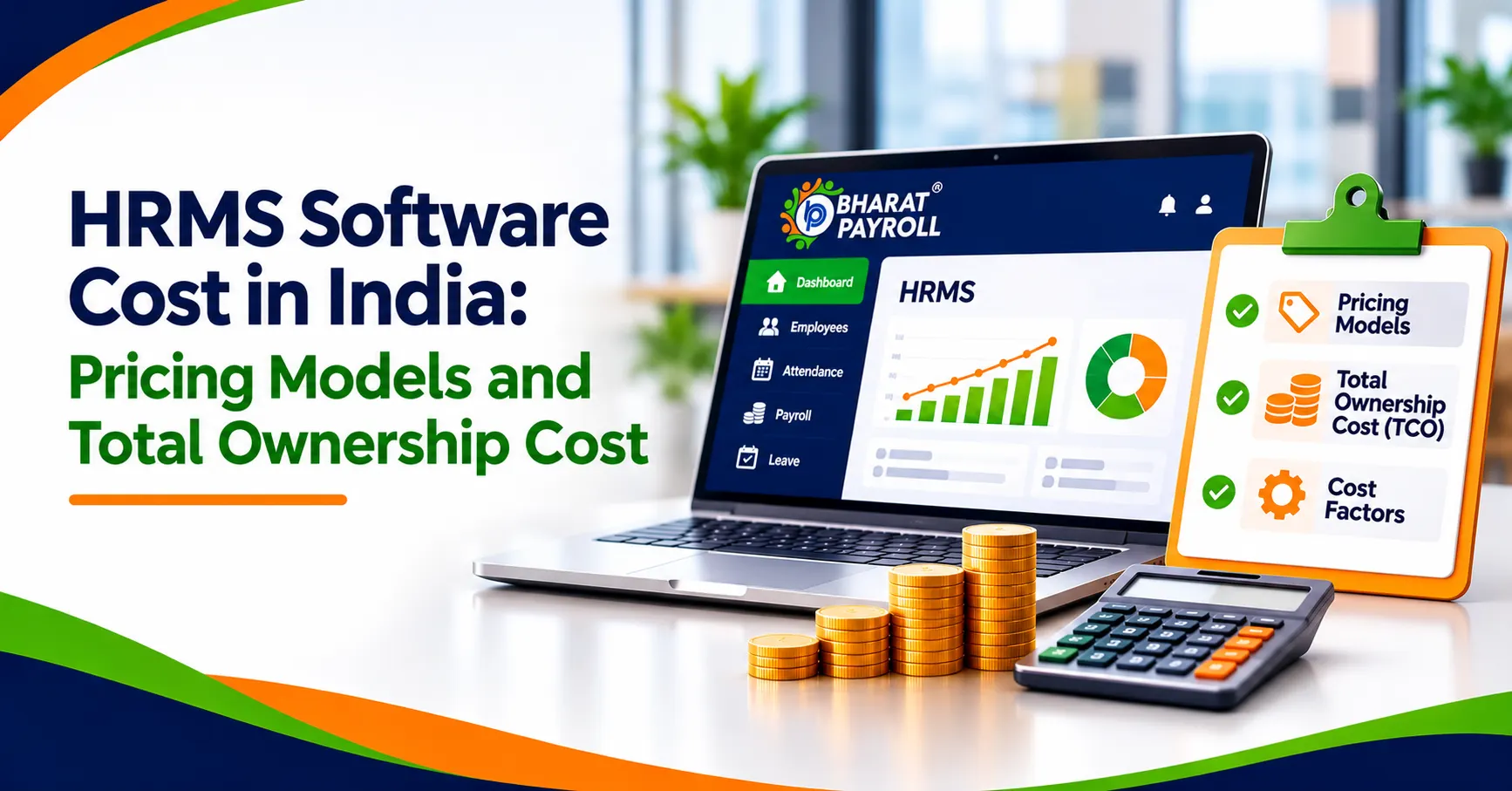
The HRMS software cost in India can look straightforward until businesses begin comparing actual proposals. One vendor charges per employee, another offers a fixed package for a defined headcount, while others price individual HR modules separately or provide customised enterprise quotations. The subscription fee is only one part of the decision.
Businesses also need to consider implementation, employee data migration, attendance integrations, payroll configuration, training, support, additional modules, and the internal time required to manage the system. These expenses collectively determine the real HR software cost over several years.
This guide explains how HRMS pricing works in India, what influences HRMS implementation cost, which expenses are commonly overlooked, and how to calculate the total cost of ownership before choosing an HR management system.
What Is Included in HRMS Software Cost?
HRMS software cost is the combined expense of licensing, implementing, operating, supporting, and eventually replacing an HR management system. It can include subscription charges, implementation, migration, integrations, training, additional modules, attendance infrastructure, internal administration, upgrades, and support throughout the software lifecycle.
Looking only at the monthly licence fee can therefore produce an incomplete cost comparison.
How Much Does HRMS Software Cost in India?
There is no single standard price for HRMS software in India because providers differ in functionality, pricing models, minimum user commitments, and included modules.
Entry-level HRMS plans can start at approximately ₹49 per user per month when billed annually. Other providers offer monthly packages ranging from around ₹2,495 to ₹4,950 for 50 employees, depending on the features included and billing terms. Additional users, advanced modules, integrations, and implementation services may increase the overall cost.
These prices are not directly comparable because each plan offers different features, user limits, support levels, and billing commitments. A lower subscription price does not necessarily mean a lower overall cost.
That is why organisations should compare the total HRMS software cost, including subscription fees, implementation, integrations, add-ons, and ongoing support, rather than selecting a solution based solely on its advertised monthly price.
What HRMS Pricing Models Are Used in India?
HRMS vendors typically use one or a combination of several pricing structures.
| HRMS Pricing Model | How the Model Works | Main TCO Consideration | Common Fit |
| Per employee per month | Charges increase according to active or billable employees | Costs rise directly with workforce growth | Growing businesses |
| Employee slab pricing | Fixed charge covers a defined number of employees | Smaller teams can pay for unused capacity | Small and mid-sized businesses |
| Module-based pricing | Businesses select payroll, attendance, recruitment, performance, or other modules | Adding capabilities can increase costs significantly | Businesses implementing HR gradually |
| Annual subscription | Software is purchased for an annual commitment | Lower effective rates can require upfront commitment | Businesses with predictable HR requirements |
| Custom enterprise pricing | Vendor creates a quotation around workforce size, entities, integrations, and requirements | Implementation and customisation become major cost variables | Large or complex organisations |
Understanding the pricing mechanism is important because two platforms advertising similar monthly rates can produce very different three-year ownership costs.
What Factors Determine HR Software Cost?
The final HR software cost depends on much more than workforce size.
Employee Count and Minimum Billing
Many HRMS providers calculate pricing according to the number of employees or users. Some also establish minimum employee slabs.
A company with 25 employees, for example, can still be charged for a 50-employee minimum under certain pricing structures. Buyers should therefore calculate the effective cost per active employee rather than relying exclusively on advertised per-user figures.
HR Modules Required
Core HR and payroll usually cost less than a broader HRMS containing:
- Time and attendance: Connect attendance records, shifts, working hours, overtime, and payroll inputs automatically.
- Leave management: Automate balances, employee requests, approvals, leave rules, and payroll-related leave calculations.
- Recruitment and onboarding: Manage candidate processes, documentation, employee creation, onboarding workflows, and joining formalities.
- Performance management: Support goals, employee assessments, appraisals, feedback, and performance review workflows.
- Analytics and reporting: Produce operational, payroll, attendance, compliance, audit, and workforce reports for management.
- Employee self-service: Allow employees to access payslips, attendance information, leave balances, documents, and HR requests.
- Integration capabilities: Connect HRMS data with biometric systems, financial applications, payroll systems, and other business tools.
A lower-cost plan can become more expensive once necessary modules are added.
What Is HRMS Implementation Cost?
HRMS implementation cost covers the work required to convert purchased software into a functioning HR system aligned with the organisation’s processes.
Implementation charges are not structured consistently across the market. Some HRMS providers include standard onboarding within the subscription, while others charge a separate one-time implementation fee. These costs may vary depending on company size, system configuration, employee data migration, integrations, customisation requirements, and overall implementation complexity.
Organisations should clarify whether their quotation covers configuration, migration, testing, training, and go-live assistance.
Data Migration
Migrating employee information can require more work than businesses initially expect.
Historical information can include employee master records, salary structures, attendance records, leave balances, tax declarations, payroll history, statutory information, reporting structures, and documents.
Poor-quality legacy data increases both implementation time and internal effort.
Payroll Configuration
Indian payroll configuration can involve salary structures, earnings, deductions, tax rules, reimbursement policies, attendance inputs, leave treatment, overtime, arrears, bonuses, and organisation-specific payroll policies.
Complex structures typically require greater configuration and testing before payroll goes live.
Third-Party Integrations
Integrations can significantly influence HRMS implementation cost.
Businesses should establish whether the quoted price includes connections with biometric attendance devices, accounting systems, financial applications, identity systems, APIs, or other business software.
An inexpensive HRMS subscription can become costly if critical integrations require separate licences, development, or recurring API charges.
Training and Change Management
Software does not create value merely because it has been installed.
HR teams, managers, payroll administrators, and employees need to understand relevant workflows. Training requirements increase when an organisation introduces several HR modules at once or replaces heavily manual processes.
How Do You Calculate the Total Cost of Ownership of HRMS?
Total cost of ownership, or TCO, measures what the HRMS costs throughout the period in which the business expects to use it.
A practical calculation is:
HRMS TCO = Software Subscription + Implementation + Data Migration + Integrations + Customisation + Training + Hardware + Support + Internal Administration + Renewal Costs + Exit or Migration Costs
For example, a proposal that appears cheaper during the first year can become the more expensive option if it requires paid integrations, multiple add-on modules, extensive administration, or higher charges as employee numbers increase.
Businesses should ideally calculate costs across at least three years rather than comparing only the first monthly invoice.
Which Hidden Costs Can Increase HRMS Total Ownership Cost?
Several expenses can be missed during the initial HRMS comparison.
Minimum Employee Commitments
A plan advertised on a per-employee basis can still have a minimum billing requirement. Ask whether charges apply to actual headcount or a contractual minimum.
Additional HR Modules
Recruitment, performance management, expenses, advanced analytics, API access, SSO, GPS tracking, or other functions can be separate add-ons.
Publicly available HRMS pricing plans show that some providers charge separately for additional capabilities beyond their standard packages. These add-on costs can increase the overall subscription expense.
Employee Growth
A system that looks affordable for 50 employees should also be modelled for 100, 250, or 500 employees if the organisation expects to grow.
Ask how the price changes when the headcount crosses a billing slab.
Integration and API Charges
Check whether API access is included, restricted by usage, or sold separately. Integration charges can become important for organisations connecting multiple systems.
Attendance Infrastructure
Biometric devices, face-recognition equipment, access-control systems, or location-based attendance requirements can create costs outside the HRMS licence.
Custom Reports and Workflows
Complex approval structures, specialised dashboards, organisation-specific reports, or custom workflows can require configuration or development.
Premium Support
Standard support can be included while dedicated account management, faster response levels, specialised training, or premium support packages carry additional fees.
Internal HR and IT Time
This cost is rarely visible in a vendor quotation.
Employees still spend time cleaning data, reviewing configurations, conducting testing, supporting adoption, managing integrations, correcting employee records, and administering the system.
That internal workload belongs in the TCO calculation.
Future Migration Costs
Businesses should understand how their data can be exported if they change systems later.
Data extraction, historical record migration, integration replacement, retraining, and parallel system operation can all create future costs.
Is Payroll Software Cheaper Than a Complete HRMS?
A payroll-only platform can carry a lower initial software cost when an organisation only needs salary processing.
However, businesses that separately purchase attendance, leave, employee records, onboarding, reporting, and performance systems should calculate the combined cost of those applications and their integrations.
A broader HRMS can deliver better long-term economics when several HR functions need to exchange the same employee information.
For example, connecting attendance and leave directly with payroll reduces the need to repeatedly transfer information between separate systems.
The correct comparison is therefore not:
Payroll software price versus HRMS subscription price
It is:
Total cost of all current HR tools and manual work versus total HRMS ownership cost
How Should You Compare HRMS Pricing Between Vendors?
Before comparing quotations, ask every provider to price the same business requirements.
Key questions include whether the quotation covers all employees, required HR modules, payroll, implementation, employee data migration, integrations, reports, training, technical support, upgrades, and applicable taxes.
Also ask how pricing changes when your organisation grows.
For example, evaluate your projected cost at current headcount and again at expected headcount after 12, 24, and 36 months.
This prevents a low introductory HRMS price from becoming an expensive long-term commitment.
What Should Be Included in an HRMS Pricing Proposal?
A useful HRMS proposal should clearly identify the licence scope and the services surrounding it.
Look for clarity around:
- Billing basis: Confirm whether charges use active employees, registered users, payroll employees, or minimum committed headcount.
- Included modules: Identify exactly which HR, payroll, attendance, reporting, onboarding, and employee-service functions are covered.
- Implementation: Confirm configuration, policy setup, payroll setup, testing, and go-live responsibilities before signing.
- Migration: Establish how much historical employee, payroll, leave, and attendance information will be transferred.
- Integrations: Verify which existing systems are included and whether API or custom integration charges apply.
- Training: Confirm administrator, manager, payroll, and employee training included within the implementation scope.
- Support: Understand support channels, response levels, operating hours, and any additional premium support charges.
- Renewal terms: Ask how prices can change at renewal or after your workforce crosses specified thresholds.
- Data ownership: Confirm data export processes and the costs involved if the organisation eventually changes providers.
This level of detail makes HRMS pricing comparisons far more reliable.
How Can Businesses Reduce HRMS Software Cost?
Reducing costs does not necessarily mean purchasing the lowest-priced plan.
Start by identifying the processes that actually need automation. Payroll, employee data, leave, attendance, onboarding, reporting, and compliance often deliver more immediate operational value than purchasing every available HR module.
Clean employee data before implementation to reduce migration effort.
Businesses can also introduce modules in phases rather than deploying an unnecessarily complex HR transformation on day one.
Most importantly, negotiate around total cost rather than only the subscription fee. Clarify implementation scope, integrations, training, support, renewal terms, employee slabs, and additional modules before signing the contract.
When Does a Higher HRMS Cost Deliver Better Value?
A higher-priced HRMS can still offer a lower total ownership cost if it removes manual processes, reduces duplicated systems, simplifies payroll administration, and avoids repeated integrations.
The useful question is not simply, “Which HRMS costs less?”
Instead, ask:
Which system delivers the required HR and payroll capabilities at the lowest sustainable cost over its expected operating life?
That perspective changes HRMS purchasing from a software-price comparison into a business-value decision.
How Does Bharat Payroll Help Control HRMS Ownership Costs?
Bharat Payroll brings HR and payroll processes into a connected environment that supports payroll, employee information, attendance, leave management, onboarding, reporting, performance management, integrations, and security capabilities.
Connecting these processes can reduce the need to operate isolated HR applications or repeatedly move workforce information between systems.
Businesses evaluating Bharat Payroll can define their required modules, workforce size, payroll complexity, attendance requirements, reporting needs, and integration scope before selecting the appropriate solution.
Rather than comparing HRMS products through headline pricing alone, organisations can evaluate the operational capabilities they require and the long-term cost of supporting those requirements.
Choose the Right HRMS Plan for Your Business
Compare HRMS pricing, understand hidden costs, and find a solution that fits your workforce and budget with Bharat Payroll.
Frequently Asked Questions
1. How much does HRMS software cost in India?
HRMS software cost varies considerably by workforce size, modules, billing model, implementation requirements, and integrations. Current public vendor pricing ranges from low per-user plans to fixed monthly packages covering an initial employee slab, while complex enterprise implementations are generally customised.
2. What factors affect HRMS pricing?
HRMS pricing is influenced by employee count, required modules, billing periods, minimum user commitments, implementation complexity, data migration, integrations, support, training, and customisation.
3. What is HRMS implementation cost?
HRMS implementation cost is the expense of configuring the system, migrating data, setting up workflows and payroll rules, integrating other systems, testing the platform, training users, and preparing it for production use.
4. Is HRMS implementation included in the subscription price?
Not always. Some providers include standard onboarding, while others charge implementation separately based on complexity. Businesses should obtain a written breakdown before comparing quotations.
5. What is the total cost of ownership of HRMS software?
HRMS total cost of ownership combines software licences with implementation, migration, integrations, customisation, training, support, internal administration, hardware, renewals, and eventual migration or exit costs.
6. Is per-employee HRMS pricing better than fixed pricing?
Neither structure is automatically cheaper. Per-employee pricing can suit growing organisations, while fixed employee slabs can provide predictable costs. The better option depends on workforce size, growth, included modules, and minimum billing requirements.
7. What hidden costs should businesses check before purchasing HRMS software?
Check implementation charges, migration, add-on modules, integrations, API access, attendance hardware, training, premium support, minimum employee commitments, renewals, customisation, and data exit costs.
8. How should a business compare HRMS software prices?
Compare vendors using the same employee count, functional requirements, implementation scope, integrations, and contract period. Calculate three-year total ownership cost rather than comparing only monthly subscription fees.