
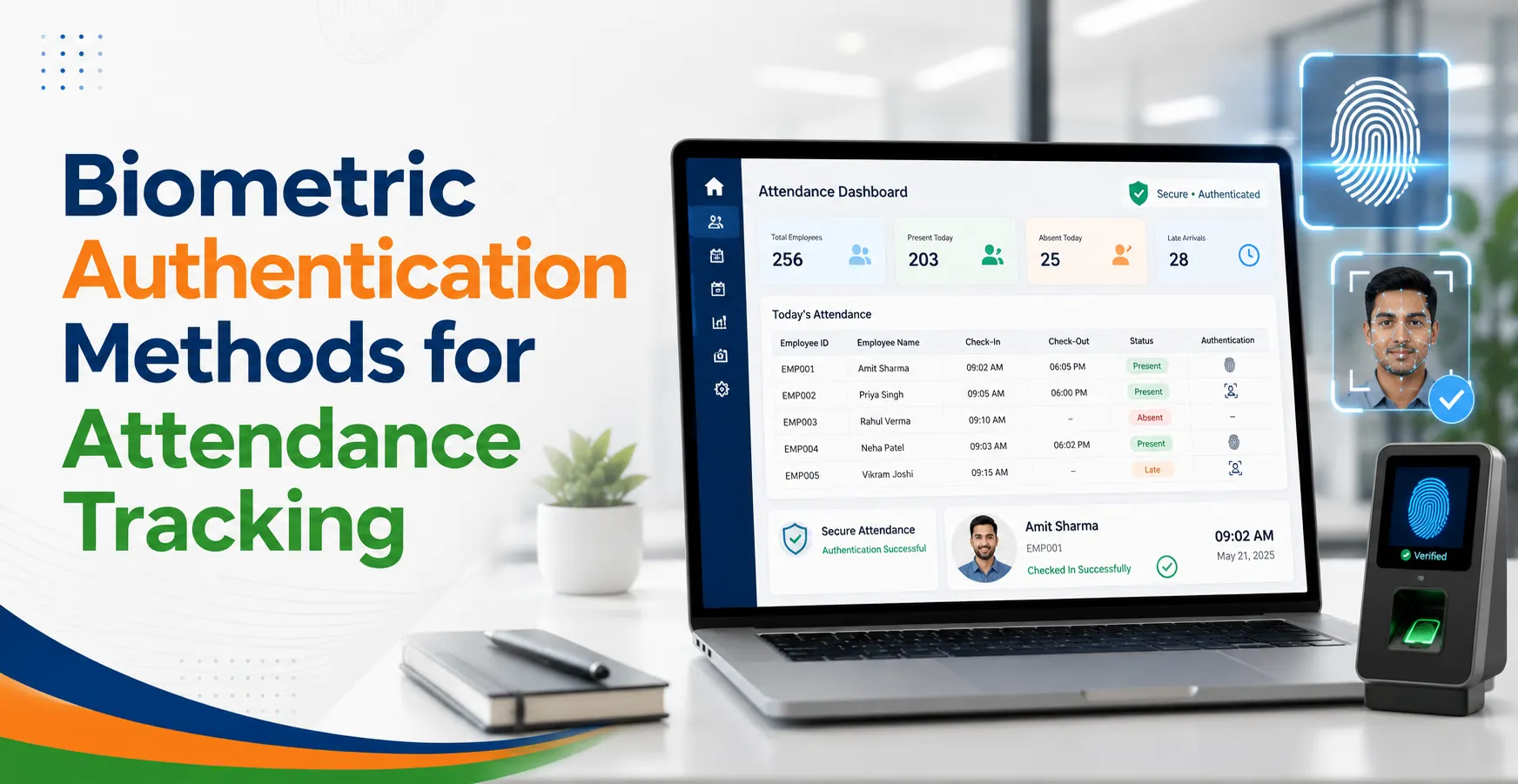
Biometric authentication has changed how employers think about attendance tracking. In many workplaces, attendance once depended on swipe cards, registers, shared devices, or manual confirmation. Those methods still exist, but they leave too much room for delay, misuse, and weak record quality. When one employee can mark attendance for another, or when punch data needs repeated correction before payroll, the problem is no longer only operational. It becomes a payroll accuracy issue.
That is why biometric authentication matters in attendance tracking. It links attendance to a person’s physical identity instead of relying only on cards, passwords, or shared access habits. For employers, that means stronger control over attendance records. For HR and payroll teams, it means better confidence in the data that later affects paid days, overtime, anomalies, and approvals.
For Bharat Payroll users, the biometric attendance does not stop at the attendance punching. It flows into attendance history, approvals, reporting, and payroll-linked review. Bharat Payroll’s public biometric reporting page also frames biometric attendance around accurate logs, reduced time fraud, better workforce tracking, and payroll-processing support.
What Is Biometric Authentication?
Biometric authentication is a method of verifying identity using a person’s physical or behavioural traits. In attendance systems, the purpose is straightforward: confirm that the employee marking attendance is the actual employee present at that moment.
Unlike passwords or cards, biometric methods rely on something tied to the person. That is why they are commonly used for attendance punching, access control, and identity verification.
The system captures a biometric input, converts it into a machine-readable template, and compares it with the stored reference for that employee before marking attendance.
How Biometric Authentication Works in Attendance
The attendance flow usually has three stages.
- First, the employee is enrolled. Their biometric input is captured and stored as a reference template.
- When the employee punches in or out, the device captures a fresh biometric sample.
- The system compares the new sample with the stored record. If the match is within the accepted threshold, attendance is marked.
That changes attendance from a simple time entry into a verified identity-linked attendance record. For HR and payroll teams, that difference matters later because attendance records influence paid days, missed punches, work duration, overtime review, anomalies, and approval workflows.
Types of Biometric Authentication Methods
Biometric methods usually fall into two groups.
Physical biometrics
These rely on body-based traits such as fingerprints, face, iris, or palm patterns.
Behavioural biometrics
These rely on action-based patterns such as voice behaviour, typing rhythm, gait, or signature movement.
For attendance punching, physical biometrics are usually more relevant because they are easier to apply at entry points, attendance kiosks, and controlled workplace devices.
Fingerprint Authentication
Fingerprint authentication remains one of the most widely used biometric attendance methods. It works by scanning the unique ridge and valley patterns of a person’s finger and matching them against the enrolled template.
1. Why employers still prefer fingerprint authentication
Fingerprint-based attendance is familiar, relatively quick, and widely used across attendance devices. It helps reduce proxy attendance because one employee cannot easily mark presence on behalf of another. It also removes the need to carry a card or remember a code.
2. Where fingerprint authentication can struggle
It may not work well when fingers are wet, dusty, injured, or worn out through manual work. This becomes more important in industrial settings, field-heavy environments, and workplaces where employees handle physical materials all day.
Facial Recognition
Facial recognition uses facial landmarks and image-based comparison to verify a person before marking attendance. It draws attention because it is contactless and does not require the employee to place a finger on a device.
1. Why employers consider facial recognition
It reduces direct contact with shared hardware, helps maintain quicker movement at entry points, and can work well in higher-volume environments when lighting and hardware quality are suitable.
2. Where facial recognition becomes difficult
Lighting, camera angle, accessories, face coverings, and crowded entry conditions can affect results. It also depends heavily on the quality of the camera and the recognition setup.
Iris Recognition
Iris recognition verifies identity through the unique pattern in the coloured ring of the eye. It is often viewed as a higher-assurance biometric method because iris patterns are highly distinctive.
Why iris recognition stands out
It offers strong identity matching and can be useful in environments where tighter control matters.
Why is routine attendance less common?
It needs more specialised hardware, stricter positioning, and higher implementation cost. For many businesses, that is more than what standard attendance punching requires.
Voice Recognition
Voice recognition checks vocal characteristics to confirm identity. In theory, it can be used for attendance or remote verification, though in workplace attendance punching it is usually less practical than fingerprint or face-based methods.
Why is voice recognition less common for attendance
Background noise, illness, and changing audio conditions can affect reliability. It may fit selected remote or telephony cases better than standard office entry attendance.
Biometric Authentication Methods Compared for Attendance
| Method | Best fit | Main strength | Common limitation |
| Fingerprint authentication | Offices, factories, and regular site-based teams | Familiar, practical, lower proxy-punch risk | Can fail with wet, dusty, injured, or worn fingers |
| CCTV Facial recognition | Lower-contact environments, fast-moving entry points | Contactless attendance and quicker movement | Lighting, camera angle, accessories, and crowding can affect accuracy |
| Physical Face/Iris recognition | Higher-control environments | Strong identity verification | Higher hardware cost and stricter setup needs |
| Voice recognition | Selected remote or telephony cases | Hands-free identity check | Noise and illness reduce reliability |
Strengthen Attendance Accuracy Before Payroll Begins
Start with biometric attendance workflows that make attendance records easier to trust and easier to review.
Common Attendance Problems Biometric Systems Can Reduce
A stronger biometric attendance setup can help reduce:
- Proxy punching
- Unclear punch ownership
- Manual attendance manipulation
- Weaker shift visibility
- Repeated attendance correction work
- Payroll mismatches caused by poor punch records
This is where biometric attendance moves from being a device choice to being an operations choice.
Why Biometric Authentication Drives Better Attendance Accuracy
The real business value of biometric attendance is not only at the device level. It shows up later in cleaner attendance inputs, fewer proxy-punch concerns, stronger anomaly handling, better shift visibility, and more dependable downstream payroll review.
That is where the topic becomes especially relevant for Bharat Payroll users. Once attendance data moves into history, approvals, and payroll-linked review, identity-linked punch records become far more valuable than ordinary time entries.
How to Choose the Right Biometric Attendance Method
The right biometric method depends on the workplace, not only the device.
Fingerprint authentication often suits businesses that want a familiar and practical attendance method. Facial recognition works better where lower-contact punching and quicker entry movement matter. Iris recognition makes more sense where tighter identity control matters more than low-cost deployment.
The choice should depend on:
- workplace conditions
- punch-point traffic volume
- hygiene expectations
- hardware environment
- workforce profile
- support needs after rollout
That is the step many employers skip. They choose the machine first and think about the workforce later.
Reduce Buddy Punching and Attendance Correction Work
Use biometric attendance workflows that support cleaner records before payroll review begins.
What Employers Should Check Before Choosing Biometric Authentication Systems
A biometric attendance method is only as useful as the process around it.
Check whether the method fits the workforce
A contact-based scanner may not fit every environment. A face-based method may not fit every lighting condition. A method that works smoothly in one office can fail repeatedly in another.
Check whether the data flows into approval and review properly
The device is only one part of the chain. Employers also need to know whether attendance entries can be reviewed properly, whether anomalies can be checked easily, whether managers and HR can see the right record later, and whether payroll-linked review can happen without rebuilding the data manually.
Check whether the system works at scale
A device may work well with a small team and fail badly during rush-hour entry when many employees are trying to punch at once.
Check whether fallback handling is clear
What happens when the scanner fails, when a match is missed, or when a punch creates an anomaly? Attendance punching should not collapse the moment ideal conditions disappear.
Security and Practical Risks Employers Should Not Ignore
Biometric attendance is useful, but it should not be treated as automatic perfection. A few risks still matter:
Device-side failure
Even a strong biometric method depends on the hardware working properly at the moment of punching.
Match failure in real conditions
A method may work neatly in demos and less neatly in dust, poor light, movement, or crowded entry conditions.
Overconfidence in the raw punch
A biometric punch still needs a process behind it. Without attendance review, approval paths, and anomaly handling, the organisation may still struggle with corrections later.
Data handling expectations
Employers should know how attendance data is stored, reviewed, exported, and reported. A biometric method without reporting discipline can still create downstream trouble.
How Biometric Attendance Affects Payroll Accuracy
This topic may look like an attendance device topic. It is really a payroll-input topic as well. If attendance punching is weak, the following can all become harder later:
- present-day count
- missed punch review
- overtime interpretation
- shift compliance
- anomaly approvals
- monthly attendance reconciliation
That is why HR and payroll teams should care about biometric attendance quality even if they are not choosing the hardware themselves.
Choose a Biometric Workflow That Works Beyond the Punch
Attendance data should be easy to review, approve, and use for payroll, not just capture at the device.
Get a Free Bharat Payroll Demo
How Bharat Payroll Fits Into Biometric Attendance Workflows
Bharat Payroll helps employers turn biometric punches into attendance records that are easier to review, approve, report on, and use for payroll-linked accuracy. That is where the business value becomes clear. A biometric attendance method only helps when the punch is captured correctly, the record enters the system cleanly, and HR teams can work with that data later without rebuilding it manually.
Bharat Payroll’s public biometric reporting page describes biometric attendance with accurate logs, reduced time fraud, better workforce tracking, and smoother payroll processing support. It also lists time and attendance features such as biometric integration, attendance rules and approvals, face recognition, and clock-in and clock-out workflows.
Fingerprint Authentication
Fingerprint authentication gives employers a familiar and dependable attendance method. In Bharat Payroll, it supports cleaner attendance capture, stronger employee-level verification, and lower proxy-punch risk.
For HR teams, that means fewer manual attendance corrections. For payroll teams, it means more dependable punch records before salary processing begins. Bharat Payroll’s biometric reporting page explicitly includes fingerprint-based attendance data and verification flow.
CCTV Facial Recognition
AI CCTV Facial recognition gives employers a lower-contact attendance option for workplaces that want quicker movement at punch points.
Bharat Payroll includes face recognition in its time and attendance feature set and uses face-based attendance to help improve attendance accuracy, reduce time fraud, and maintain cleaner records for attendance review and payroll use.
Physical Face/Iris Recognition
A physical Face/Iris recognition works better for businesses that want a more advanced biometric attendance method with stronger identity verification and tighter control over attendance authenticity before payroll review.
This should be treated as the higher-assurance attendance option in the article’s method comparison, rather than as the default method for standard office punching.
What Bharat Payroll Supports Around Biometric Attendance
Bharat Payroll’s value in biometric attendance is not only in the punch. It is in the wider workflow around that punch. The platform supports biometric reporting, attendance history, attendance approvals, attendance review, and payroll-linked attendance handling so employers can actually use biometric attendance records in day-to-day HR and payroll operations. Its biometric reporting page highlights biometric reports, attendance accuracy, automation, secure access control, and payroll-processing support.
The clearest support points include:
- Biometric Report for biometric attendance tracking
- Attendance and Attendance History for record review
- Attendance Approvals for exceptions and corrections
- audit and tracking visibility through reporting tools
- payroll-linked attendance accuracy through cleaner biometric records
In practical terms, Bharat Payroll helps employers use biometric attendance to improve attendance accuracy, reduce buddy punching and manual errors, strengthen workforce visibility, and keep records more usable for payroll and compliance review.
Bring Biometric Attendance, Approvals, and Reports Into One Flow
Use Bharat Payroll to manage attendance history, biometric reports, anomaly review, and payroll-linked accuracy together.
Final Word
Biometric authentication helps attendance move away from shared cards, memory-based logins, and loosely controlled time entry. That shift matters because attendance records do not stay inside attendance alone. They move into review, approval, reporting, and later payroll-linked decisions.
For attendance punching, the most practical biometric authentication methods are usually fingerprint authentication and face-based methods, while other biometric types are more situational. The right choice depends on the work environment, employee profile, and how well the wider attendance system handles reporting and corrections.
For Bharat Payroll users, the stronger point is not that a biometric device exists. It is that biometric attendance data can sit inside broader attendance history, approval, anomaly, and reporting workflows, which is where employers actually manage the consequences of each punch.
Turn Biometric Attendance into Payroll-Ready Attendance Records
Bring biometric reporting, attendance approvals, and attendance history into one structured workflow with Bharat Payroll.
Frequently Asked Questions
1. What is biometric authentication in attendance?
Biometric authentication in attendance is a way of verifying that the person marking attendance is the actual employee by using a physical trait such as a fingerprint or facial features.
2. Which biometric authentication methods are most common for attendance?
For workplace attendance, fingerprint authentication and facial recognition are usually the most commonly assessed methods.
3. Is fingerprint authentication still useful for attendance?
Yes. Fingerprint authentication is still widely used for attendance because it is familiar and helps reduce proxy punching, though it can be affected by finger condition and device quality.
4. Does Bharat Payroll support biometric attendance review?
Yes. Bharat Payroll’s public content and shared manuals show biometric reporting, attendance history, attendance approvals, anomaly handling, and related reporting views.
5. Should employers assume every biometric device type is supported?
No. Employers should confirm exact hardware compatibility during implementation, even when biometric reporting and attendance workflows are already supported.